What Is a Good Credit Score in 2026?
Last reviewed: August 14, 2026
A lot of people ask whether their credit score is “good” as if there should be one clean answer.
There usually is not.
A 675 may feel solid to one borrower, disappointing to another, and only borderline useful to a lender evaluating a mortgage, personal loan, auto loan, apartment screening, or premium credit-card application. The same credit score can also lead to different pricing outcomes across mortgage rates, personal loans, credit cards, and auto loan rates.
That is why the question needs one extra word:
Good for what?
That is the version of the question that actually helps.
Because in 2026, a good credit score still matters. It can affect approval odds, mortgage rates offered to a borrower, pricing on personal loans, credit-card limits and terms, auto loan rates, deposits, and how much friction you face in everyday financial decisions. But lenders still do not read a score in isolation. They usually read the score itself, the score model being used, the file behind the score, the product you are applying for, and the risk signals that still show up in the report.
So a better question is not just:
“Is my score good?”
It is:
Is my score good enough for the thing I want to do, and does the file behind it support that number?
That is what this guide is built to explain.
The most useful idea to remember from the start is this:
A good credit score is not just a range label. It is a score that gives you practical flexibility for your next financial goal without the rest of your file creating obvious risk concerns.
Key Takeaways
In common FICO educational ranges, 670–739 is typically considered good.
A “good” score can improve approvals and terms, but it does not automatically mean best-tier pricing.
Lenders still look beyond the number to factors like utilization, payment history, recent applications, and file depth.
A 680 can be good enough for some goals and still not be strong enough for others.
In practical terms, moving from fair to good—and then from good to very good—can expand borrowing options and improve pricing potential.
Why You Can Trust This Guide
This guide is based on public consumer-credit guidance and primary scoring resources, including the Consumer Financial Protection Bureau, myFICO, and VantageScore. It is written for ordinary readers trying to understand what “good credit” means in real lending situations, not just memorize a range chart.
It is also written with a practical goal in mind: helping you separate score labels from lender reality.
Who This Article Is For
This guide is especially useful if you checked your score and want to know whether it is actually good enough, are trying to move from fair to good or from good to stronger approvals, want to understand why a “good” score still may not get the best terms, want a lender-facing explanation rather than just a consumer score chart, or want to know what to improve next rather than just where your number falls.
Who This Article Is Not For
This article may not be enough on its own if you are dealing with active identity theft or report errors that still need to be disputed, a major derogatory event that requires case-by-case recovery planning, business-credit questions, a highly specific mortgage-underwriting strategy with lender-specific rules, or advanced score-model analysis beyond normal consumer use.
In those situations, this guide can still help you think more clearly, but it should not replace more specific support.
Our Editorial Review Standard
We review credit information against a simple editorial standard.
Does the article distinguish a score range from the credit file behind it?
Does it explain what “good” means in practical lender terms instead of marketing language?
Does it avoid implying that one score threshold guarantees the same outcome everywhere?
Does it use authoritative public or primary sources when discussing scoring ranges, lending decisions, and pricing?
This standard matters because a credit-score chart alone does not explain how lenders may evaluate the broader application.
Disclaimer
This article is for educational purposes only. It reflects general consumer-credit information and is not individualized lending, legal, financial, or tax advice. Different lenders, scoring models, and products may use different standards.
Official Resources to Review First
Credit Score Basics: What the Ranges Usually Mean
Most consumer credit scores commonly fall within a range of 300 to 850, although not every score uses exactly the same scale. The CFPB explains that many scores use the 300–850 framework, and myFICO’s official scoring structure uses familiar educational ranges.
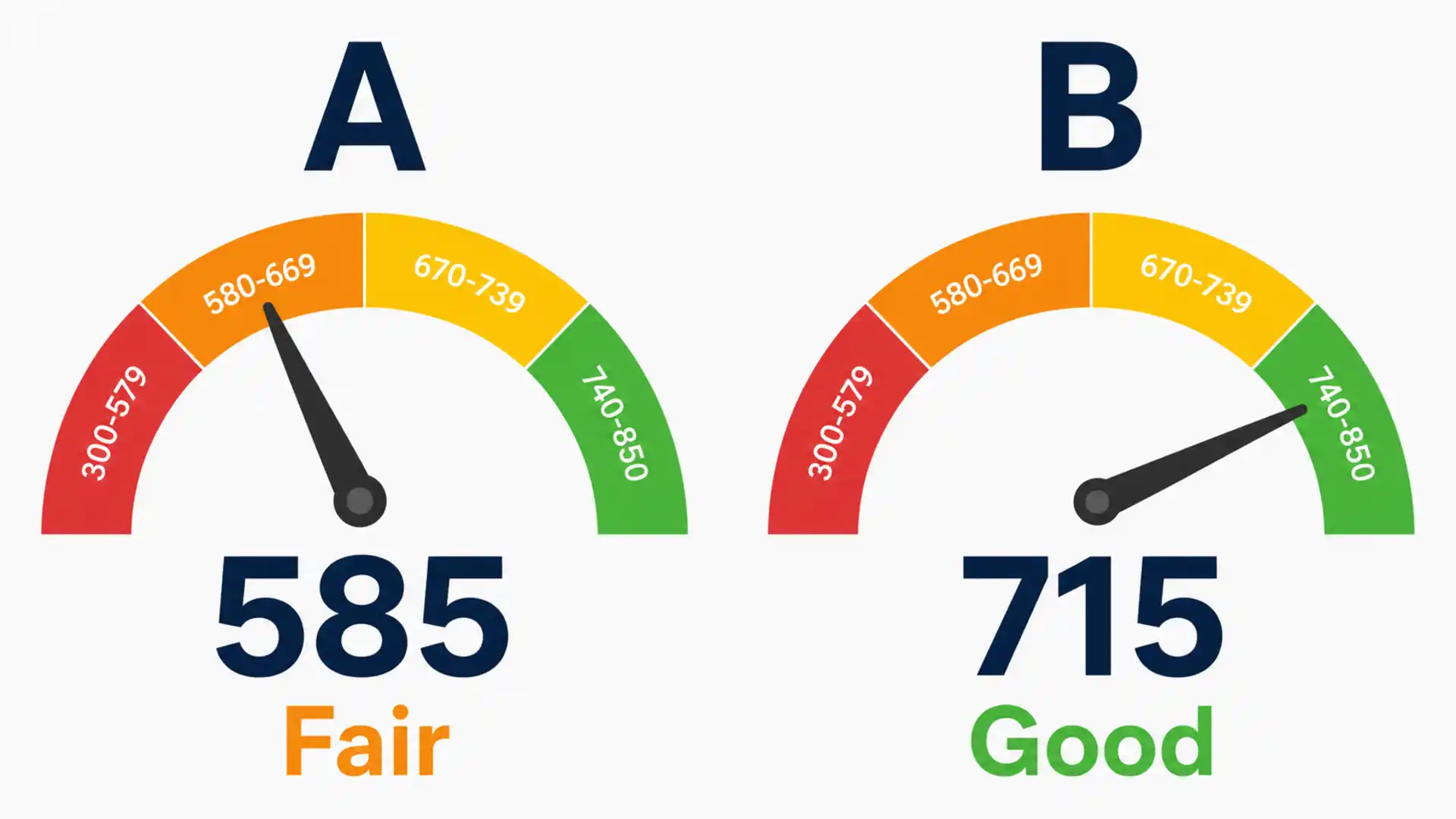
Scores from 300 to 579 are commonly described as Poor. Approvals may be harder and borrowing costs may be higher.
Scores from 580 to 669 are commonly described as Fair. Some approvals may be possible, but terms can be more limited.
Scores from 670 to 739 are commonly described as Good. This is a solid range for many standard financial products.
Scores from 740 to 799 are commonly described as Very Good. This range generally represents stronger positioning and better pricing potential.
Scores from 800 to 850 are commonly described as Excellent or Exceptional. This represents strong borrower positioning in many lending contexts.
According to FICO’s official educational range structure, 670–739 is commonly described as good.
These are educational score bands, not universal approval or pricing thresholds. Individual lenders and products may use different standards.
That is the benchmark most readers need first.
So What Is Considered a Good Credit Score in 2026?
In practical terms, a good credit score in 2026 usually starts around 670 or higher.
At that level, you are moving into the range FICO commonly labels “good,” which can support broader borrowing options than lower score bands.
That may mean better approval potential, more access to unsecured products, fewer deposit requirements in some situations, and more flexibility than someone in the fair range.
But “good” does not mean “best available.”
Good Does Not Always Mean Best
A 670–739 score may fall within FICO’s Good range, but that label does not mean a borrower will receive the best available offer.
Scores in stronger ranges may support better pricing or approval treatment in some lending contexts. FICO classifies 740–799 as Very Good, while the CFPB explains more generally that higher credit scores can make it easier to qualify for credit and may result in better interest rates or loan terms.
Lenders can also apply their own underwriting and risk-pricing standards. A public score label therefore does not guarantee identical results across products or lenders.
Sources:
myFICO:
https://www.myfico.com/credit-education/credit-scores
CFPB:
https://www.consumerfinance.gov/ask-cfpb/what-is-a-credit-score-en-315/What Does Your Score Probably Mean Right Now?
A score of 670 or higher combined with high balances may fall within the good range while still sitting behind a stressed credit file.
A score above 700 with a thin credit history may be in the good range while still showing limited credit depth.
A score above 740 with a clean report can represent a stronger practical position, depending on the product.
A score above 780 with a recent late payment may remain in a strong range while still showing a warning signal that matters to lenders.
A score in the 650s with improving credit behavior may be approaching the common FICO Good range.
That is often a more useful way to read your score than asking whether it is simply “good” or “bad.”
How Lenders Actually View Your Score
A lender does not only see the number.
Lenders may also evaluate payment history, current balances, utilization patterns, recent applications, file age and depth, income or debt information where relevant, and the product you are applying for.
So even with the same score, two applicants may not be viewed the same way.
A 700 with low balances and a stable file may look very different from a 700 with rising revolving debt and several recent inquiries.
That is one reason consumers sometimes feel confused after a denial.
They assume the score alone should have carried the decision.
But lenders may underwrite the broader file and application, not just the score label.
Good, Very Good, and Excellent Are Not the Same Thing in Practice
Good, from 670 to 739, can support many mainstream credit products, but top-tier pricing is not automatic.
Very Good, from 740 to 799, generally represents stronger credit positioning and may improve access to favorable rates or terms.
Excellent or Exceptional, generally 800 and above within FICO’s common educational ranges, represents a very strong score range. However, even an 800-plus score does not guarantee approval or a specific rate because lenders can consider additional underwriting factors.
These FICO educational categories help describe relative credit strength. They should not be interpreted as universal lending thresholds.
The Same Score Can Feel Different Depending on the Product
For standard credit cards, a good score is often workable, although limits, annual percentage rates, and other terms can still vary.
For premium rewards credit cards, the same score may still be borderline because card issuers apply their own credit standards and evaluate the applicant’s credit history.
For personal loans, a good score may support approval, but pricing can still depend on income, debt, loan size, repayment term, and the lender’s risk model.
For auto financing, a good score may support qualification, but auto loan rates can still differ materially across lenders and borrower profiles.
For a mortgage, a good score may be acceptable, but mortgage rates and loan terms still depend on the broader application, loan program, market conditions, and lender pricing.
For apartment screening, a good score may be enough depending on the landlord and overall profile.
That is why “good enough” should always be tied to a real goal.
How Can a Credit Score Affect Mortgage Rates, Personal Loans, Credit Cards, and Auto Loan Rates?
A credit score can influence both approval and pricing, but the score is only one part of the decision. A stronger score may improve a borrower’s position, while income, debt, down payment, loan size, collateral, recent credit activity, and lender-specific rules can still change the final offer.
Mortgage Rates
A higher credit score can improve the pricing available to a mortgage applicant, but mortgage rates are not determined by credit score alone. The loan program, down payment, debt-to-income profile, property details, lender pricing, and broader interest-rate environment can all matter.
The CFPB states that higher credit scores generally make borrowers eligible for lower mortgage interest rates and notes that applicants with higher scores may have access to more affordable loan options.
The practical takeaway is simple: a score that is good may be sufficient for some mortgage options without necessarily producing the lowest mortgage rate available to that borrower.
Sources:
CFPB:
https://www.consumerfinance.gov/ask-cfpb/does-my-credit-score-affect-my-ability-to-get-a-mortgage-loan-or-the-mortgage-rate-i-pay-en-319/
CFPB Explore Interest Rates:
https://www.consumerfinance.gov/owning-a-home/explore-rates/
Personal Loans
For personal loans, lenders may use the credit score and credit report together with income, existing debt, requested loan amount, repayment term, and other underwriting information.
The CFPB explains that when lenders determine the interest rate and terms for a personal installment loan, they commonly consider factors including the borrower’s credit score and reports, income, debts, and the amount and length of the loan.
A good score may expand borrowing options, but it does not guarantee approval or the lowest annual percentage rate.
Source:
CFPB:
https://www.consumerfinance.gov/ask-cfpb/what-is-a-personal-installment-loan-en-2114/
Credit Cards
With credit cards, a good credit score can improve access to mainstream products and may support better limits or terms. Premium rewards credit cards, balance-transfer offers, or cards with the most competitive pricing may still require a stronger overall profile.
Credit-card issuers can also consider existing balances, recent applications, account history, income, and their own internal risk models. The CFPB notes that card issuers may review an applicant’s credit report and that credit limits can reflect credit history, balances, income, and card-specific factors.
Sources:
CFPB:
https://www.consumerfinance.gov/ask-cfpb/when-can-a-credit-card-company-look-at-my-credit-reports-en-3/
CFPB:
https://www.consumerfinance.gov/ask-cfpb/why-did-i-get-a-low-credit-limit-on-a-credit-card-en-11/
Auto Loan Rates
A good score can help with vehicle financing, but auto loan rates can vary even among borrowers with similar scores.
The CFPB explains that auto lenders may consider the credit score, credit history, income, debts, and down payment when deciding what interest rate to offer.
That is why comparing only a score band is less useful than comparing the complete loan offer, including the annual percentage rate, term, amount financed, and total borrowing cost.
Source:
CFPB:
https://www.consumerfinance.gov/ask-cfpb/how-does-a-lender-decide-what-interest-rate-to-offer-me-on-an-auto-loan-en-765/
Why Standards Can Shift Even If the Public Ranges Do Not
Public score labels can remain relatively stable while lending conditions change.
How a score is interpreted in practice can depend on economic conditions, lender risk standards, delinquency trends, the scoring model being used, and the kind of product you want.
So the chart may stay familiar while the real approval environment feels stricter or looser.
That is one reason a borrower can say:
“My score is good. Why did this still feel harder than I expected?”
The public score range may not have changed.
The lending context may have.
Name the Models: Why Newer Scoring Approaches Matter
Some newer scoring models, including FICO 10T and VantageScore 4.0, incorporate trended credit data rather than relying only on a one-day snapshot.
myFICO explains that FICO Score 10T assesses trended bureau data, and VantageScore describes VantageScore 4.0 as incorporating trended credit data as well.
That does not mean every lender uses those models or evaluates trends in the same way.
A safer way to think about it is:
Some scoring approaches may consider not only a current balance, but also how certain credit information has changed over time.
That is another reason one score update should not be viewed as the entire lending picture.
What a Good Score Gets You
A good credit score can improve your position for many financial products.
Depending on the lender and application, it may support stronger approval potential, access to more unsecured credit options, more favorable borrowing terms, higher credit limits in some situations, and more competitive pricing than lower score ranges.
For mortgages, personal loans, credit cards, and auto financing, the final outcome still depends on more than the score alone.
The CFPB explains generally that higher credit scores can make it easier to qualify for loans and may help borrowers obtain lower interest rates.
What a Good Score Does Not Guarantee
A good score is a positive credit signal, not a guarantee.
Even within the good range, approval is not guaranteed, the lowest available rate is not automatic, high balances may still matter, recent late payments may still matter, and a thin credit file may still affect underwriting.
The score should therefore be read as one part of the borrower’s broader credit and application profile.
What Should You Focus on Next?
If your score is below 670, the first priority may be stopping active credit damage and improving the factors currently weakening the file.
If you have newly entered the good range, protecting on-time payments and keeping revolving balances controlled may be more useful than chasing a few extra points.
If you have a good score but approvals feel weaker than expected, review the strength of the file behind the score rather than focusing only on the score label.
If you are in the very good range, protecting consistency and avoiding unnecessary mistakes may matter more than aggressively pursuing a higher score.
If you are in the excellent range, maintaining stability is usually more practical than chasing a perfect score.
The Factors That Still Matter Most
Payment History
Payment history is one of the major factors used in common credit-scoring models.
Utilization
High revolving balances relative to available limits can pressure a score even without missed payments.
Credit Age
Older and more established credit history can help strengthen a file.
New Credit Activity
Several recent applications or newly opened accounts can affect how a credit profile is evaluated.
Credit Mix
A mix of different credit types can contribute to scoring, although it generally should not be pursued at the expense of more important fundamentals such as on-time payments.
FICO’s score-factor guidance and the CFPB’s broader credit-score education both emphasize the importance of the information contained in a consumer’s credit history.
Common Mistakes
If your score is already around the good range or you are trying to reach it, common mistakes include treating 670 as an automatic premium-product threshold.
Another mistake is assuming one score should produce the same mortgage rates, personal-loan pricing, credit-card terms, or auto loan rates everywhere.
Consumers may also focus only on the number while ignoring high balances, allow one card to carry disproportionately high utilization, apply for credit reactively instead of strategically, assume one good month means the file now looks strong everywhere, or close useful older cards without considering the broader impact on the credit profile.
Decision Framework by Stage
Below the good range with active stress is a damage-control stage. The priority is to stop fresh damage first.
Around 670 with uneven balances is a transition stage. The focus should be on stabilizing utilization and payment patterns.
A good score with weaker-than-expected approvals is a profile-quality stage. The focus should shift to strengthening the file behind the score.
A score above 740 with clean behavior can represent an advantage stage. The goal is to protect consistency rather than assume universal approval.
A strong score with one recent problem can be viewed as a preservation stage. The priority is preventing one warning signal from becoming a pattern.
These stages are practical planning categories, not lender approval thresholds.
A Simple Example Plan
Month 1
Review your credit reports.
Identify the biggest weak signal.
Reduce a high-stress revolving balance if practical.
Set up reminders or autopay to help protect payment consistency.
Month 2
Keep revolving balances controlled.
Avoid unnecessary new applications.
Check whether account balances are reporting as expected.
Month 3
Protect the cleaner pattern.
Avoid impulsive account changes.
Review whether your score and overall file are becoming more useful for your actual goal.
Credit improvement does not follow the same timeline for every consumer. The effect of any action depends on the information in the credit file and the scoring model being used.
A Simple Reality Check
What Is a Good Credit Score in 2026?
Do I know what score model I am looking at?
Do I know whether my score is good enough for my actual goal?
Do I know whether my file looks strong or just acceptable?
Do I know what factor is most likely holding me back?
Do I know what I should improve next?
If you cannot answer most of these questions, the score label alone is probably not telling you enough.
FAQ
What is considered a good credit score in 2026?
In common FICO educational ranges, 670–739 is considered good.
That is a general scoring category, not a universal approval threshold. Individual lenders and credit products can use different standards.
Is 700 a good credit score in 2026?
Yes. 700 falls within FICO’s commonly defined 670–739 Good range.
Whether a 700 score is strong enough for a particular mortgage, personal loan, credit card, or auto loan depends on the lender and the rest of the application.
Is 670 enough to get the best rates?
Not necessarily. 670 is the beginning of FICO’s commonly defined Good range, not a universal best-rate threshold.
Pricing can depend on the score band, lender, product, credit report, income, debt, collateral, and other underwriting factors.
Do lenders only care about the score?
No. A credit score is only one part of many lending decisions.
Depending on the product, lenders may also consider credit-report information, income, debts, balances, down payment, loan amount, and other underwriting factors.
Do I need an 850 to have good credit?
No. You do not need an 850 to fall within a good or stronger FICO score range.
FICO commonly identifies 670–739 as Good, 740–799 as Very Good, and 800–850 as Exceptional. These categories describe score ranges rather than guaranteed lending outcomes.
Can a good score still lead to denial?
Yes. A lender may decline an application even when the applicant has a score within the commonly defined good range.
The lender can consider other relevant parts of the credit file and application, subject to applicable lending rules.
How does a credit score affect mortgage rates?
A stronger credit score can improve a borrower’s mortgage pricing position.
However, mortgage rates also depend on factors such as the loan program, down payment, debt profile, property, market conditions, and lender-specific pricing. A good credit score does not by itself guarantee the lowest mortgage rate.
Source:
CFPB:
https://www.consumerfinance.gov/ask-cfpb/does-my-credit-score-affect-my-ability-to-get-a-mortgage-loan-or-the-mortgage-rate-i-pay-en-319/
What credit score is good for personal loans?
There is no single credit score that guarantees approval for personal loans.
A score in the commonly defined good range may improve a borrower’s position, but lenders can also evaluate credit reports, income, debt, loan amount, repayment term, and other factors.
Source:
CFPB:
https://www.consumerfinance.gov/ask-cfpb/what-is-a-personal-installment-loan-en-2114/
Does a good credit score help with credit cards?
Usually, yes. A good credit score can improve access to mainstream credit cards and may support more favorable terms.
However, card issuers set their own standards and can evaluate the broader credit history and application. A good score therefore does not guarantee approval for a premium card.
Source:
CFPB:
https://www.consumerfinance.gov/ask-cfpb/when-can-a-credit-card-company-look-at-my-credit-reports-en-3/
Can a good credit score lower auto loan rates?
It can improve a borrower’s pricing position, but auto loan rates are not based on credit score alone.
The CFPB explains that lenders may also consider credit history, income, debts, down payment, and other factors when deciding what interest rate to offer.
Source:
CFPB:
https://www.consumerfinance.gov/ask-cfpb/how-does-a-lender-decide-what-interest-rate-to-offer-me-on-an-auto-loan-en-765/
Next Steps and Related Content
Useful follow-up topics include Credit Score Ranges Explained: What Lenders Actually See.
How Credit Scores Can Affect Mortgage Rates.
Credit Scores and Personal Loans: What Lenders May Review.
What Credit Score Do You Need for Credit Cards?
How Credit Scores Can Affect Auto Loan Rates.
How Credit Utilization Affects Your Score With Examples.
How Late Payments Affect Your Credit Score.
Does Checking Your Credit Score Lower It?
How to Fix a 500 Credit Score: Realistic Plan.
A Good Score Is Not Just a Number
A good credit score in 2026 generally starts around 670 under FICO’s commonly used educational ranges.
But that does not mean 670 is a universal lending threshold.
The more useful question is whether the score is strong enough for your specific financial goal and whether the rest of the credit file and application support it.
Rather than chasing a perfect number, focus on building a credit profile that remains current, controlled, stable, and consistent over time.
When the information behind the score becomes stronger, the score can become more useful across real-world lending decisions.