How Long Does It Take to Rebuild Credit?
Rebuilding credit is one of those problems that feels simple from far away and confusing up close.
From far away, the advice sounds easy:
Pay on time.
Keep balances lower.
Reduce credit card debt where practical.
Stop applying for unnecessary new credit.
Review your credit report.
Wait for healthier financial behavior to be reflected in your credit history.
Up close, it does not feel easy at all.
Because what most people really want to know is not just how to rebuild credit.
It is this:
How long is this going to take, and how do I know whether my credit score is actually making progress?
That is a much better question.
A person whose credit score dropped because of high credit card debt or high credit utilization is usually dealing with a different recovery timeline than someone with recent late payments, collections, charge-offs, or a very thin credit file.
Someone whose credit report contains inaccurate negative information may also have a different path. In that situation, legitimate credit repair may involve identifying inaccurate information and using the appropriate dispute process rather than simply waiting for time to pass.
There is no single universal timetable.
But there is a realistic framework.
The most useful idea to remember from the start is this:
Some parts of a credit profile may begin changing after updated information is reported, while other parts can take much longer.
That is why rebuilding credit works best when you stop expecting one timeline and start identifying which kind of rebuilding timeline you are actually in.
Key Takeaways
Credit rebuilding does not happen on one universal timeline.
High utilization and elevated credit card debt may show improvement sooner after lower balances are reported.
Credit report errors may also create a different timeline if inaccurate information is successfully corrected.
Late payments, collections, and charge-offs usually create a slower rebuilding path.
A thin credit file is often a building problem as much as a rebuilding problem.
Credit monitoring can help you notice changes, but it does not replace reviewing your actual credit report.
Credit repair is most relevant when inaccurate or potentially fraudulent information needs to be investigated or disputed. It is not a shortcut for removing accurate negative information.
The most realistic approach is to stop fresh damage first, correct genuine errors, improve what can change sooner, and then protect the cleaner pattern long enough for the credit profile to look more stable.
Why You Can Trust This Guide
This guide is based on public consumer-credit guidance and primary scoring resources, including the Consumer Financial Protection Bureau, AnnualCreditReport.com, IdentityTheft.gov, and myFICO.
This guide is written for ordinary readers trying to understand realistic credit rebuilding timelines rather than chase unrealistic credit score claims.
Its practical goal is to help you separate faster-moving credit problems from slower-fading negative history so you know what to work on first.
Who This Article Is For
This guide is especially useful if your credit score is lower than you want and you are trying to understand how long rebuilding may take.
It can help if you are not sure whether your main problem is high credit card debt, utilization, late payments, collections, charge-offs, a thin credit file, or inaccurate information on a credit report.
It is also useful if you are using credit monitoring and seeing changes but are unsure whether those changes represent meaningful progress.
The goal is to give you a practical rebuilding framework rather than a promise that a particular action will produce a specific credit score within a fixed period.
Who This Article Is Not For
This article may not be enough on its own if you are dealing with active identity theft or fraud involving new accounts.
It may also be insufficient for legal disputes involving debts or collections, bankruptcy timing decisions that require individualized legal advice, highly specific mortgage-underwriting strategies, or business-credit rebuilding questions.
In those situations, the framework here may still help you organize the problem, but it should not replace more specific professional guidance.
How This Article Was Reviewed
This guide was reviewed against a simple standard.
Does it distinguish between faster and slower rebuilding paths?
Does it explain what can improve relatively quickly versus what naturally takes longer?
Does it distinguish credit repair from broader credit rebuilding?
Does it explain the roles of a credit report, credit monitoring, credit card debt, and payment history?
Does it avoid unrealistic credit score promises?
Does it point readers toward authoritative public resources where appropriate?
That standard matters because a lot of content about rebuilding credit either gives false certainty or avoids giving readers a usable structure at all.
Disclaimer
This article is for educational purposes only.
It reflects general consumer-credit information and is not individualized financial, legal, lending, or tax advice.
Credit scores can vary by credit bureau, scoring model, information reported, and reporting timing.
Different lenders may also respond differently to the same credit profile.
Official Resources to Check First
If you are rebuilding credit, start with authoritative public resources.
Official credit reports:
https://www.annualcreditreport.com/
CFPB credit report dispute guidance:
https://www.consumerfinance.gov/ask-cfpb/how-do-i-dispute-an-error-on-my-credit-report-en-314/
CFPB guidance on rebuilding credit:
https://www.consumerfinance.gov/consumer-tools/credit-reports-and-scores/how-to-rebuild-your-credit/
CFPB guidance on starting or rebuilding a good credit history:
Identity theft guidance:
https://www.identitytheft.gov/
myFICO credit score factors:
https://www.myfico.com/credit-education/whats-in-your-credit-score
The Honest Short Answer
How long does it take to rebuild credit?
The most accurate answer is:
You may see some visible improvement over time, but stronger rebuilding often takes longer depending on what damaged the credit profile in the first place.
That is not a dodge.
It is the practical answer.
A utilization-heavy problem caused by high credit card debt may begin moving sooner because lower balances can be reflected in later reporting cycles.
A legitimate late payment, collection, or charge-off usually does not lose its influence that quickly, even if your current financial behavior improves immediately.
A credit report error creates another type of timeline. If information is genuinely inaccurate, the correct response is to review and dispute the information rather than treat it as an ordinary rebuilding problem.
That is where legitimate credit repair may overlap with credit rebuilding.
Rebuilding credit therefore feels uneven.
One part of the credit profile may improve relatively quickly.
Another part may still be holding the credit score back.
Which Rebuild Timeline Are You Actually In?
This is the most useful place to start.
Mostly a utilization or credit card debt problem
This may produce faster visible movement once lower balances are reported.
Recent late payments
This is usually a slower path. The priorities are getting current, preventing additional late payments, and building a cleaner payment pattern over time.
Collections or charge-offs
This is generally a longer rebuilding path. Review the information for accuracy and focus on stable current behavior.
Thin credit file rather than heavily damaged credit
This is partly a credit-building problem. Positive history needs time to accumulate.
Credit score seems inconsistent with your actual history
Review your credit report for inaccurate or unfamiliar information before assuming the issue is simply poor credit.
This is not a scoring formula.
It is a practical way to identify the type of rebuilding problem you are dealing with.
Why Rebuilding Credit Feels Slower Than It Should
One of the hardest parts of rebuilding credit is that the action and the visible result usually happen at different speeds.
You can make a good decision today.
You can reduce credit card debt.
You can bring a delinquent account current.
You can stop unnecessary new credit applications.
You can review your credit report.
You can dispute inaccurate information.
But your credit score may not move instantly.
That lag exists because credit reports update according to reporting cycles, credit scoring models react to reported information, and some negative information may continue to matter even after current behavior improves.
That is why rebuilding often feels frustrating.
You may be making better decisions before the credit file fully reflects those decisions.
The CFPB explains that rebuilding credit takes time and emphasizes consistent financial behavior rather than shortcuts.
Source:
https://www.consumerfinance.gov/consumer-tools/credit-reports-and-scores/how-to-rebuild-your-credit/
Different Credit Problems Recover on Different Timelines
1. High Credit Utilization and Credit Card Debt
High credit utilization is one of the faster-moving credit rebuilding problems because reported balances can change from one reporting cycle to another.
If your credit score dropped mostly because balances on your credit cards became high relative to your available credit, improvement may begin after lower balances are reported.
Reducing credit card debt can therefore affect more than monthly interest costs. It may also reduce the amount of revolving credit reported as being used.
myFICO identifies amounts owed as one of the major FICO Score categories and discusses revolving utilization within that category.
Source:
https://www.myfico.com/credit-education/credit-scores/amount-of-debt
This does not mean every balance reduction produces a predictable credit score increase.
The effect depends on the broader credit profile and the scoring model being used.
2. Late Payments
Late payments usually create a slower rebuilding path.
Getting current is important because it can stop an active delinquency from becoming more severe.
But bringing an account current does not automatically erase previously reported late-payment history.
The practical rebuilding path usually becomes:
Stop new late payments.
Bring active delinquent accounts current where possible.
Build a consistent payment record after the event.
Allow time to reduce the relative importance of older negative history.
Payment history is a major credit score factor.
According to myFICO, payment history accounts for 35% of a FICO Score in its general factor breakdown.
Source:
https://www.myfico.com/credit-education/credit-scores/payment-history
3. Collections and Charge-Offs
Collections and charge-offs generally create a longer rebuilding path.
You may still be able to improve other parts of your credit profile while these items remain.
For example, you can keep current accounts on time, reduce credit card debt, avoid unnecessary applications, and make sure the rest of the credit report is accurate.
Serious negative information usually requires more patience because it represents a different kind of risk signal than ordinary utilization changes.
That does not mean nothing can improve until the negative item disappears.
It means two processes may need to happen together.
The negative information becomes older.
The rest of the credit profile becomes more stable.
4. Thin Credit File
Sometimes the problem is not severe damage.
It is lack of credit history.
A person may have a weak or difficult-to-evaluate credit profile because the credit report contains relatively little account history or because the existing history is short.
In that situation, rebuilding is partly a building process.
Positive history needs time to accumulate.
The goal is not to create as many accounts as possible.
It is to establish a manageable pattern of responsible credit use over time.
5. Credit Report Errors
Credit report errors create a different type of rebuilding problem.
If the credit profile looks worse because information is inaccurate, the appropriate first step is verification.
The CFPB identifies common credit report errors such as accounts that do not belong to the consumer, incorrect account information, incorrect balances, and duplicate information.
Source:
https://www.consumerfinance.gov/ask-cfpb/what-are-common-credit-report-errors-that-i-should-look-for-on-my-credit-report-en-313/
If you find information that appears inaccurate, the CFPB provides guidance on the dispute process.
Source:
https://www.consumerfinance.gov/ask-cfpb/how-do-i-dispute-an-error-on-my-credit-report-en-314/
This is where legitimate credit repair is most relevant.
Credit repair is primarily a correction process when credit report information is inaccurate, incomplete, duplicated, or potentially fraudulent.
Credit rebuilding is broader. It focuses on developing a healthier credit profile over time when the reported information is accurate.
No legitimate credit repair process can guarantee a specific credit score increase or remove accurate negative information merely because it is damaging.
What Should You Do First This Month?
If you are rebuilding credit right now, keep the first steps simple.
Review your credit reports.
Identify the biggest active problem.
Check whether credit card debt and utilization are major factors.
Verify late-payment information.
Review collections or charge-offs for accuracy.
Dispute genuine credit report errors before trying to optimize other parts of the profile.
Stop fresh damage first.
Avoid unnecessary new credit applications.
If you use credit monitoring, use it to track changes after you understand what is actually on the underlying credit report.
This month is usually about clarity and stabilization, not dramatic credit score movement.
A Realistic Credit Rebuilding Timeline
The First 30 Days
The early stage is usually about preventing the situation from getting worse and understanding what is actually affecting the credit profile.
Review your credit reports.
Identify whether the main issue is credit card debt, utilization, late payments, collections, thin history, or credit report errors.
Verify unfamiliar accounts or inquiries.
Dispute genuine inaccuracies.
Bring active delinquent accounts current where possible.
Reduce heavily utilized revolving balances where practical.
Stop unnecessary new credit applications.
The first month is usually about gaining control of the credit profile.
The goal is not to force a particular score increase within a fixed period.
The Next Few Months
During the early months, some parts of the credit profile may begin changing as creditors report updated account information.
This may be more noticeable when the primary issue involves high credit card debt or utilization and lower balances begin appearing on the credit report.
A period of consistent on-time payments can also begin creating a cleaner recent pattern.
That does not erase accurate older negative information.
Credit monitoring may be useful during this stage because it can alert you to updated balances, new accounts, inquiries, or unfamiliar activity.
However, credit monitoring should complement credit report review rather than replace it.
Around 3 to 6 Months
Some people may begin noticing clearer progress over several months, particularly when the main issue involves factors such as high reported utilization and no new negative information appears.
myFICO notes that improving FICO Scores is generally a gradual process and that some people may begin noticing small changes within about three to six months, although the timing depends on individual circumstances.
Source:
https://www.myfico.com/credit-education/improve-your-credit-score
Several months of more stable behavior may also begin appearing in the credit data.
That could include lower credit card debt.
Lower revolving utilization.
No new late payments.
Fewer recent applications.
More consistent account management.
This does not mean older negative information has disappeared.
It means the direction of the credit profile may be becoming more stable.
The exact credit score outcome still varies because scoring models and individual credit profiles differ.
Over a Longer Period
For some credit profiles, continued stability over many months may make the rebuilding trend more meaningful.
A credit profile that remains stable can gradually look different from the same file at the beginning of the process.
There may be less revolving stress.
Payment behavior may be more consistent.
Credit card debt may be lower.
There may be fewer recent inquiries.
There may be no fresh negative information.
Serious accurate negative information may still remain relevant, which is why longer-term rebuilding cannot be reduced to a single calendar deadline.
Beyond the First Year
Longer-term rebuilding depends less on one corrective action and more on repeated stability.
At this point, progress is often about maintaining a pattern.
Manage credit card debt.
Keep payments current.
Avoid unnecessary new accounts.
Review your credit report periodically.
Use credit monitoring if it helps you detect unfamiliar activity or important changes.
Make sure genuine credit report errors that were disputed have been addressed appropriately.
Long-term rebuilding is not about getting one month right.
It is about creating a credit profile that continues to look more predictable over time.
What Not to Do While Rebuilding Credit
Avoid panic-applying for new credit.
Do not focus so heavily on one account that you ignore other active problems.
Do not assume older negative information means nothing else can improve.
Do not close credit cards without understanding how the change may affect utilization.
Do not watch credit monitoring alerts or credit score apps while never reviewing the actual credit report.
Do not treat credit repair as a way to remove accurate negative history.
Do not increase credit card debt simply because a card has available credit.
Do not treat rebuilding as a short sprint.
What Can Help Credit Rebuilding?
Lowering Credit Utilization
If credit card debt is creating high reported utilization, reducing balances can improve the utilization side of the credit profile.
The goal is not to chase a specific utilization percentage as though it guarantees a particular credit score.
The more useful principle is to manage revolving balances carefully and avoid persistently high utilization where practical.
myFICO information on amounts owed:
https://www.myfico.com/credit-education/credit-scores/amount-of-debt
Getting and Staying Current
Rebuilding becomes more difficult if new late payments continue appearing while you are trying to recover.
If an account is currently behind, understanding what is required to bring it current should generally come before cosmetic score optimization.
Reviewing Your Credit Report Carefully
A rebuilding plan can be misdirected if the underlying data is wrong.
Check your credit report for accounts you do not recognize, incorrect payment information, unexpected balances, duplicate items, or other inaccuracies.
Official reports:
https://www.annualcreditreport.com/
CFPB dispute guidance:
https://www.consumerfinance.gov/ask-cfpb/how-do-i-dispute-an-error-on-my-credit-report-en-314/
Using Credit Monitoring Appropriately
Credit monitoring can help you notice account changes, new inquiries, unfamiliar activity, or updates to reported balances.
It can be useful during credit rebuilding because it gives you another way to observe changes.
But credit monitoring is not the same as credit repair.
It does not correct inaccurate information by itself.
It also does not replace reviewing a complete credit report when you are trying to diagnose a problem.
Building Stable Trends
A credit profile with lower credit card debt, cleaner payment timing, fewer unnecessary applications, and no new negative information may become more stable over time.
One dramatic cleanup action is usually less important than maintaining a healthier pattern.
What Slows Credit Rebuilding Down?
Repeated missed payments.
Increasing credit card debt while trying to reduce utilization.
Focusing only on the credit score instead of the credit report behind it.
Expecting serious derogatory information to lose impact immediately.
Adding several new inquiries and accounts during an already weak period.
Ignoring inaccurate credit report information.
Assuming credit repair can replace responsible credit management.
Treating credit rebuilding as a short-term project instead of an ongoing system.
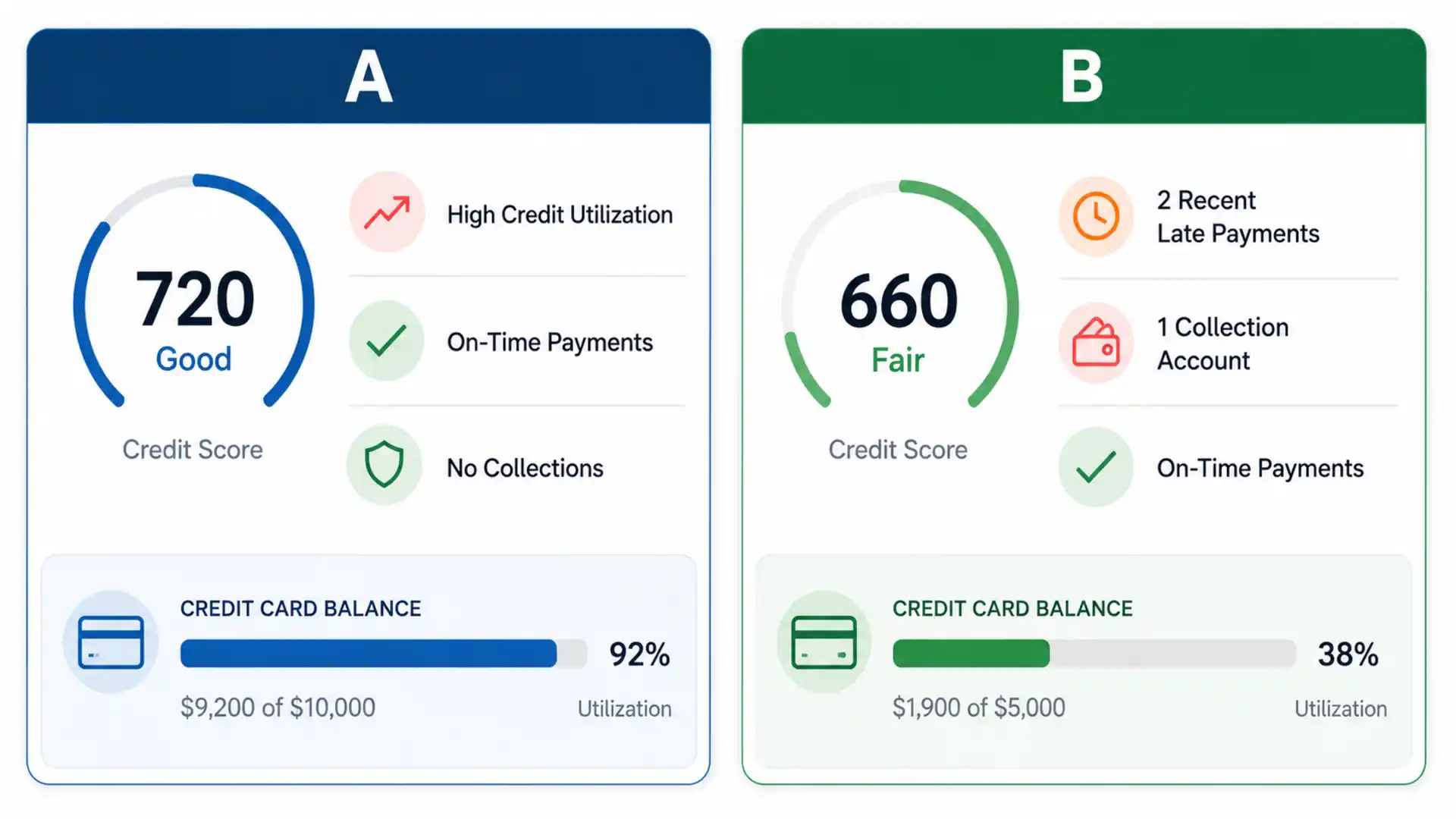
Example: A Faster Rebuild Path
Imagine someone whose credit score dropped mostly because credit card debt increased and utilization became high.
The person did not miss payments.
There are no collections.
The credit report does not contain serious derogatory information.
The biggest visible problem is revolving credit stress.
The person then begins reducing credit card debt.
New unnecessary charges are limited.
Every account remains current.
No unnecessary new credit applications are submitted.
Once lower balances are reported, the credit profile may begin looking better sooner than a profile damaged by recent serious late payments or other significant negative information.
This does not mean the credit score will increase by a predictable number of points.
It means the main problem is one of the faster-moving parts of a credit profile.
Example: A Slower Rebuild Path
Now imagine someone whose credit report contains recent late payments, a collection account, high credit card debt, and several recent hard inquiries.
That person can still rebuild.
But the rebuilding process is likely to be slower because several types of credit risk appear at the same time.
Early progress may come from bringing active accounts current and reducing credit card debt.
The overall credit score recovery may still take longer because accurate older negative information can continue influencing the profile.
If credit monitoring shows changes during this period, those changes should be interpreted in the context of the full credit report rather than treated as proof that the entire rebuilding process is complete.
What Does Rebuilt Actually Mean?
This is one of the most important questions in the process.
Does rebuilt mean returning to your previous highest credit score?
Does it mean reaching a generally stronger score range?
Does it mean qualifying for more ordinary credit options?
Does it mean no longer appearing as risky as you did when the rebuilding process began?
For many people, rebuilding does not need to mean perfection.
It may mean moving from a severely stressed credit profile to a more stable one.
It may mean lower credit card debt.
It may mean a longer period without late payments.
It may mean fewer recent inquiries.
It may mean correcting inaccurate information on a credit report.
It may mean having more borrowing flexibility than before.
That distinction matters because focusing on one ideal credit score can make real progress harder to recognize.
A Credit Rebuilding Reality Check
I know what damaged my credit most.
I know whether the main issue is credit card debt, utilization, late payments, collections, thin history, or credit report errors.
I have reviewed my credit report rather than relying only on a credit score app.
I understand that credit monitoring can help track changes but does not replace the report.
I know whether legitimate credit repair is relevant because inaccurate information needs to be disputed.
I understand which rebuilding timeline I am actually in.
I am focused on stopping fresh damage first.
I have a realistic plan rather than a specific promised credit score target.
If you cannot confirm most of these points yet, the problem may be that you have not identified which rebuilding timeline applies to your credit profile.
FAQ
How Long Does It Usually Take to Rebuild Credit?
There is no single universal timetable.
Some utilization-driven problems related to high credit card debt may begin showing improvement after lower balances are reported.
Late payments, collections, charge-offs, and other serious negative information usually create a longer rebuilding path.
Your exact credit score timeline depends on the information in your credit report, the scoring model, reporting timing, and what changes over time.
Can a Credit Score Start Improving Within a Few Months?
Sometimes.
That is more plausible when the main issue is high utilization, credit card debt, or an inaccurate credit report item that is successfully corrected.
Serious and accurate derogatory history generally creates a slower rebuilding process.
myFICO provides additional guidance on improving a FICO Score here:
https://www.myfico.com/credit-education/improve-your-credit-score
Does Paying Down Credit Card Debt Help Rebuild Credit?
It can help when high revolving balances and utilization are important problems in the credit profile.
Lower credit card debt can reduce reported utilization once updated balances are reflected in the credit report.
The effect on a specific credit score varies by credit profile and scoring model.
Do Late Payments Take Longer to Recover From Than High Balances?
Generally, high reported balances can change relatively quickly once lower amounts are reported.
Accurate late-payment history usually follows a slower rebuilding path.
The appropriate response is to prevent additional missed payments and build a cleaner payment history over time.
Can Collections or Charge-Offs Still Allow Credit Improvement?
Yes.
Collections and charge-offs may create a longer rebuilding timeline, but other parts of the credit profile can still become more stable.
Current payments can remain on time.
Credit card debt can be reduced.
New unnecessary applications can be avoided.
Credit report information can be checked for accuracy.
Is Credit Monitoring Necessary to Rebuild Credit?
No.
Credit monitoring can be useful because it may alert you to changes, new inquiries, unfamiliar accounts, or balance updates.
But it is a monitoring tool.
It does not rebuild credit by itself.
Your underlying credit report and your actual account behavior remain more important.
Is Credit Repair the Same as Credit Rebuilding?
No.
Credit repair is primarily a correction process when credit report information is inaccurate, incomplete, duplicated, or potentially fraudulent.
Credit rebuilding is broader. It focuses on developing a healthier credit profile over time when the reported information is accurate.
No legitimate credit repair process can guarantee a specific credit score increase or remove accurate negative information merely because it is damaging.
What Should I Do First If I Am Rebuilding Credit?
Start with your credit reports.
Identify the biggest active problem.
Determine whether credit card debt, utilization, late payments, collections, or inaccurate information is driving the problem.
Dispute genuine errors.
Bring active delinquent accounts current where possible.
Avoid unnecessary new credit applications.
Then allow healthier financial behavior to build a more stable credit profile over time.
Rebuilding Credit Is Not One Timeline
That is the cleanest conclusion.
Some parts of credit recovery can move faster.
Some parts naturally take longer.
High credit card debt may be a faster-moving problem once lower balances are reported.
Accurate late payments, collections, and charge-offs usually require more patience.
Credit report errors require verification and, when appropriate, a formal dispute process.
Credit monitoring can help you observe changes, but it does not replace understanding the information in the credit report.
Credit repair is relevant when data is wrong.
Credit rebuilding is the broader process of developing a healthier credit profile when the reported information is accurate.
The biggest mistake is expecting one universal timetable and then assuming you have failed when your credit score does not follow it.
A better way to think about the process is:
Identify what caused the damage.
Review the credit report.
Correct genuine errors.
Reduce active pressure such as high credit card debt where practical.
Prevent new late payments or unnecessary applications.
Monitor the profile for meaningful changes.
Give consistent financial behavior time to become part of the credit history.
The goal is not to force a particular score increase within a fixed period.
You do not need instant perfection.
You need a credit profile that is gradually becoming more accurate, more stable, and easier to evaluate over time.