How Credit Utilization Affects Your Score (With Examples)
Credit card utilization is one of the most misunderstood parts of credit scoring.
A lot of people know the slogan version:
“Keep it under 30%.”
That advice is not useless.
It is just incomplete.
Credit card utilization is not only about whether your total credit use is above or below a clean round number.
It is also about which balances get reported, how high one specific card is relative to its own limit, how much of your total revolving credit you are using, whether a utilization spike is temporary or recurring, and whether your reported balances suggest a controlled or stressed revolving-credit profile.
That is why two people can both say:
“I’m under 30%.”
and still experience very different credit score behavior.
One person may have a relatively controlled credit profile.
Another may have one credit card sitting close to its limit.
Same overall percentage.
Different signal.
Credit card debt and credit card utilization are related, but they are not the same thing.
Credit card debt is the dollar amount you owe.
Credit card utilization compares the reported revolving balance with the available revolving credit limit.
That difference matters because the same amount of credit card debt can produce very different utilization ratios depending on available limits.
This guide explains how credit card utilization affects a credit score, how total utilization differs from per-card utilization, why reported balances matter, what a credit report can show you, and how credit monitoring can help you keep track of changes.
The most useful idea to remember from the beginning is this:
Credit card utilization can affect a credit score because scoring models may consider reported revolving balances relative to available revolving credit.
Because reported revolving balances can change from one reporting cycle to another, utilization can also change relatively quickly.
It is not just a static ratio.
It reflects current reported revolving-credit use.
Key Takeaways
Credit card utilization generally means how much of your revolving credit you are using compared with how much revolving credit you have available.
Credit card debt and credit card utilization are connected but different. The same debt balance can produce a low or high utilization ratio depending on the credit limits available.
The CFPB references common expert guidance about keeping credit use at no more than 30% of total credit limits, but that percentage should be understood as general guidance rather than a guaranteed credit score threshold.
Total utilization matters, but a single heavily utilized credit card can also matter.
The balance shown on a credit report may be more important for utilization analysis than the balance you see after making a more recent payment.
Credit monitoring can help you notice changes in reported balances, accounts, inquiries, or unusual activity.
The most useful response is usually not paying balances at random. It is understanding what was reported, which credit card has the highest utilization, whether credit card debt is becoming difficult to manage, and what can reasonably change.
Why You Can Trust This Guide
This guide is based on public consumer-credit guidance and primary scoring resources, including the Consumer Financial Protection Bureau, AnnualCreditReport.com, and myFICO.
It is written for ordinary readers who want to understand how credit card utilization works in real monthly life rather than simply memorize one percentage.
Its practical goal is to help distinguish between a temporary utilization spike, a structurally stressed revolving-credit profile, significant credit card debt, and a reporting issue that deserves closer review.
Who This Article Is For
This guide is especially useful if you keep hearing about the 30% guideline and want a clearer explanation.
It can also help if your credit score moves even though you make payments on your credit cards.
You may find it useful if you want to understand total credit card utilization versus per-card utilization.
It is relevant if you are reviewing a credit report and trying to understand why the balances shown there may be affecting your credit score.
It can also help if you use credit monitoring and want to understand what reported balance changes actually mean.
The goal is to provide a practical decision guide rather than a collection of credit score myths or tiny scoring tricks.
Who This Article Is Not For
This article may not be enough on its own if you are dealing with major active delinquencies, charge-offs, identity theft, credit report errors that still need to be disputed, business-credit utilization questions, or highly specialized mortgage-score timing strategies.
In those situations, credit card utilization may still matter, but it may not be the most important issue in the overall credit profile.
How This Article Was Reviewed
This guide was reviewed against a simple standard.
Does it explain credit card utilization in a way ordinary readers can actually use?
Does it separate total utilization from per-card utilization?
Does it distinguish credit card debt from the utilization ratio?
Does it explain why the balance appearing on a credit report matters?
Does it explain the appropriate role of credit monitoring?
Does it separate credit score myths from useful practical patterns?
Does it point readers toward authoritative public resources where appropriate?
That standard matters because a lot of utilization content is either too vague or too focused on tiny scoring tactics to help consumers understand their actual revolving-credit picture.
Disclaimer
This article is for educational purposes only.
It reflects general consumer-credit information and is not individualized lending, legal, or financial advice.
Different scoring models and lenders may evaluate credit card utilization and other credit information differently.
A particular utilization percentage does not guarantee a specific credit score result.
What Credit Card Utilization Actually Means
At its simplest, credit card utilization generally means the amount of revolving credit you are using divided by the amount of revolving credit you have available.
Consider two examples.
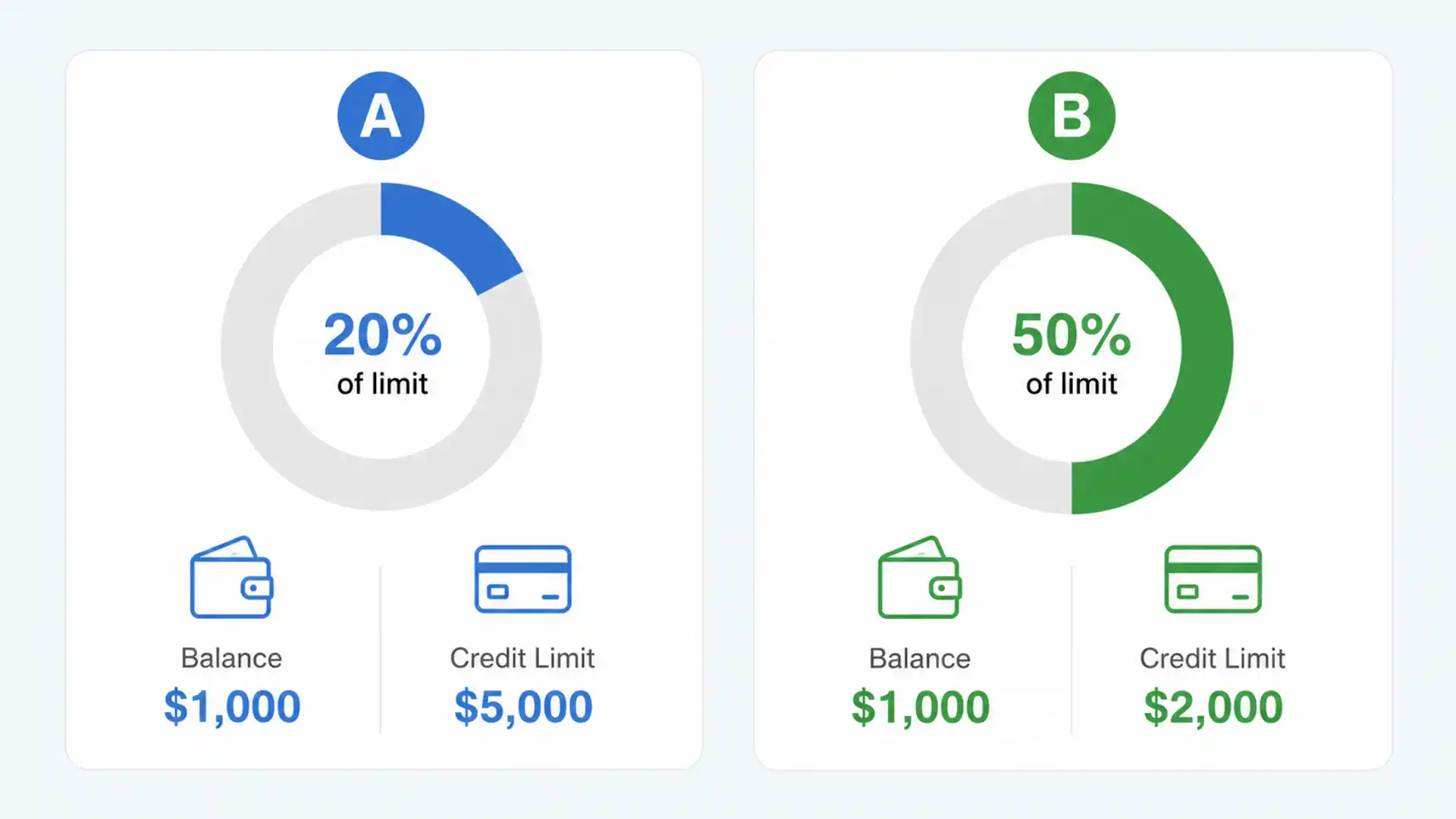
Person A has $1,000 in credit card debt and a $10,000 credit limit.
Person B also has $1,000 in credit card debt but only a $1,500 credit limit.
The dollar amount of credit card debt is the same.
The utilization ratio is very different.
That difference is one reason a credit score does not react only to the amount of money owed.
The relationship between reported revolving balances and available revolving credit also matters.
The CFPB explains that credit scoring models may consider how close consumers are to being maxed out.
Source:
https://www.consumerfinance.gov/ask-cfpb/how-do-i-get-and-keep-a-good-credit-score-en-318/
Additional CFPB credit score guidance:
https://www.consumerfinance.gov/consumer-tools/credit-reports-and-scores/understand-your-credit-score/
The broad principle is straightforward.
Credit card utilization helps describe how stretched or controlled a revolving-credit profile appears based on reported information.
Credit Card Debt and Credit Card Utilization Are Not the Same Thing
This distinction is important.
Credit card debt tells you how many dollars you currently owe.
Credit card utilization tells you how large that balance is relative to the revolving credit available.
Suppose two consumers each owe $2,000.
One has $20,000 in total credit limits.
The other has $3,000 in total credit limits.
Their credit card debt is identical.
Their credit card utilization is not.
This is why focusing only on total debt can miss an important part of the credit score picture.
The 30% Rule Is a Guideline, Not a Magic Line
This is one of the most important things to understand.
The CFPB references common expert guidance about using no more than 30% of total credit limits.
That does not mean 29% is perfect.
It does not mean 31% is disastrous.
It does not mean everyone above 30% has the same credit risk.
It does not mean everyone below 30% has optimized a credit score.
Think of 30% as a practical guideline rather than a scoring formula.
A lower utilization ratio may generally present a less stressed revolving-credit picture, but the exact credit score effect depends on the broader credit profile and scoring model.
A lower utilization ratio does not guarantee a particular credit score increase.
One specific credit card can also carry high utilization even when total utilization looks much lower.
Total Credit Card Utilization vs. Per-Card Utilization
This is where many people get confused.
There are two useful ways to look at revolving utilization.
Total utilization looks at combined revolving balances compared with combined revolving limits.
Per-card utilization looks at the reported balance on a specific credit card compared with that card’s individual limit.
myFICO discusses both individual-card and aggregate utilization calculations.
Source:
https://www.myfico.com/credit-education/blog/credit-utilization-be
That distinction matters because a credit profile can look relatively controlled on one measure and stressed on another.
Consider this example.
Total available revolving credit: $10,000.
Total credit card debt: $2,400.
Total utilization: 24%.
At first glance, that may not seem unusually high.
But suppose one credit card has a $2,500 limit and a reported balance of $2,200.
That card has 88% utilization.
The remaining available credit may be spread across other accounts with little or no balance.
The total utilization ratio is still 24%.
But one credit card is using most of its available limit.
The better question is therefore not only:
“What is my total credit card utilization?”
It is also:
“Is one credit card carrying a much higher utilization ratio than the others?”
What Your Credit Report Has to Do With Utilization
A credit score is generally calculated from information in a credit file.
That means the balance appearing on a credit report matters.
The balance you see in your banking app today may not always be the same balance currently appearing on your credit report.
For example, you may make a large payment after a statement closes.
Your current account balance may fall immediately.
But the lower balance may not appear in your credit file until the creditor reports updated account information.
This is one reason people sometimes see a credit score move even though they believe they have been managing the card responsibly.
When you are trying to understand credit card utilization, checking the underlying credit report can be more useful than looking only at a credit score.
Official credit reports:
https://www.annualcreditreport.com/
Statement Balance vs. Current Balance vs. Due Date
These three terms are easy to confuse.
Current balance means what you currently owe on the account.
Statement balance means the balance shown when the billing statement closed.
Due date means when the required payment is due.
The due date is critically important for avoiding late-payment problems.
But from a credit card utilization perspective, the balance reported by the issuer also matters.
Depending on reporting timing, the reported amount may resemble a statement balance rather than the live balance shown after a more recent payment.
That is why someone can truthfully say:
“I pay on time every month.”
and still see credit score movement related to utilization.
The person may have excellent payment timing while still having a relatively high balance reported during a particular cycle.
Example 1: Same Credit Card Debt, Different Utilization Signal
Imagine two people who both have $2,000 in total credit card debt.
Person A
Card 1 has a $5,000 limit and a $1,000 balance.
Card 2 has a $5,000 limit and a $1,000 balance.
Total available revolving credit is $10,000.
Total credit card debt is $2,000.
Total utilization is 20%.
Each card is also at 20% utilization.
Person B
Card 1 has a $2,500 limit and a $2,000 balance.
Card 2 has a $7,500 limit and no balance.
Total available revolving credit is also $10,000.
Total credit card debt is also $2,000.
Total utilization is also 20%.
But Card 1 is at 80% utilization.
The total amount of credit card debt is identical.
The overall utilization percentage is identical.
The per-card picture is very different.
Person B has one revolving account carrying much more concentrated utilization.
This is one of the most useful lessons in credit card utilization.
A reasonable total ratio does not automatically mean every individual card looks equally controlled.
What Kind of Credit Card Utilization Problem Do You Have?
If utilization is high across nearly every revolving account, the main issue is probably overall utilization stress.
If total utilization looks moderate but one credit card is close to its limit, the main issue may be concentration on one account.
If your credit score changed after a statement closed, reported balance timing may be part of the explanation.
If utilization increased after you closed a card, reduced available revolving credit may be part of the explanation.
If you recently made large payments but the credit report still shows older balances, reporting timing may explain why your score has not yet reflected the new balances.
This is not a scoring formula.
It is a practical way to identify what type of utilization issue deserves attention.
Example 2: Closing a Credit Card Can Increase Utilization
Closing a credit card does not create new credit card debt.
But it can reduce your available revolving credit.
That can raise your utilization ratio if balances remain on other cards.
The CFPB has specifically discussed how closing a credit card can affect utilization and a credit score.
Source:
https://www.consumerfinance.gov/ask-cfpb/does-it-hurt-my-credit-to-close-a-credit-card-en-1231/
Consider this example.
Before closing a card:
Total revolving limits: $10,000.
Total credit card debt: $2,000.
Total utilization: 20%.
Now suppose you close a credit card with a $4,000 limit.
After closing the card:
Total revolving limits: $6,000.
Total credit card debt: $2,000.
Utilization becomes about 33%.
No new credit card debt was added.
The available revolving credit changed.
That is why closing a card should not automatically be treated as a credit score improvement strategy.
Example 3: Why Paying in Full Can Help
Carrying a balance is not required to build or maintain a credit score.
The CFPB notes that paying a credit card balance in full each month can help consumers avoid getting too close to their credit limits and can support responsible credit management.
Source:
https://www.consumerfinance.gov/ask-cfpb/will-paying-off-my-credit-card-balance-every-month-improve-my-score-en-1293/
CFPB rebuilding guidance:
https://www.consumerfinance.gov/consumer-tools/credit-reports-and-scores/how-to-rebuild-your-credit/
That does not mean your balance must be zero every day.
It means carrying unnecessary credit card debt is not required for credit scoring purposes.
Lower and more manageable reported revolving balances generally create a different utilization picture than balances that remain close to credit limits.
How Credit Monitoring Fits Into Credit Card Utilization
Credit monitoring can be useful when you are trying to understand changes in a credit profile.
A credit monitoring service may alert you when account information changes, when a new inquiry appears, or when reported balances update.
That can make it easier to notice when credit card utilization changes.
But credit monitoring should be understood correctly.
Credit monitoring does not reduce credit card debt.
Credit monitoring does not change the balance reported by a card issuer.
Credit monitoring does not directly improve a credit score.
Its role is tracking, organization, reporting awareness, and unusual activity monitoring.
If a credit monitoring alert shows a significant balance change, use the alert as a reason to review the underlying account and, when necessary, the credit report.
Common Credit Card Utilization Mistakes
1. Treating One Percentage Like a Hard Scoring Threshold
Credit card utilization should be interpreted in context rather than treated as a single pass-or-fail number.
2. Focusing Only on Total Utilization
A reasonable total utilization ratio can hide one heavily utilized credit card.
Review both the overall ratio and individual-card ratios.
3. Ignoring Credit Card Debt
Utilization is a ratio, but the underlying credit card debt still matters financially.
A consumer should not borrow more simply because additional credit limits make the utilization percentage look lower.
4. Closing Cards Without Checking the Math
Closing a credit card can reduce available revolving credit.
If balances remain, total utilization may rise.
5. Choosing a Repayment Priority Based Only on Utilization
If one card has much higher utilization than the others, that concentration can be useful information.
But financial priorities can also involve interest rates, required payments, cash flow, delinquency risk, and other factors beyond credit scoring.
Utilization should not be the only consideration when deciding how to allocate limited repayment funds.
6. Carrying a Balance Because You Think It Helps Your Credit Score
You do not need to carry credit card debt from month to month merely to build credit.
Source:
https://www.consumerfinance.gov/ask-cfpb/will-paying-off-my-credit-card-balance-every-month-improve-my-score-en-1293/
7. Relying on Alerts Without Reviewing the Underlying Information
Alerts can help identify changes.
When a balance or account change seems unusual, review the underlying account or credit report to understand what was actually reported.
What Usually Creates More Utilization Stress Than People Expect?
One credit card close to its limit.
High credit card debt across several revolving accounts.
Closing a card before checking how much available credit will disappear.
A high reported balance even when you plan to make a large payment later.
Repeated utilization spikes from month to month.
Assuming the current balance in an app is already reflected in the credit report.
Using a credit score alone without looking at the reported balances behind it.
A Practical Credit Card Utilization Decision Framework
Start by determining whether the main issue is high overall utilization or concentrated utilization on one card.
Then review the reported balances and available limits before making assumptions based only on the credit score.
If you are considering closing a card, check how losing that available credit would affect total utilization.
If an account or balance change looks unfamiliar, review the underlying account and credit report before drawing conclusions.
How Credit Card Utilization Fits Different Credit Situations
When utilization is one of several negative factors, its effect should be considered alongside late payments, collections, or other credit-report information.
When payment history is relatively stable but revolving balances are high, utilization may be one of the more important factors affecting the current credit profile.
When a credit profile has few recent negative changes, a temporary increase in reported revolving balances may help explain short-term score movement.
These are practical patterns rather than guaranteed scoring rules.
The exact effect depends on the scoring model and the rest of the credit file.
A Practical Way to Read Your Own Credit Card Utilization
Start with your total revolving utilization.
Then identify which single credit card has the highest utilization ratio.
Next, decide whether the high reported balance is temporary or reflects ongoing credit card debt.
Check whether a card was recently closed or a credit limit changed.
Compare the balance you currently see with the balance appearing on your credit report.
Ask whether you are preparing for a new credit application or simply trying to build a healthier long-term credit profile.
If you use credit monitoring, check whether recent alerts correspond with balance changes or other activity you recognize.
That process is usually more useful than obsessing over one utilization percentage.
What to Do This Month
If credit card utilization is the main issue, keep the next steps practical.
Check your total utilization.
Check which individual credit card has the highest ratio.
Review the credit card debt behind those percentages.
Confirm what balances are actually appearing on your credit report.
Avoid unnecessary new charges on heavily utilized cards where practical.
Avoid closing a card solely because you assume it will improve your credit score.
Continue making required payments on time.
Use monitoring tools, if you have them, to stay aware of meaningful reported changes.
A Credit Card Utilization Reality Check
I know my total credit card utilization.
I know which credit card has the highest utilization ratio.
I understand the difference between credit card debt and credit card utilization.
I know whether the high utilization is temporary or an ongoing borrowing problem.
I checked the utilization math before closing a credit card.
I reviewed the balance appearing on my credit report.
I understand that my current balance may not always be the same as the balance currently reported.
I know how to use monitoring tools for awareness rather than treating them as a substitute for credit management.
I know what issue deserves attention instead of focusing only on the credit score number.
If several of these points are still unclear, the first problem may not be your credit score.
The first problem may be that you do not yet have a clear picture of your revolving-credit utilization.
FAQ
Does Credit Card Utilization Affect Your Credit Score?
It can.
Credit card utilization is one of the more dynamic parts of a credit profile because reported revolving balances can change from one reporting cycle to another.
The exact credit score effect depends on the scoring model and the rest of the credit file.
Is Under 30% Credit Card Utilization Always Good Enough?
No single percentage guarantees a particular credit score result.
The CFPB references expert guidance about using no more than 30% of total credit limits, but a specific card can still carry high utilization even when total utilization is below 30%.
Source:
https://www.consumerfinance.gov/ask-cfpb/how-do-i-get-and-keep-a-good-credit-score-en-318/
Does Paying Down Credit Card Debt Help Credit Card Utilization?
Yes, when lower balances are reflected in the reported account information.
Reducing credit card debt while available credit limits remain unchanged generally reduces the utilization ratio.
A lower utilization ratio does not guarantee a particular credit score increase because a credit score depends on more than utilization alone.
Does Paying in Full Help Credit Card Utilization?
It can.
Paying balances in full can help prevent credit card debt from remaining close to available limits.
The balance that appears on a credit report still depends on issuer reporting timing.
Should I Carry Credit Card Debt to Improve My Credit Score?
No.
Carrying a balance is not required to build or maintain a credit score.
CFPB guidance:
https://www.consumerfinance.gov/ask-cfpb/will-paying-off-my-credit-card-balance-every-month-improve-my-score-en-1293/
Should I Close a Credit Card to Improve My Credit Score?
Not automatically.
Closing a credit card can reduce available revolving credit and increase your utilization ratio if balances remain on other cards.
CFPB guidance:
https://www.consumerfinance.gov/ask-cfpb/does-it-hurt-my-credit-to-close-a-credit-card-en-1231/
What Matters More: Total Utilization or One Highly Utilized Card?
Both can matter.
Total utilization looks at combined revolving balances compared with combined revolving limits.
Per-card utilization looks at the reported balance on a specific credit card compared with that card’s individual limit.
A relatively low total ratio does not necessarily make a heavily utilized individual card irrelevant.
Why Is My Credit Score Moving Even Though I Pay on Time?
Payment history and credit card utilization are different parts of the credit profile.
You may be paying by the due date while still having a relatively high balance reported during a particular cycle.
Reviewing the reported balance can help explain the difference.
Does Credit Monitoring Improve My Credit Score?
No.
Credit monitoring is a tracking and awareness tool.
It may help you notice reported balance changes, new inquiries, unfamiliar accounts, or unusual activity.
It does not reduce credit card debt, change reported utilization, or directly improve a credit score.
Should I Check My Credit Report When My Utilization Looks Wrong?
Yes, if you are trying to understand what balance is currently being reported.
A credit report can help you confirm account balances, limits when reported, account status, and other credit-file information.
Official credit reports:
https://www.annualcreditreport.com/
Official Resources Worth Checking First
CFPB credit score basics:
https://www.consumerfinance.gov/consumer-tools/credit-reports-and-scores/understand-your-credit-score/
CFPB guidance on getting and keeping a good credit score:
https://www.consumerfinance.gov/ask-cfpb/how-do-i-get-and-keep-a-good-credit-score-en-318/
CFPB guidance on paying a credit card balance each month:
https://www.consumerfinance.gov/ask-cfpb/will-paying-off-my-credit-card-balance-every-month-improve-my-score-en-1293/
CFPB credit rebuilding guidance:
https://www.consumerfinance.gov/consumer-tools/credit-reports-and-scores/how-to-rebuild-your-credit/
Official credit reports:
https://www.annualcreditreport.com/
myFICO credit utilization guidance:
https://www.myfico.com/credit-education/blog/credit-utilization-be
myFICO information on accounts that affect utilization:
https://www.myfico.com/credit-education/blog/accounts-credit-utilization-ratio
Understanding FICO Scores:
https://www.myfico.com/credit-education-static/doc/education/Understanding_FICO_Scores_5181BK.pdf
Credit Card Utilization Is a Credit Stress Signal, Not a Morality Test
That is one of the cleanest ways to understand credit card utilization.
When utilization is high, a credit profile may show more revolving-credit stress.
When utilization is lower and balances are more controlled, the revolving picture may look different.
That does not mean every temporary balance increase is a serious problem.
It does not mean one specific percentage determines your credit score.
It does mean that reported credit card debt, available credit limits, total utilization, per-card utilization, and reporting timing can all help explain why a credit score changes.
A credit report helps you see the account information behind the score.
Credit monitoring can help you notice when that information changes.
Neither tool replaces responsible debt management.
If you understand your total credit card utilization, your per-card utilization, your reported balances, the amount of credit card debt you are carrying, and the timing of account reporting, utilization becomes much easier to interpret.
And once it becomes easier to interpret, it becomes much easier to manage without relying on myths or arbitrary scoring tricks.