How to Fix a 500 Credit Score (Realistic Plan)
A 500 credit score is serious.
But it is not hopeless.
That distinction matters because a lot of people react to a very low credit score in one of two unhelpful ways.
They panic and start doing random things that feel productive but do not address the actual problem.
Or they assume their credit is already ruined, so there is no point trying.
Both reactions are understandable.
Neither is useful.
A credit score around 500 generally falls within a very low range in commonly used scoring models, but the exact meaning depends on the scoring model, credit bureau data, and lender.
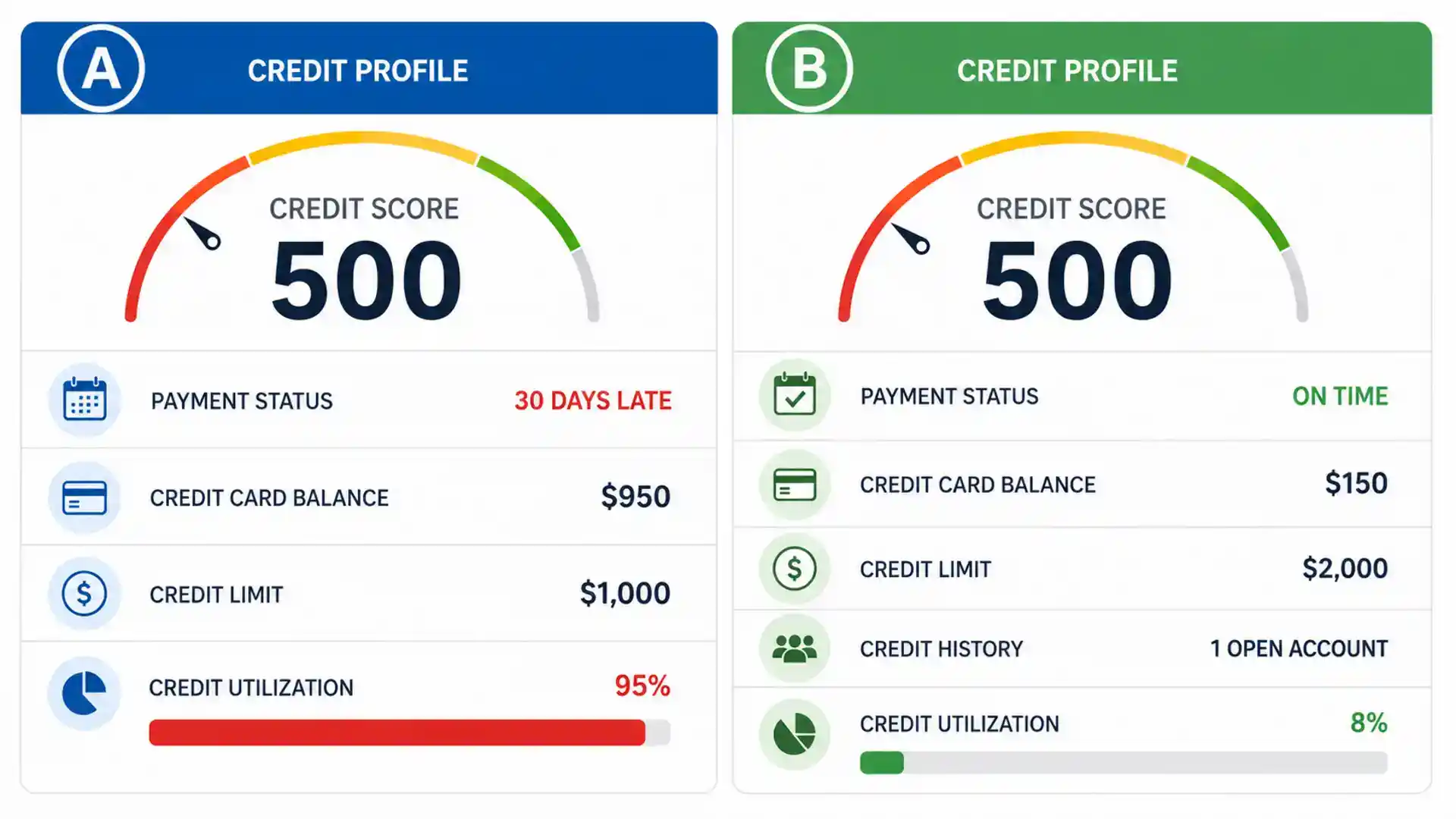
That may reflect recent late payments, collections, charge-offs, very high utilization, substantial credit card debt, a thin credit file mixed with negative marks, or several problems appearing at the same time.
That is why a 500 credit score is not usually addressed by one trick.
It is usually addressed by doing the right things in the right order.
That is the key.
Not just:
“Improve your credit.”
But:
Stop the active damage first.
Correct inaccurate information.
Deal with the most serious existing problems.
Rebuild what is missing.
Then protect the progress long enough for the credit profile to become more stable.
That is the realistic plan.
This guide explains what a 500 credit score may mean, how to review your credit report, where legitimate credit repair fits into the process, how credit card debt and utilization can affect the rebuilding plan, and when products such as a secured credit card or credit builder loan may be appropriate.
The goal is not to promise a miracle.
The goal is to help move a low, unstable credit profile toward a cleaner and more manageable one over time.
Key Takeaways
A credit score around 500 generally falls within a very low range, but its exact meaning depends on the scoring model, credit bureau data, and lender.
The first step is usually not opening new accounts immediately.
Start by reviewing your credit report, identifying active problems, and correcting inaccurate information.
Credit repair is most relevant when information on a credit report is inaccurate, incomplete, duplicated, or potentially fraudulent.
If high credit card debt and utilization are major problems, reducing revolving balances may be part of the rebuilding process.
A secured credit card or credit builder loan may help establish positive history after active problems are under better control, but neither product automatically fixes a low credit score.
A 500 credit score can improve, but the path is generally based on sustained stability rather than a few days of shortcuts.
Why You Can Trust This Guide
This guide is based on public consumer-credit guidance and official credit-reporting resources, including the Consumer Financial Protection Bureau, AnnualCreditReport.com, and IdentityTheft.gov.
It is written for ordinary consumers trying to understand a very low credit score under realistic conditions.
The practical goal is to separate emergency credit repair work from longer-term credit rebuilding.
Who This Article Is For
This guide may be useful if your credit score is around 500 and you want a realistic plan.
It may also help if you are not sure whether late payments, collections, credit card debt, high utilization, or credit report errors should be addressed first.
It is designed for readers who want a clear order of operations rather than vague advice about improving credit.
It may also help if you are considering a secured credit card or credit builder loan but are unsure whether opening a new account should actually be your next step.
Who This Article Is Not For
This article may not be enough on its own if you are dealing with active identity theft or fraud that is still unfolding.
It may also be insufficient for legal disputes over debts or collections, business-credit questions, highly specific mortgage-timing strategies, or bankruptcy decisions that require individualized legal advice.
In those situations, the framework here can still help organize the problem, but it should not replace more specific professional support.
How This Article Was Reviewed
This guide was reviewed against a simple standard.
Does it explain what should generally be stabilized first instead of only discussing long-term improvement?
Does it distinguish credit repair, credit report disputes, and credit rebuilding?
Does it explain where credit card debt and utilization fit into the process?
Does it explain when a secured credit card or credit builder loan may be useful?
Does it avoid unrealistic credit score promises?
Does it point readers toward authoritative public resources where appropriate?
That matters because a lot of “fix your credit fast” content is built around unrealistic promises rather than a practical sequence.
Disclaimer
This article is for educational purposes only.
It reflects general consumer-credit information and is not individualized legal, tax, lending, or financial advice.
Credit scores vary by scoring model, credit bureau, reported information, and reporting timing.
Different lenders may also respond differently to the same credit profile.
What a 500 Credit Score Usually Means
In CFPB consumer-credit trend data using FICO Score 8, scores below 580 are grouped as deep subprime.
A score around 500 therefore falls within that category in this specific scoring framework, although score ranges and lender interpretations can vary.
Source:
https://www.consumerfinance.gov/data-research/consumer-credit-trends/student-loans/borrower-risk-profiles/
That does not automatically mean you will be denied for every financial product.
But it may make some forms of credit harder to qualify for or more expensive, depending on the lender, product, and scoring model.
A low credit score is not a moral category.
It is a risk indicator produced from information in a credit file.
That distinction matters.
The more useful question is not:
“How bad is a 500 credit score?”
The better question is:
“What information in the credit report is causing the credit profile to look risky?”
What Kind of 500 Credit Score Do You Have?
Different low-credit profiles need different first moves.
If the main issue is recent missed payments, the priority is generally stopping active payment damage.
If credit cards are close to their limits but there are few other serious negative items, high utilization and credit card debt may be major factors.
If older charge-offs or collections remain but no new negative information is appearing, the profile may be dealing more with aging damage than fresh damage.
If the credit report contains very little history plus one or two negative items, the problem may be a fragile or thin credit file rather than simply one bad account.
If the score seems inconsistent with your known history, the first step should be reviewing the credit report for inaccurate or unfamiliar information.
The same 500 credit score can therefore come from very different underlying problems.
Step 1: Get the Real Damage List Before You Do Anything Else
Do not guess.
Start with your credit reports.
AnnualCreditReport.com provides access to official credit reports from the nationwide credit reporting companies.
https://www.annualcreditreport.com/
Review the reports carefully.
You need to know which accounts are late.
You need to know whether collections are present.
You need to know which accounts have been charged off.
You need to know whether credit card debt is creating very high utilization.
You need to know whether the same issue appears across multiple accounts.
You also need to know whether any information is inaccurate or unfamiliar.
This is the first major turning point.
Trying to improve a 500 credit score without reviewing the underlying credit report is like trying to solve a problem before identifying what caused it.
The credit score is the output.
The credit report contains much of the information behind that output.
Step 2: Separate Active Damage From Old Damage
Not all negative information creates the same type of problem.
A very low credit score often includes both active damage and older damage.
Active damage may include accounts that are continuing to become more delinquent, current missed payments, heavily utilized credit cards, new collections, or repeated new credit applications.
Old damage may include older late payments, older collections, or charge-offs that remain on the credit report but are no longer changing every month.
This distinction matters because active damage usually deserves attention first.
If new negative information is still appearing, trying to optimize the credit score around that continuing damage may be less useful.
The first goal is stabilization.
Step 3: Understand What Credit Repair Can and Cannot Do
Credit repair should begin with accuracy.
If information on a credit report is inaccurate, incomplete, duplicated, or potentially fraudulent, it may be appropriate to investigate and dispute it.
The CFPB explains that consumers can dispute errors on a credit report and generally recommends contacting both the credit reporting company and the company that furnished the information.
CFPB dispute guidance:
https://www.consumerfinance.gov/ask-cfpb/how-do-i-dispute-an-error-on-my-credit-report-en-314/
Examples of information worth reviewing include accounts that are not yours, incorrect balances, inaccurate duplicate reporting, late payments reported in error, or identity-theft accounts.
If the problem appears related to identity theft, use:
https://www.identitytheft.gov/
Credit repair should not mean disputing accurate negative information simply because it is damaging to a credit score.
Legitimate credit repair is primarily about correcting inaccurate or incomplete information.
Credit rebuilding is different.
Credit rebuilding is the longer process of developing a healthier credit profile when the reported information is accurate.
No legitimate credit repair process can guarantee a particular credit score increase or remove accurate negative information merely because it is unfavorable.
Step 4: Take Steps to Prevent New Late Payments
If the credit report is still showing new late payments, preventing additional problems should generally come before score optimization.
The CFPB consistently emphasizes paying on time as an important part of maintaining and rebuilding credit.
CFPB guidance:
https://www.consumerfinance.gov/ask-cfpb/how-do-i-get-and-keep-a-good-credit-score-en-318/
Additional guidance:
https://www.consumerfinance.gov/ask-cfpb/will-paying-off-my-credit-card-balance-every-month-improve-my-score-en-1293/
For a credit score around 500, this is an important damage-control priority.
Before trying to add new positive signals, ongoing negative activity generally needs attention.
That may mean setting automatic minimum payments where practical.
It may mean adjusting payment due dates when a creditor allows it and when doing so better matches cash flow.
It may mean reducing discretionary spending to protect required payments.
It may also mean contacting a creditor early if you know you may have difficulty making a payment.
Step 5: Review Credit Card Debt and Utilization
Credit card debt and credit utilization are related, but they are not the same thing.
Credit card debt is the amount you owe.
Utilization compares revolving balances with available revolving credit limits.
If several cards are near their limits, high utilization can make an already weak credit profile look more stressed.
The CFPB discusses the importance of avoiding getting too close to credit limits in its rebuilding guidance.
https://www.consumerfinance.gov/consumer-tools/credit-reports-and-scores/how-to-rebuild-your-credit/
If credit card debt is creating high utilization, reducing balances may improve the utilization side of the credit profile once lower balances are reported.
That does not mean you should choose every repayment decision based only on credit scoring.
Interest rates, minimum payments, delinquency risk, cash flow, and other financial priorities also matter.
A useful first step is to identify which credit cards are most heavily utilized and whether overall revolving balances are becoming difficult to manage.
If several cards are near their limits, stopping new charges and gradually reducing credit card debt may be more useful than opening additional accounts simply to create more available credit.
The goal is not to chase a specific credit score increase.
The goal is to reduce active revolving-credit stress where practical.
Step 6: Do Not Open Random New Accounts Just to Build Credit
A low credit score does not automatically mean you should immediately open several new accounts.
Sometimes a carefully chosen rebuilding product can help.
But random new accounts do not automatically fix a 500 credit score.
If the credit report still contains active missed payments, heavily utilized cards, unresolved collections, or inaccurate information, new credit may add complexity without addressing the main problem.
The CFPB also advises against applying for more credit than you need.
Source:
https://www.consumerfinance.gov/ask-cfpb/how-do-i-get-and-keep-a-good-credit-score-en-318/
That does not mean you should never use a secured credit card or credit builder loan.
It means new credit should not be used as a substitute for fixing the actual reasons the credit score is low.
Step 7: Consider a Secured Credit Card or Credit Builder Loan Only When Appropriate
Once active damage is under better control, a carefully chosen account may help establish additional positive credit history.
The CFPB notes that certain credit cards and loans can be used to start or rebuild credit history.
Source:
https://www.consumerfinance.gov/ask-cfpb/what-are-some-ways-to-start-or-rebuild-a-good-credit-history-en-2155/
A secured credit card is one possible option.
A secured credit card generally requires a cash security deposit that helps secure the account. Refund terms depend on the issuer and account terms.
If the issuer reports account activity to the nationwide credit reporting companies, responsible use may help add positive payment information to the credit file over time.
But a secured credit card is still a real credit account.
It can create problems if payments are missed or if new credit card debt becomes difficult to manage.
Before applying for a secured credit card, review fees, deposit requirements, reporting practices, interest rates, and account terms.
A credit builder loan is another possible rebuilding tool.
A credit builder loan is generally structured differently from a traditional loan because the borrowed funds may be held while the borrower makes scheduled payments.
Depending on the product and reporting practices, those payments may help establish payment history.
A credit builder loan should still fit your budget.
Opening one does not automatically improve a credit score.
Missed payments can work against the rebuilding goal.
The key question is not:
“Is a secured credit card better than a credit builder loan?”
The more useful question is:
“Do I need another positive reporting account, and can I manage it without creating new financial pressure?”
Sometimes the answer is yes.
Sometimes the best move is to stabilize existing accounts first.
Step 8: Understand What Time Can and Cannot Fix
Time matters.
But time does not erase negative information immediately.
The CFPB explains that many types of negative information can generally remain on a credit report for up to seven years, while some bankruptcy information may remain longer.
Source:
https://www.consumerfinance.gov/ask-cfpb/how-long-does-information-stay-on-my-credit-report-en-323/
Additional rebuilding guidance:
https://www.consumerfinance.gov/consumer-tools/credit-reports-and-scores/how-to-rebuild-your-credit/
That means a 500 credit score is not usually addressed by waiting passively.
But time can matter in important ways.
Older negative information may eventually become less recent.
A longer period without new missed payments can create a different recent pattern.
Credit card debt may become more manageable if balances are gradually reduced.
A secured credit card or credit builder loan, when appropriate and managed responsibly, may help add positive history.
The realistic plan is not:
“Do one thing and wait.”
It is:
Stop new damage.
Correct inaccurate information.
Manage credit card debt and utilization.
Add positive credit history only when appropriate.
Then give the credit profile time to reflect a more stable pattern.
What Should You Do in the First 30 Days?
The first month should generally focus on control rather than optimization.
Get your credit reports.
Identify the most serious active problems.
Separate current damage from older negative information.
Investigate inaccurate credit report entries.
Take steps to prevent new late payments where practical.
Review credit card debt and utilization.
Avoid applying for several new credit products in a rush.
Do not assume a secured credit card or credit builder loan should be opened before you understand why the credit score is low.
The first month is about diagnosis and stabilization.
It is not a promise that a particular credit score increase will occur within 30 days.
What Should You Do in the Next 90 Days?
After the most urgent problems are under better control, the next few months can focus on stability.
Avoid new late payments where practical.
Reduce credit card debt where practical.
Keep revolving balances more manageable.
Follow up on legitimate credit report disputes.
Avoid unnecessary credit applications.
If the credit file is thin and active damage has stabilized, evaluate whether one carefully chosen secured credit card or credit builder loan is appropriate.
Watch statements and due dates consistently.
The goal is not to force a specific credit score within 90 days.
The goal is to make the credit profile less chaotic and more stable.
What a Realistic 12-Month Improvement Path Looks Like
A realistic year of rebuilding is usually less dramatic than fast-credit marketing suggests.
But it can be more meaningful.
A healthier pattern may include no new derogatory information, lower credit card debt, more manageable utilization, better on-time payment behavior, aging of existing negative information, and more consistent account management.
If a secured credit card or credit builder loan was added, the account should remain affordable and manageable.
If credit repair involved correcting inaccurate information, confirm that legitimate corrections are reflected on the relevant credit reports.
None of these actions guarantees a specific credit score.
Credit scores depend on the scoring model and the information in the credit file.
The goal is to build a profile that is more stable and easier for lenders and scoring models to evaluate.
What Usually Wastes Time When Your Credit Score Is Around 500?
Obsessing over exact credit score point forecasts usually does not identify the underlying problem.
Applying for several credit cards at once does not replace fixing active damage.
Opening a secured credit card while existing accounts are still becoming late may add complexity without solving the main issue.
Taking out a credit builder loan that does not fit your budget can create a new payment obligation at the wrong time.
Focusing on card rewards instead of credit repair and stabilization usually misses the bigger problem.
Ignoring active late payments because the score is already low allows fresh damage to continue.
Assuming one new account will rescue a damaged credit report creates unrealistic expectations.
A 500 credit score usually needs less hype and more order.
What Usually Makes Recovery Slower?
New late payments, new collections, persistently high revolving balances, unnecessary credit applications, unresolved reporting errors, and unaffordable new credit products can all make rebuilding more difficult.
Official Resources Worth Checking First
Official credit reports:
https://www.annualcreditreport.com/
CFPB credit report dispute guidance:
https://www.consumerfinance.gov/ask-cfpb/how-do-i-dispute-an-error-on-my-credit-report-en-314/
CFPB rebuilding guidance:
https://www.consumerfinance.gov/consumer-tools/credit-reports-and-scores/how-to-rebuild-your-credit/
CFPB guidance on starting or rebuilding credit:
https://www.consumerfinance.gov/ask-cfpb/what-are-some-ways-to-start-or-rebuild-a-good-credit-history-en-2155/
CFPB guidance on getting and keeping a good credit score:
https://www.consumerfinance.gov/ask-cfpb/how-do-i-get-and-keep-a-good-credit-score-en-318/
CFPB guidance on paying credit card balances:
https://www.consumerfinance.gov/ask-cfpb/will-paying-off-my-credit-card-balance-every-month-improve-my-score-en-1293/
Identity theft recovery:
https://www.identitytheft.gov/
A 500 Credit Score Recovery Check
I know what is actively damaging my credit profile right now.
I checked my credit reports.
I know whether any information appears inaccurate or unfamiliar.
I understand that legitimate credit repair focuses on correcting inaccurate or incomplete information rather than removing accurate negative history.
I have taken steps to reduce the risk of new late payments where practical.
I know whether credit card debt and high utilization are major problems.
I am not opening random new accounts simply because my credit score is low.
I understand what a secured credit card is and when it may be appropriate.
I understand what a credit builder loan is and when it may be appropriate.
I know that neither a secured credit card nor a credit builder loan guarantees a particular credit score increase.
I have a realistic stability plan rather than a fast-credit shortcut.
If you cannot confirm most of these points yet, you probably do not need another trick.
You need a clearer order of operations.
FAQ
Can a 500 Credit Score Be Fixed?
A 500 credit score can improve.
The process is generally about stopping fresh damage, correcting inaccurate credit report information, reducing active financial stress, and building a cleaner pattern over time.
The exact outcome depends on the credit file and scoring model.
How Long Does It Take to Improve a 500 Credit Score?
There is no single timetable.
The answer depends on what is driving the score down.
Recent late payments, collections, high utilization, substantial credit card debt, and inaccurate credit report information can create different rebuilding paths.
The goal should be sustained stability rather than a promised score increase within a fixed period.
What Is the Difference Between Credit Repair and Credit Rebuilding?
Credit repair is primarily a correction process when information on a credit report is inaccurate, incomplete, duplicated, or potentially fraudulent.
Credit rebuilding is the broader process of developing a healthier credit profile over time when the reported information is accurate.
Credit repair should not mean disputing accurate negative information simply because it is unfavorable.
Should I Get a Secured Credit Card With a 500 Credit Score?
Sometimes.
A secured credit card may be useful after active damage is under better control and when the account fits your budget.
A secured credit card generally requires a cash security deposit, and refund terms depend on the issuer and account terms.
Before applying, review fees, deposit requirements, interest rates, reporting practices, and account terms.
Do not assume that opening a secured credit card automatically improves a credit score.
What Is a Credit Builder Loan?
A credit builder loan is generally designed to help consumers establish payment history.
The funds may be held while scheduled payments are made, depending on the structure of the product.
Depending on the product and reporting practices, those payments may help establish payment history.
A credit builder loan can create a new payment obligation, so affordability matters.
Opening one does not automatically improve a credit score.
Missed payments can work against the rebuilding goal.
Is a Secured Credit Card Better Than a Credit Builder Loan?
Neither option is automatically better for everyone.
A secured credit card is a revolving credit account.
A credit builder loan is an installment-style rebuilding product.
The more important question is which type of account, if any, fits your credit profile, budget, and ability to make every required payment.
Do I need another positive reporting account, and can I manage it without creating new financial pressure?
That is the more useful decision point.
Will Paying Down Credit Card Debt Help a 500 Credit Score?
It may help when high revolving balances and utilization are important problems in the credit profile.
Reducing credit card debt can lower utilization once updated balances are reported, assuming available limits remain unchanged.
The exact credit score effect depends on the rest of the credit file and the scoring model.
Should I Open Several New Accounts to Rebuild Faster?
Usually, opening several accounts in a rush is not a sound substitute for addressing the underlying problems.
If the credit report still shows active missed payments, high credit card debt, collections, or errors, those issues generally deserve attention first.
What Should I Do First if My Credit Score Is Around 500?
Start with your credit reports.
Identify what is actively damaging the credit profile.
Investigate inaccurate information.
Take steps to prevent new late payments where practical.
Review credit card debt and utilization.
Then decide whether additional credit-building products are actually necessary.
A 500 Credit Score Is Not Fixed by Hope. It Is Fixed by Order.
That is the biggest lesson in this topic.
You do not address a 500 credit score by doing ten random things.
You address it by doing the right things in the right order.
Stop active damage.
Review the credit report.
Correct inaccurate information through legitimate credit repair processes.
Reduce visible revolving-credit stress and manage credit card debt where practical.
Consider a secured credit card or credit builder loan only when another positive reporting account is actually appropriate.
Protect the credit profile long enough for a more stable pattern to develop.
That is not glamorous.
But it is more realistic than relying on fast-credit promises.
A very low credit score is a problem to diagnose and manage, not a permanent identity.
The goal is not a guaranteed number.
The goal is a credit profile that becomes more accurate, more stable, and more manageable over time.