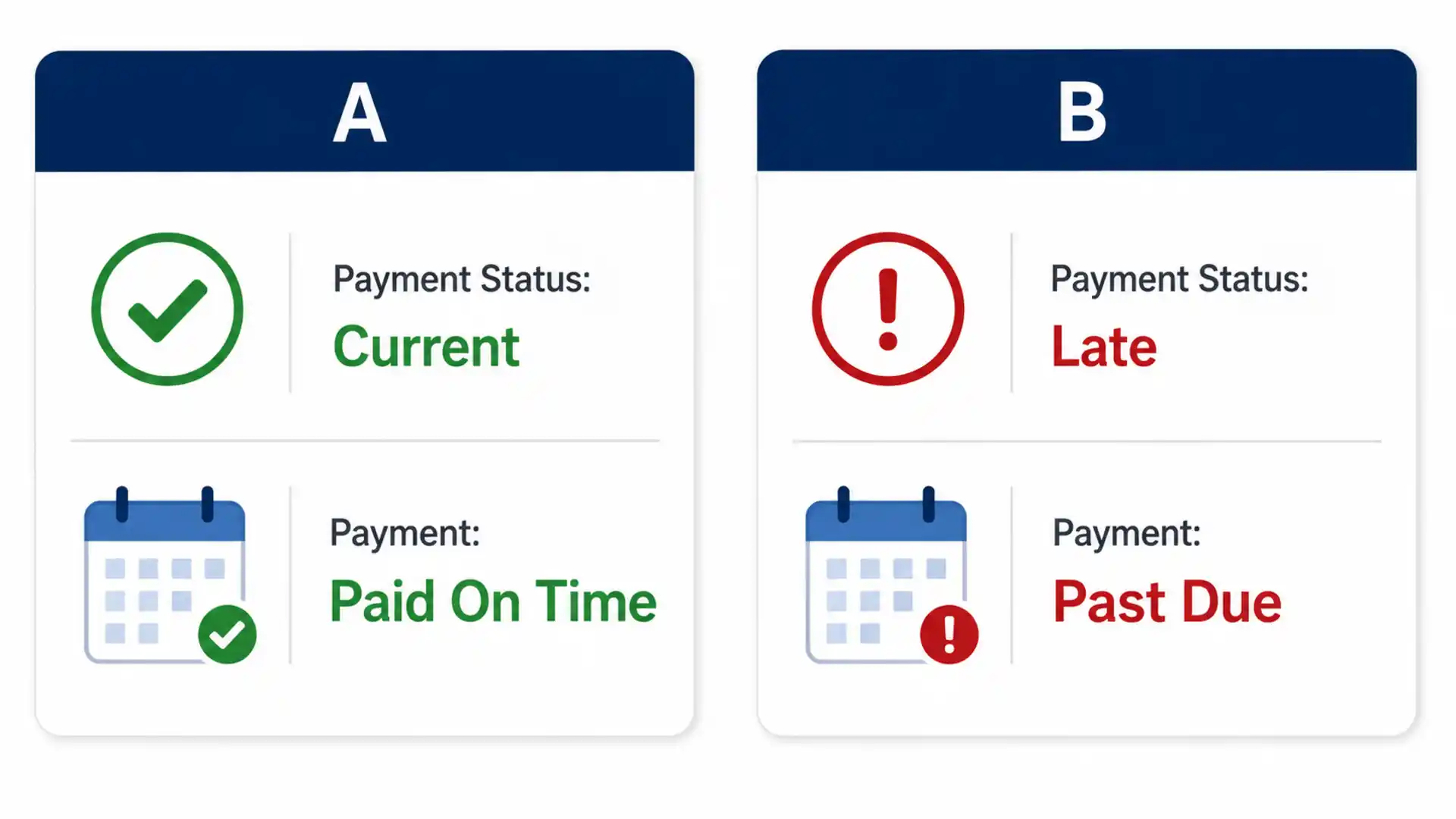
How Late Payments Affect Your Credit Score
Late payments matter because they can change the information shown in your credit report and influence how a credit score reflects recent payment behavior.
But one of the biggest mistakes people make is treating every late payment as if it works the same way.
It does not.
A payment that is one day late is usually not the same thing as a payment that becomes 30 days late.
A payment that is 30 days late is not the same thing as 60 days late.
And 60 days late is not the same thing as a deeply delinquent account that continues aging.
That difference matters because the phrase late payment can describe several very different stages.
A payment may simply be past the due date.
It may be late enough to trigger a fee.
It may be late enough to become a reported delinquency.
Or it may remain unpaid long enough to create a much more serious credit report problem.
A lot of panic comes from not knowing which stage you are actually in.
People sometimes imagine credit score damage happening all at once.
Usually, it does not work that way.
On the other hand, some people assume a late payment is harmless because they plan to fix it soon.
That can also become expensive because what matters is not only whether the bill was late, but how far the delinquency progressed before it was resolved.
High credit card debt can make the situation more difficult if several accounts are already close to their limits and cash flow is tight.
Credit monitoring may help you notice reported changes, but it cannot prevent a missed payment or directly repair a credit score.
This guide explains what late payments can do to a credit score, why 30 days late is an important threshold, how long negative payment history can remain on a credit report, where legitimate credit repair fits when information is inaccurate, and what to do after a missed payment.
The most useful idea to keep in mind from the start is this:
A late payment can hurt your credit score, but the size and duration of the impact usually depend on how serious the delinquency becomes, whether it is reported, and what happens afterward.
Key Takeaways
A payment that is a few days late is usually not the same thing as a 30-day late delinquency reported on a credit report.
Late-payment problems can become more serious once an account reaches a reportable delinquency stage.
One late payment can matter, but repeated late payments can create a much stronger pattern of instability.
Negative payment history can generally remain on a credit report for up to seven years.
Credit repair is relevant when late-payment information is inaccurate, duplicated, incomplete, or connected to fraud. It is not a legitimate method for removing accurate negative information simply because it hurts a credit score.
Credit card debt can make recovery harder when high balances and payment pressure contribute to additional missed payments.
Credit monitoring can help identify reported changes or unfamiliar activity, but it does not correct inaccurate information or directly improve a credit score.
The practical priority is usually to understand the stage, act early, prevent the delinquency from progressing, and reduce the risk of another missed payment.
Why You Can Trust This Guide
This guide is based on public consumer-credit and credit-reporting guidance, including official resources from the Consumer Financial Protection Bureau and AnnualCreditReport.com.
It is written for ordinary readers trying to understand what a late payment actually does to a credit profile rather than simply reacting to the phrase late payment.
The practical goal is to distinguish between an account-level payment problem, a reported credit report problem, and a longer-term rebuilding problem.
Who This Article Is For
This guide may be useful if you recently missed a payment and want to understand what it could do to your credit score.
It can also help if you are worried that a late payment has already been reported.
You may find it useful if you want to understand why 30 days late matters.
It can help if you are trying to recover from one late payment without allowing it to become a pattern.
It is also relevant if you are carrying substantial credit card debt and are concerned that payment pressure could create additional delinquencies.
If you use credit monitoring, this guide can help you understand why an alert should usually lead you back to the underlying credit report and account information.
Who This Article Is Not For
This article may not be enough on its own if you are dealing with active collections or charge-offs that are already much further along.
It may also be insufficient for identity theft, fraud, a legal billing dispute, a servicing problem requiring case-specific escalation, severe multi-account debt problems, or bankruptcy questions.
In those situations, the timeline described here can still help organize the issue, but it should not replace more specific support.
How This Article Was Reviewed
This guide was reviewed against a simple standard.
Does it clearly distinguish between being just past due and being reportably delinquent?
Does it explain how late-payment harm can grow over time instead of pretending everything happens instantly?
Does it explain the relationship between a late payment, a credit report, and a credit score?
Does it distinguish legitimate credit repair from attempts to remove accurate negative information?
Does it give practical next steps instead of only describing damage?
Does it point readers toward authoritative public resources where appropriate?
That standard matters because a lot of late-payment content is either too vague, too frightening, or too simplistic to help.
Disclaimer
This article is for educational purposes only.
It reflects general consumer-credit information and is not individualized legal, lending, tax, or financial advice.
Credit scoring models and lenders may treat delinquencies differently.
Card issuers also have their own account rules, reporting practices, fees, and hardship policies.
A Better Baseline Before You Panic
Before getting into credit score damage, it helps to clear up several common misunderstandings.
First, being past the due date is not always the same thing as being 30 days late on your credit report.
Second, a late payment can hurt more than people expect, but the full credit-reporting impact usually does not happen the moment the due date passes.
Third, one late payment is a problem, but a pattern of late payments can be much more serious.
Fourth, credit monitoring and a credit report are not the same thing.
Credit monitoring may alert you to a change.
The credit report contains the underlying reported account information that helps explain what changed.
That is why the timeline matters so much.
What Does a Late Payment Actually Mean?
When people say late payment, they often blend together several different events.
The due date may have passed.
The issuer may have charged a late fee.
The account may now be delinquent.
The delinquency may have been reported to the nationwide credit reporting companies.
The credit score may have reacted to the newly reported information.
Those events are related, but they are not identical.
A late fee can appear before a reported delinquency does.
A payment can be several days late without yet becoming the type of reported late mark that people are usually most concerned about.
But if the delinquency continues aging, the problem can become much more serious.
That is why a better question is not simply:
“Was I late?”
The better question is:
“How late did the account become before it was brought current?”
The Timeline That Matters Most
The CFPB explains that a credit card company generally cannot treat a payment as late if it is received by 5 p.m. on the due date in the time zone stated on the billing statement.
Source:
https://www.consumerfinance.gov/ask-cfpb/when-is-my-credit-card-payment-considered-to-be-late-en-79/
That is the first anchor.
After the due date passes, the timeline becomes increasingly important.
1 to 29 Days Late
At this stage, a payment may trigger a late fee, additional interest, or an internal account problem depending on the issuer and account terms.
It is important not to assume that every payment a few days late is already a 30-day delinquency on a credit report.
30 Days Late
Around this stage, a delinquency may become reportable to the credit reporting companies.
That can turn a short-term account problem into a credit report problem.
60 Days Late
A continuing delinquency becomes more serious.
The credit profile can now reflect a deeper payment problem rather than one short delay.
90 Days Late or More
A deeply delinquent account can represent a much more serious payment-history problem and may eventually move toward additional collection or account-management actions depending on the creditor and circumstances.
This timeline is simplified.
But the core point is important.
Late-payment harm can become much more serious when the problem moves from being past due to becoming a reported delinquency.
What Stage Are You In Right Now?
If the due date just passed, you may still be dealing primarily with an early past-due account.
If the account is approaching 30 days late, the risk of a reported delinquency becomes more important.
If the account is already 30 days or more late, reviewing the account and your credit report becomes more important.
If several payments have been missed, the issue may no longer be one isolated mistake.
It may be becoming a pattern.
How Late Payments Affect Your Credit Score in Practice
Credit scores are calculated from information in your credit file using scoring models.
Payment history is one of the important types of information used in many credit scoring systems.
That is why a reported late payment can matter.
A late payment may indicate payment instability.
It may indicate an increased risk of future delinquency.
It may also show that an account was not managed according to the agreed payment schedule.
The score impact is not about embarrassment or punishment.
It is about how a scoring model evaluates information in the credit report.
A credit profile with a long history of on-time payments looks different from a profile containing a recent reported late payment.
A profile with one older late payment also looks different from a profile containing several recent late payments.
So the most useful question is usually not:
“How many points will I lose?”
The answer varies too much by credit file and scoring model.
The better question is:
“How serious is this delinquency, how recent is it, and what else is happening in the credit report?”
Why 30 Days Late Matters So Much
This is the threshold many consumers need to understand most clearly.
A payment that is a few days late can still be expensive and stressful.
But a payment that becomes 30 days late can change the type of problem you are dealing with.
Around this stage, a delinquency may become reportable to the credit reporting companies.
Once a delinquency appears on a credit report, it can influence a credit score depending on the scoring model and the rest of the credit file.
This is why people sometimes say:
“I only missed one payment. Why did it matter so much?”
“I thought paying later would erase the problem.”
“I did not realize 30 days made such a difference.”
Those reactions are understandable because many consumers do not realize that being a few days past due and having a reported 30-day delinquency are different stages.
Does One Late Payment Ruin Your Credit Score?
Usually, one late payment does not permanently ruin a credit profile.
But it can still matter.
The effect can depend on how strong the credit file was before the late payment.
It can depend on whether the late payment was actually reported.
It can depend on how recent the delinquency is.
It can depend on whether another late payment follows.
It can also depend on credit card debt, utilization, collections, inquiries, and other information already in the credit report.
A late mark can stand out sharply on a credit profile that previously had very little negative information.
On a file that already contains several negative items, the same late payment appears in a different context.
In either situation, the practical response is not panic.
It is preventing one late payment from becoming a repeated pattern.
How Much Could a Credit Score Drop?
There is no universal point loss for one late payment.
Older FICO educational examples have shown that the same late-payment event can affect different credit profiles differently.
For example, historical FICO examples estimated that a 30-day late payment could have a larger point impact on some cleaner, higher-scoring files than on files that already contained more credit risk.
More recent FICO educational material continues to emphasize the broader point that credit score effects depend on the full credit profile.
Source:
https://www.myfico.com/credit-education/faq/affects-of-credit-actions
Do not treat historical point examples as a prediction for your own credit score.
The exact result depends on the scoring model and the information in the credit file.
Why Repeated Late Payments Are More Serious
One late payment can indicate that something went wrong.
Repeated late payments can indicate that something keeps going wrong.
That difference matters.
A pattern of late payments can make a credit profile appear less stable than one isolated event.
This is also where credit card debt can become especially important.
If high credit card debt leaves little room in the monthly budget, one missed payment may be followed by another.
That is why the problem is not always simply remembering a due date.
Sometimes the deeper problem is cash flow.
If substantial credit card debt is making required payments difficult, preventing another delinquency may require broader debt and budget management rather than only setting another reminder.
How Long Does a Late Payment Stay on Your Credit Report?
The CFPB explains that negative information about credit account payment history can generally remain on credit reports for up to seven years.
Source:
https://www.consumerfinance.gov/ask-cfpb/how-long-does-information-stay-on-my-credit-report-en-323/
That does not mean a late payment affects a credit score with exactly the same strength throughout the entire period.
But it does mean that a serious reported delinquency can remain visible much longer than the month in which the payment was missed.
That is why allowing a short-term financial problem to become a reported delinquency can have longer-term consequences.
Can Credit Repair Remove a Late Payment?
This depends on whether the information is accurate.
Credit repair should begin with accuracy, not with the assumption that every negative item can be removed.
The CFPB explains that accurate negative information generally cannot be removed from a credit report merely because the consumer dislikes it or because it affects a credit score.
Source:
https://www.consumerfinance.gov/ask-cfpb/is-it-possible-to-remove-accurate-negative-information-from-my-credit-report-en-1249/
If the reported late payment is accurate, legitimate credit repair should not mean disputing it simply because it is damaging.
If the information is inaccurate, duplicated, incomplete, or connected to fraud or identity theft, the situation is different.
Consumers have the right to dispute inaccurate credit report information.
The CFPB explains that correcting an error generally involves contacting both the credit reporting company and the company that furnished the information.
Source:
https://www.consumerfinance.gov/ask-cfpb/how-do-i-dispute-an-error-on-my-credit-report-en-314/
The distinction is important.
Accurate negative information is generally not removable simply because it is unfavorable.
Inaccurate information should be investigated and disputed.
No legitimate credit repair process can guarantee the removal of accurate late-payment information or promise a specific credit score increase.
What Should You Do Right Away If You Missed a Payment?
If you already missed a payment, acting early is generally more useful than freezing or ignoring the account.
The CFPB states that consumers who cannot pay their credit card bills should act quickly and contact their credit card company.
Source:
https://www.consumerfinance.gov/ask-cfpb/what-should-i-do-if-i-cant-pay-my-credit-card-bills-en-1697/
Start by logging in and checking the account.
Confirm exactly how late the payment is.
Check the minimum payment due.
If you can make the required payment, consider doing so as soon as practical.
Check whether a late fee has been charged.
Review whether autopay failed, a bank transfer was rejected, or the date was simply missed.
Then look at your next due date.
Do not focus only on the missed payment while allowing another account to become late.
What to Do This Week
Once the immediate situation is understood, review the rest of the payment system.
Confirm whether the account is now current or still short of the required payment.
Check whether another credit card or bill is approaching its due date.
Review statement dates and due dates across active accounts.
If credit card debt is consuming a large share of available cash flow, identify that as a broader problem rather than treating the late payment as an isolated calendar mistake.
Review the system that caused the missed payment.
That could include autopay settings.
It could involve reminders.
It could involve insufficient cash in the linked bank account.
It could involve having too many due dates clustered together.
Avoid unnecessary new credit applications while you are still trying to understand and stabilize the situation.
What If You Know You Cannot Pay?
Do not simply ignore the account.
The CFPB advises consumers who cannot pay their credit card bills to contact the credit card company promptly.
Source:
https://www.consumerfinance.gov/ask-cfpb/what-should-i-do-if-i-cant-pay-my-credit-card-bills-en-1697/
Additional CFPB guidance:
https://www.consumerfinance.gov/language/cfpb-in-english/act-fast-if-you-cant-pay-your-credit-cards/
Depending on the issuer and circumstances, there may be options for consumers facing financial difficulty.
Availability and terms vary.
If credit card debt is the underlying reason payments are becoming difficult, recognize that the problem may require more than one late-payment fix.
The goal should be to prevent a temporary payment problem from turning into repeated delinquency where practical.
How Credit Monitoring Fits After a Late Payment
Credit monitoring can be useful after a missed payment, but its role should be understood correctly.
Credit monitoring may alert you when account information changes.
It may notify you about a new inquiry.
It may alert you to an unfamiliar account.
It may also show changes related to reported balances or account status.
But credit monitoring does not prevent a late payment.
It does not pay credit card debt.
It does not correct inaccurate credit report information by itself.
And credit monitoring does not directly improve a credit score.
If a credit monitoring alert shows a change you do not recognize, review the underlying credit report and account information.
The credit report is the more important document for understanding what was actually reported.
What Not to Do After a Late Payment
Do Not Ignore the Account
Avoiding the account can allow the delinquency to continue aging.
Do Not Assume the Credit Score Is Already Ruined
Even when a late payment has been reported, preventing additional late payments still matters.
Do Not Panic-Apply for New Credit
Opening additional accounts does not remove a late payment from a credit report.
New applications can also create additional inquiries.
Do Not Keep Increasing Credit Card Debt as if Nothing Happened
If the payment problem was caused by financial pressure, adding more credit card debt may make future required payments harder to manage.
Do Not Assume Credit Repair Can Remove Accurate Information
Legitimate credit repair is not a process for deleting accurate negative information simply because it lowers a credit score.
Do Not Rely Only on Credit Monitoring Alerts
Credit monitoring can help identify changes.
It should not replace reviewing the credit report and the underlying account.
Do Not Rely Only on Memory
If one missed payment happened because of a system problem, improve the system.
That may involve reminders.
It may involve calendar alerts.
It may involve reviewing autopay settings.
It may involve checking accounts weekly.
It may involve creating more cash-flow margin before payment due dates.
What Usually Makes Late-Payment Damage Worse?
Ignoring the account can allow the delinquency to progress.
Missing another payment can turn one event into a pattern.
Assuming that paying later automatically erases a reported delinquency can create unrealistic expectations.
Growing credit card debt can increase pressure on future payments.
Panic-applying for additional credit can add complexity without addressing the original problem.
Ignoring inaccurate credit report information can leave legitimate errors unresolved.
How to Rebuild After a Late Payment
Recovery is usually less about undoing accurate late-payment history and more about changing the pattern around it.
That generally means avoiding new late payments where practical.
It can mean reducing credit card debt where possible.
It can mean keeping revolving balances more manageable.
It can mean improving account management.
It can mean making fewer reactive credit decisions.
It can also mean reviewing your credit report periodically to make sure reported information is accurate.
The CFPB provides broader guidance on rebuilding credit.
Source:
https://www.consumerfinance.gov/consumer-tools/credit-reports-and-scores/how-to-rebuild-your-credit/
A late payment may become less central to the overall credit profile when the behavior that follows it becomes more stable.
That does not guarantee a specific credit score increase.
The exact outcome depends on the credit file and scoring model.
Official Resources Worth Reviewing First
Official credit reports:
https://www.annualcreditreport.com/
CFPB guidance on how long negative information can remain:
https://www.consumerfinance.gov/ask-cfpb/how-long-does-information-stay-on-my-credit-report-en-323/
CFPB credit report dispute guidance:
https://www.consumerfinance.gov/ask-cfpb/how-do-i-dispute-an-error-on-my-credit-report-en-314/
CFPB guidance if you cannot pay a credit card bill:
https://www.consumerfinance.gov/ask-cfpb/what-should-i-do-if-i-cant-pay-my-credit-card-bills-en-1697/
CFPB rebuilding guidance:
https://www.consumerfinance.gov/consumer-tools/credit-reports-and-scores/how-to-rebuild-your-credit/
Identity theft recovery:
https://www.identitytheft.gov/
A Late-Payment Reality Check
I know whether the account is simply past due or already 30 days or more late.
I checked whether the delinquency appears on my credit report.
I know whether the required payment has been made or is still outstanding.
I know whether this was a one-time mistake or part of a broader cash-flow problem.
I know whether high credit card debt is making future payments harder to manage.
I understand that credit repair is appropriate for inaccurate information, not for automatically removing accurate negative information.
I understand that credit monitoring can help me notice changes but does not directly improve my credit score.
I am focused on preventing another late payment where practical.
If several of these points are still unclear, the most useful next step is usually to understand the stage and the underlying account information before making additional credit decisions.
FAQ
Do Late Payments Hurt Your Credit Score Immediately?
Not always in the same way.
A payment that is a few days late is usually not the same thing as a reported 30-day delinquency.
The exact credit score effect depends on whether the delinquency is reported, the scoring model, and the rest of the credit file.
Why Does 30 Days Late Matter So Much?
Around that stage, a late payment may become reportable to the credit reporting companies.
That can turn an account-level payment issue into a credit report issue.
How Long Can a Late Payment Stay on My Credit Report?
Negative payment-history information can generally remain on a credit report for up to seven years according to CFPB guidance.
That does not mean the credit score effect remains identical for the entire period.
Can Credit Repair Remove an Accurate Late Payment?
Generally, accurate negative information cannot be removed simply because it hurts a credit score.
Credit repair is most relevant when credit report information is inaccurate, incomplete, duplicated, or potentially fraudulent.
Can I Dispute an Incorrect Late Payment?
Yes.
If a late payment appears to be inaccurate, review the account records and follow the appropriate credit report dispute process.
CFPB guidance:
https://www.consumerfinance.gov/ask-cfpb/how-do-i-dispute-an-error-on-my-credit-report-en-314/
Does Credit Monitoring Improve My Credit Score?
No.
Credit monitoring is a tracking and awareness tool.
It may help you notice changes in reported balances, account status, inquiries, or unfamiliar activity.
Credit monitoring does not reduce credit card debt, correct inaccurate information by itself, or directly improve a credit score.
Will Paying Credit Card Debt Help After a Late Payment?
It may help when high revolving balances and utilization are also affecting the credit profile.
Reducing credit card debt does not erase an accurate reported late payment.
However, lower balances may improve another part of the credit profile once updated information is reported.
What Should I Do First After a Late Payment?
Check the account.
Confirm how late the payment is.
Determine whether the required payment is still outstanding.
Review the next due date.
If the account is already reportably delinquent, review the relevant credit report.
Then focus on preventing the problem from progressing where practical.
If I Pay It Now, Will My Credit Score Go Back Immediately?
Not necessarily.
Paying may stop the account from becoming more delinquent, but an accurate reported late payment can remain in the credit report.
The exact credit score response depends on the scoring model and the rest of the credit file.
Does One Late Payment Hurt More on a Clean Credit File?
It can have a different effect depending on the rest of the credit profile.
Credit score changes vary by scoring model and individual credit file, so there is no universal point loss for one late payment.
Should I Apply for Another Credit Card After a Late Payment?
Opening another card does not remove the late payment.
If the existing problem is unstable payments, high credit card debt, or cash-flow pressure, adding another account may not address the underlying issue.
The Most Important Question Is Not “Was I Late?”
The more useful question is:
“How late did this become before I fixed it, and what do I need to do now to keep it from getting worse?”
That question is more useful than focusing only on a credit score number.
A late payment can hurt.
But the size and duration of the impact usually depend on whether the problem stayed at an early past-due stage, became a reported delinquency, or developed into a repeating pattern.
The practical response is to understand the stage.
Review the account.
Check the credit report when appropriate.
Correct inaccurate information through legitimate credit repair processes.
Manage credit card debt and cash flow where practical.
Use credit monitoring for awareness rather than treating it as a credit-score improvement tool.
Contact the issuer when needed.
And focus on preventing another late payment from turning one mistake into a longer-term pattern.
The goal is not a guaranteed credit score increase.
The goal is a more accurate, stable, and manageable credit profile over time.