How Often Should You Replace Your Toothbrush? Dentist Guidelines, Replacement Signs, and Dental Care Costs
Most adults should replace a toothbrush about every three to four months, or sooner when the bristles become visibly frayed, matted, bent, or worn. Electric toothbrush users should replace the brush head according to wear and the manufacturer’s instructions. The calendar is a useful reminder, but visible bristle condition is an equally important toothbrush replacement sign.
Medical information notice: This article provides general educational information and does not replace individualized examination, diagnosis, or treatment by a licensed dentist or other qualified healthcare professional.
Key Takeaways
Replace most manual toothbrushes about every three to four months, and sooner if the bristles become matted or frayed.
Visible wear matters. NIDCR advises replacing a toothbrush when the bristles become worn.
Electric toothbrush heads also wear out. Follow the instructions for your particular model; for example, Philips currently recommends three months of normal twice-daily use for relevant Sonicare heads.
A fresh toothbrush is only one part of preventive dental care. Brushing technique, interdental cleaning, diet, and appropriate dental checkups still matter.
Dental care costs should be separated into predictable home-care expenses, preventive professional care, and treatment expenses rather than treating toothbrush replacement as a guarantee against future dental bills.
This guide answers the practical questions behind toothbrush replacement: when to change a brush, which signs justify replacing it early, what to do with an electric toothbrush head, how illness and storage affect the decision, and how to budget replacement costs without buying unnecessary products.
How Was This Guide Researched and Reviewed?
This guide uses current first-party guidance from the American Dental Association (ADA), National Institute of Dental and Craniofacial Research (NIDCR), and Centers for Disease Control and Prevention (CDC). Manufacturer documentation is used only when a recommendation depends on a specific electric toothbrush system.
The ADA currently recommends replacing toothbrushes approximately every three to four months or sooner when bristles become matted or frayed. NIDCR uses a practical wear-based rule: replace the toothbrush when its bristles become worn.
This article does not claim hands-on product testing, does not rank toothbrush brands, and does not assume that a more expensive toothbrush produces better health outcomes.
Evidence standard: Medical and oral-health statements are based on authoritative professional or government guidance. Cost examples are explicitly labeled as hypothetical calculations rather than current market-price claims.
How Often Should You Replace Your Toothbrush?
The best general rule is every three to four months, with earlier replacement whenever visible wear develops.
The ADA states that toothbrushes should be replaced approximately every three to four months and more often if the bristles become matted or frayed. It also notes that toothbrush effectiveness decreases as bristles wear.
NIDCR reinforces the condition-based side of the rule by advising people to replace a toothbrush when the bristles become worn.
The most practical Dentist Guidelines framework is therefore not “90 days no matter what.” It is:
Time + Wear
Toothbrush ConditionRecommended Action: About 3–4 months old; Replace
Toothbrush ConditionRecommended Action: Bristles frayed early; Replace sooner
Toothbrush ConditionRecommended Action: Bristles matted or badly bent; Replace sooner
Toothbrush ConditionRecommended Action: Brush physically damaged; Replace
Toothbrush ConditionRecommended Action: Electric head reaches its model-specific interval; Follow manufacturer guidance
Toothbrush ConditionRecommended Action: Electric head shows early wear; Replace sooner
Toothbrush ConditionRecommended Action: Brush still looks acceptable near four months; Follow the ADA replacement interval
A toothbrush does not suddenly become ineffective on one exact day. Replacement is maintenance, not an emergency countdown.
What Are the Most Important Toothbrush Replacement Signs?
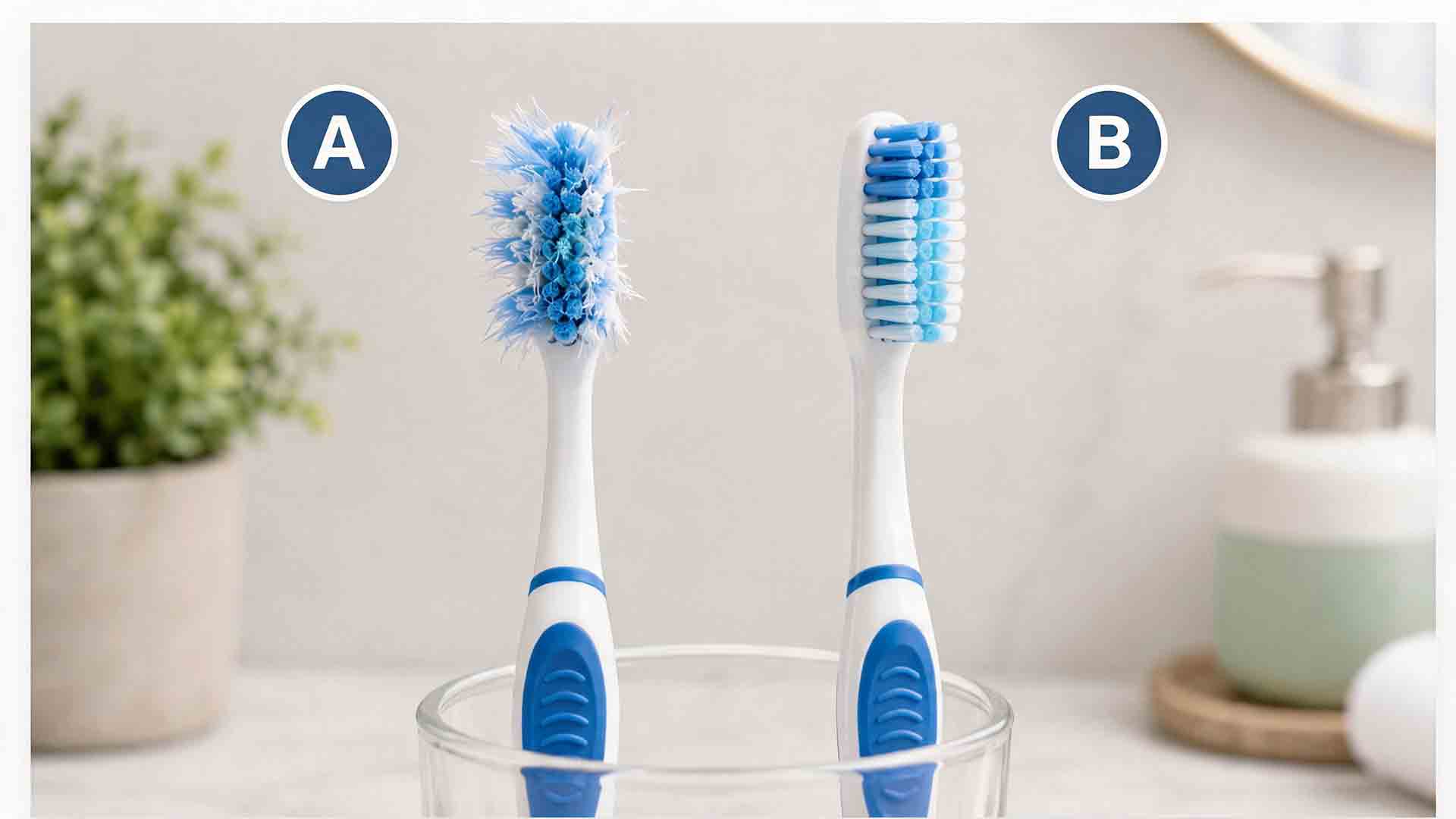
Fraying, matting, bending, spreading, and loss of the original bristle shape are the most useful visible replacement signs.
The ADA specifically identifies matted and frayed bristles as reasons to replace a brush before the usual interval.
Frayed Bristles
When the ends of many bristles begin looking irregular or worn, the brush has moved beyond its original condition.
There is no benefit in waiting until the brush looks completely destroyed.
Bristles Spreading Outward
A new toothbrush usually has a relatively orderly bristle profile. When many bristles flare outward, inspect both the brush and your technique.
Very rapid spreading can be a practical clue that you are applying excessive pressure.
Matted or Bent Bristles
Bristles that remain flattened, tangled, or heavily bent are another reason to replace the brush.
NIDCR recommends gentle circular brushing rather than hard back-and-forth scrubbing.
Physical Damage
Replace a toothbrush if its head, neck, or bristle field is physically damaged.
This is a straightforward equipment-maintenance decision rather than a medical diagnosis.
You Cannot Remember When You Opened It
If the brush is clearly old and you cannot identify when it was last replaced, starting with a new brush and setting a reminder is simpler than trying to estimate its age.
Why Does a Worn Toothbrush Matter?
Toothbrush replacement matters primarily because the bristles are the mechanical cleaning surface, and that surface changes with repeated use.
The ADA states that brush effectiveness decreases as the bristles become worn.
That is a more accurate reason to replace a toothbrush than frightening claims about an old brush automatically becoming dangerous.
Toothbrush bristles need to contact accessible tooth surfaces and areas near the gumline. When the bristles are heavily deformed, continuing to use the brush simply to save a small replacement expense is not an ideal maintenance strategy.
A useful distinction is:
Worn does not mean toxic. Worn means the cleaning tool is no longer in its intended condition.
How Often Should You Replace an Electric Toothbrush Head?
Electric toothbrush users should usually replace the removable head on a regular schedule and sooner when it becomes visibly worn, while following the instructions for their specific model.
The ADA's general toothbrush guidance remains approximately three to four months or sooner with visible wear.
Manufacturer guidance may be more specific. Philips currently recommends replacing applicable Sonicare brush heads every three months under normal twice-daily use or when indicator bristles show that replacement is due.
Some electric systems also provide automated reminders. Philips states that compatible BrushSync systems can use brushing behavior to help determine when the head should be replaced.
Manual vs. Electric Toothbrush Replacement
QuestionManual ToothbrushElectric Toothbrush: Replace what?; Entire brush; Usually brush head
QuestionManual ToothbrushElectric Toothbrush: General schedule; About 3–4 months; Model-specific; often similar
QuestionManual ToothbrushElectric Toothbrush: Replace sooner if worn?; Yes; Yes
QuestionManual ToothbrushElectric Toothbrush: Built-in replacement reminder; Usually no; Available on some systems
QuestionManual ToothbrushElectric Toothbrush: Main recurring expense; New toothbrush; Replacement heads
QuestionManual ToothbrushElectric Toothbrush: Manufacturer instructions important?; Helpful; Particularly important
The durable electric handle normally does not need to be replaced every few months. The brush head is the recurring maintenance component.
What If an Electric Brush Head Still Looks Fine After Three Months?
Visible appearance is useful, but it should not automatically override model-specific manufacturer guidance.
Bristle wear develops gradually and may not always look dramatic.
For Philips Sonicare heads covered by its current guidance, three months of normal twice-daily use is the recommended replacement point.
The practical rule is:
Use the ADA's general wear guidance plus the instructions for your actual electric toothbrush system.
Do not assume that a premium brush head should stay in service longer simply because it costs more.
Does Brushing Too Hard Wear Out a Toothbrush Faster?
Yes, excessive pressure can contribute to rapid bristle deformation, so an unusually short brush life is a reason to review technique.
NIDCR recommends gentle circular brushing and specifically advises against hard back-and-forth scrubbing.
If a new toothbrush becomes heavily splayed after only a few weeks, use a two-step response:
First, replace the badly worn brush.
Second, reduce brushing pressure and review technique.
Replacing the equipment without changing the behavior may simply produce another worn brush a few weeks later.
Some powered toothbrushes include pressure feedback. These features can be useful behavior aids, but they do not replace correct brushing technique.
Should You Replace a Toothbrush After a Cold or Other Illness?
Routine ADA guidance does not establish a universal rule requiring a new toothbrush after every ordinary illness.
The ADA notes that toothbrushes can harbor bacteria but also states that evidence has not shown adverse health effects from the bacteria that may remain on toothbrushes. Its routine advice focuses on three-to-four-month replacement and visible bristle wear.
That makes claims such as “you must throw out your toothbrush after every cold” too absolute.
A reasonable practical recommendation is to replace the brush when it is already due, visibly worn, physically contaminated, or when a healthcare professional gives specific instructions based on your circumstances.
People with significant immune-system concerns or unusual infection-control needs should follow individualized medical or dental advice.
What If Someone Else Uses Your Toothbrush?
Toothbrushes should not be shared.
The ADA advises against sharing toothbrushes because doing so can involve an exchange of bodily fluids and microorganisms.
If another person accidentally uses your brush, using a new personal toothbrush is a reasonable practical response.
This situation is different from normal wear: the concern is cross-use rather than the age of the bristles.
How Should You Store a Toothbrush?
After brushing, rinse the toothbrush and allow it to air-dry rather than routinely sealing it while wet.
The ADA advises rinsing toothbrushes thoroughly after use, storing them upright when possible, and allowing them to air-dry. It also notes that moist closed storage promotes more microbial growth than open-air storage.
A simple routine is enough:
1. Rinse away visible toothpaste and debris.
2. Shake off excess water.
3. Store the brush where it can dry.
4. Avoid direct contact between different people's bristles when practical.
5. Do not share toothbrushes.
6. Inspect the bristles periodically.
The ADA also advises against using microwaves or dishwashers to disinfect toothbrushes because high heat may damage them.
Routine Oral Health Care does not require turning a toothbrush into a sterilization project.
The Three-Check Toothbrush Replacement Framework
Instead of remembering a single number, evaluate three things:
1. Age
Is the toothbrush approaching the ADA's approximate three-to-four-month replacement interval?
2. Wear
Are the bristles frayed, matted, bent, or widely spread?
If yes, condition overrides the calendar.
3. Care
Has the brush been rinsed, allowed to dry, and kept for individual use?
This Age–Wear–Care Framework is a practical way to turn toothbrush replacement into routine maintenance instead of relying on memory alone.
How Much Does Toothbrush Replacement Cost Per Year?
Annual replacement cost is easy to estimate, but it depends entirely on the price of the toothbrush or replacement head you choose.
Current retail prices vary by retailer, brand, package size, promotions, and electric-brush system, so there is no responsible reason to present one price as universal.
Use:
Annual toothbrush cost = cost per replacement × number of replacements per year
A three-to-four-month schedule generally creates roughly three or four replacement cycles during a year.
Hypothetical Example: Manual Toothbrush
If one toothbrush costs $4:
Three brushes per year:
$4 × 3 = $12
Four brushes per year:
$4 × 4 = $16
These are illustrative calculations, not claims about current average retail prices.
Hypothetical Example: Electric Brush Head
If an electric replacement head effectively costs $8:
Four heads:
$8 × 4 = $32
Again, this example demonstrates budgeting only.
The important consumer question is not whether these example numbers match a particular store today. It is whether the recurring replacement cost of your chosen system is affordable enough that you will actually replace worn components.
How Should You Think About Dental Care Costs?
Dental care costs are easier to understand when separated into predictable home-care costs, preventive professional costs, and less predictable treatment costs.
Cost CategoryExamplesPredictabilityBest Planning Approach: Home oral care; Toothbrushes, toothpaste, floss; Relatively high; Annual household budget
Cost CategoryExamplesPredictabilityBest Planning Approach: Electric-brush maintenance; Replacement heads; Relatively high; Calculate annual head cost before buying
Cost CategoryExamplesPredictabilityBest Planning Approach: Preventive dental care; Dental checkups, professional cleaning; Medium; Review insurance and recommended visit schedule
Cost CategoryExamplesPredictabilityBest Planning Approach: Dental treatment; Restorative or periodontal treatment; Lower; Depends on diagnosis and individual needs
Cost CategoryExamplesPredictabilityBest Planning Approach: Unplanned care; Urgent dental problems; Low; Cannot be reliably predicted from toothbrush spending
This distinction is important because Toothbrush Replacement should not be marketed as a guarantee that a person will avoid future dental treatment.
CDC/NCHS reports that routine dental visits are associated with fewer treatments for oral and craniofacial conditions and lower dental-care costs, but that population-level association does not mean buying a new toothbrush guarantees a particular financial outcome for an individual.
That is the appropriate way to discuss Dental Care Costs without creating an exaggerated health or financial promise.
Is Keeping a Worn Toothbrush Longer a Good Way to Save Money?
Extending the life of a visibly worn toothbrush is usually a poor cost-saving strategy.
This does not mean you need an expensive toothbrush.
A better approach is to choose a toothbrush or electric-brush ecosystem with replacement costs you can comfortably sustain.
For an electric toothbrush, calculate recurring cost before purchasing the handle:
Annual head budget = effective price per head × expected annual replacements
If replacement heads are so expensive that you routinely postpone replacing worn ones, a less expensive system or a suitable manual toothbrush may be a better long-term fit.
This is a consumer-budget decision, not a claim that one toothbrush format is medically superior.
Which Costs Less Long Term: Manual or Electric Toothbrushes?
There is no universal answer because total cost depends on the product prices a person actually pays.
Manual toothbrushes generally have a simple recurring-cost model: replace the entire brush.
Electric toothbrushes generally have two components: an initial durable handle and recurring replacement heads.
The ADA says both manual and powered toothbrushes can be effective.
Therefore, the buying decision can reasonably include:
comfort;
dexterity;
timer or pressure-feedback preferences;
initial purchase cost;
availability of replacement heads;
recurring annual replacement cost;
willingness to maintain the system.
Do not select an expensive electric toothbrush solely because its price creates an impression of better dental outcomes.
How Does Toothbrush Replacement Fit Into Preventive Dental Care?
Replacing a worn toothbrush supports a good routine, but it is not the routine by itself.
ADA home-care guidance supports twice-daily brushing and daily interdental cleaning as central components of oral hygiene.
NIDCR likewise recommends fluoride toothpaste, gentle brushing of all tooth surfaces, and cleaning between the teeth.
CDC preventive guidance includes brushing twice daily, flossing daily, limiting foods and beverages high in added sugar, having at least a yearly dental checkup and professional cleaning, and attending additional visits when recommended by a healthcare provider.
This produces a simple hierarchy:
Good technique > regular daily care > timely toothbrush replacement > optional features.
A brand-new toothbrush cannot compensate for routinely missing large areas of the mouth.
How Do Dental Checkups Fit Into the Routine?
Dental checkups provide professional assessment that a toothbrush cannot provide.
CDC currently recommends at least a yearly dental checkup and professional cleaning as general preventive guidance, with additional dental visits when recommended by a healthcare provider.
The right interval can vary according to individual needs.
A toothbrush cannot diagnose:
dental decay;
periodontal disease;
failing restorations;
unexplained sensitivity;
persistent oral lesions;
other conditions that require professional evaluation.
If a person has symptoms, buying a new toothbrush should not delay appropriate dental care.
What If a Toothbrush Wears Out After Only One Month?
Replace the worn toothbrush and then identify why the wear happened so quickly.
Possible practical causes include excessive pressure, chewing the bristles, physical damage, unusually frequent use, or product durability.
Because NIDCR recommends gentle brushing rather than aggressive scrubbing, rapid bristle spreading is a useful reason to review pressure.
Use this troubleshooting sequence:
Worn early → replace brush → reduce pressure → monitor next brush
If the next toothbrush develops the same wear pattern quickly, technique deserves more attention than simply purchasing brushes more frequently.
What Are the Most Common Toothbrush Replacement Mistakes?
One common mistake is waiting until the bristles are severely destroyed. ADA guidance supports earlier replacement once matting or fraying becomes visible.
Another is focusing only on the calendar. Three to four months is the default; visible wear can justify earlier replacement.
A third mistake is keeping an expensive electric brush head too long because replacement heads cost more. Price does not restore worn bristles.
Other avoidable mistakes include sharing toothbrushes, routinely sealing a wet brush in a closed container, and using extreme heat to try to sterilize the brush. ADA guidance advises individual use, air-drying, and avoiding damaging high-heat cleaning methods.
The 30-Second Toothbrush Replacement Decision Tree
Is the toothbrush approximately three to four months old?
Yes → Replace it.
No → Check the bristles.
Are they visibly frayed, matted, bent, or spread?
Yes → Replace it now.
No → If it is electric, check the model's instructions or replacement reminder.
Is the manufacturer recommending replacement?
Yes → Replace the head as directed.
No → Continue using it and inspect it regularly.
Was it shared or physically damaged?
Yes → Using a new personal toothbrush is a practical choice.
No → Continue normal use.
This decision tree combines Dentist Guidelines, manufacturer-specific maintenance, and actual toothbrush condition instead of relying on only one trigger.
Toothbrush Buying Checklist
Before committing to a toothbrush system, ask whether it has soft bristles, a comfortable head size, easy access to your back teeth, replacement products you can readily find, and recurring costs you can afford.
For an electric toothbrush, also check whether compatible heads are widely available and calculate the likely yearly replacement budget before buying the handle.
The most useful toothbrush is not necessarily the cheapest or most expensive one. It is one that allows effective brushing and whose maintenance requirements you will realistically follow.
Real-World Example: Two Sensible Toothbrush Strategies
Consider two hypothetical users.
Maya prefers a basic manual toothbrush. She chooses soft bristles, uses a calendar reminder, checks for wear each month, and replaces the brush within the recommended interval.
Her advantages are simple purchasing and predictable replacement.
Daniel prefers an electric toothbrush because a timer and pressure feedback help his routine. Before buying the handle, he checks how much compatible replacement heads cost and whether they are easy to purchase.
His main recurring expense is the brush head.
Neither strategy is automatically superior. The ADA recognizes both manual and powered toothbrushes as effective options when used properly.
The better system is the one the individual can use correctly and maintain consistently.
How Can You Remember to Replace Your Toothbrush?
A simple reminder system can remove most guesswork.
Set a recurring calendar reminder around the expected replacement interval, but still inspect the bristles in case they wear sooner.
Electric-toothbrush users can also use model-specific replacement indicators where available. Philips, for example, provides replacement reminders on compatible systems.
Keeping one unopened replacement brush or compatible head at home can also prevent the common habit of postponing replacement because there is no spare available.
When Is a Dentist More Important Than a New Toothbrush?
A new toothbrush fixes a maintenance problem; it does not diagnose a dental problem.
Seek professional evaluation for persistent or concerning issues such as:
tooth pain;
persistent gum bleeding;
facial or gum swelling;
loose adult teeth;
pain when chewing;
recurring cavities;
persistent sensitivity;
unexplained oral sores;
ongoing bad breath despite reasonable oral hygiene.
NIDCR describes gum disease as involving symptoms that can include swollen, red, or bleeding gums and notes that advanced disease can affect the supporting tissues of the teeth.
If symptoms persist, do not keep changing toothbrush brands in place of professional evaluation.
Practical Toothbrush Replacement Checklist
Replace now when:
the brush is approximately three to four months old;
bristles are visibly frayed or matted;
bristles have become heavily bent or spread;
the brush is physically damaged;
an electric brush head reaches its model-specific replacement point.
Review brushing technique when:
bristles spread unusually quickly;
you routinely press hard;
a powered toothbrush repeatedly warns about excessive pressure.
Review your buying strategy when:
replacement costs cause you to keep worn heads too long;
replacement heads are difficult to find;
the original electric handle price distracted you from recurring head costs.
Conclusion: Use Time and Wear Together
For most adults, the most practical toothbrush replacement rule is:
Replace a manual toothbrush approximately every three to four months, and replace it sooner when the bristles become visibly worn. Electric toothbrush users should combine visible condition with the instructions for their specific brush-head system.
If your brush wears out unusually quickly, replace it and review brushing pressure.
If replacement-head costs make an electric toothbrush difficult to maintain, compare the annual recurring cost with a suitable manual option rather than stretching worn heads beyond their intended service life.
If you have tooth pain, repeated cavities, persistent bleeding gums, sensitivity, or another ongoing dental concern, focus on appropriate Dental Checkups rather than expecting a new toothbrush to solve a medical problem. CDC recommends at least yearly dental checkups and professional cleanings as general preventive guidance, with additional visits when advised.
Toothbrush replacement is a small but useful part of Preventive Dental Care. It works best alongside correct brushing, interdental cleaning, sensible dietary habits, and appropriate professional care.
Frequently Asked Questions
Can I Keep My Toothbrush Longer Than Four Months If It Looks Fine?
The ADA recommends replacement approximately every three to four months rather than keeping the same toothbrush indefinitely. Visible wear is also a reason to replace it sooner.
Do I Need a New Toothbrush After Every Cold?
Current ADA toothbrush guidance does not establish a universal requirement to discard a toothbrush after every routine illness. Its main replacement guidance focuses on brush age and bristle condition.
People with special medical or infection-control concerns should follow individualized professional advice.
How Often Should I Replace an Electric Toothbrush Head?
Follow the instructions for the specific manufacturer and model. As one current example, Philips recommends replacement every three months under normal twice-daily use for relevant Sonicare brush heads.
Why Does My Toothbrush Become Frayed So Quickly?
Excessive pressure is one possible explanation. NIDCR recommends gentle circular movements rather than hard scrubbing.
If rapid wear repeatedly occurs, review your technique as well as replacing the brush.
Are Electric Toothbrushes Better Than Manual Toothbrushes?
Neither format is universally superior for every person. The ADA states that both manual and powered toothbrushes can be effective.
Choose based on technique, comfort, dexterity, useful features, and sustainable replacement costs.
Does Regular Toothbrush Replacement Guarantee Lower Dental Bills?
No. It is one component of home oral hygiene and cannot guarantee future treatment costs.
CDC/NCHS data associate routine dental visits with fewer treatments for oral and craniofacial conditions and lower dental-care costs, but individual costs still depend on health status, access to care, treatment needs, insurance, and other factors.