Quick Answer and Key Takeaways
Quick Answer
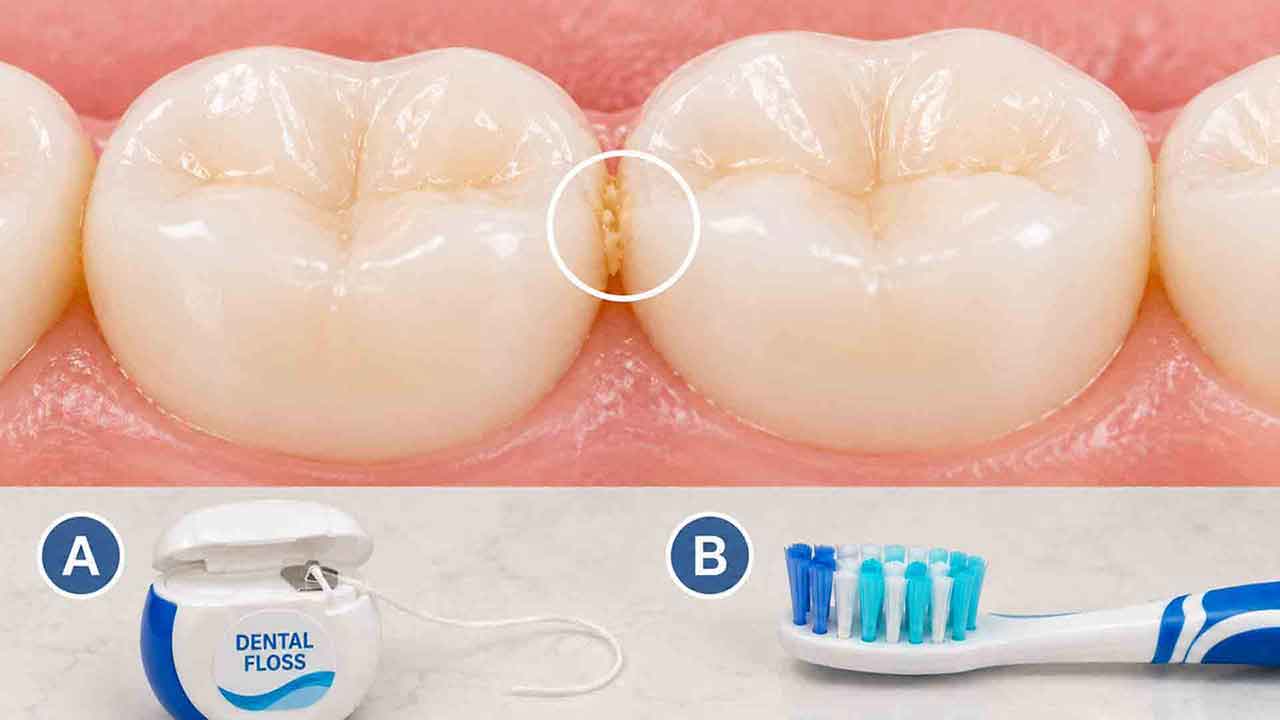
Cleaning between your teeth once a day helps remove plaque and food from surfaces a toothbrush may not reach effectively. String floss is useful for tight contacts, while interdental brushes or water flossers may work better around larger spaces, braces, bridges, or limited hand mobility. Hardened tartar and periodontal disease require professional evaluation rather than more aggressive home cleaning.
Key Takeaways
Clean between your teeth once a day in addition to brushing twice daily with fluoride toothpaste.
String floss works well in tight contacts, but other interdental tools may be more practical for larger spaces or dental work.
Plaque can often be removed at home, while hardened tartar generally cannot.
Persistent bleeding, swelling, recession, or loose teeth should be evaluated by a dental professional.
Routine cleaning and scaling and root planing serve different purposes and should not be treated as interchangeable procedures.
This guide explains how to clean between your teeth correctly, how to choose an interdental tool, which common mistakes reduce effectiveness, and how to recognize when home care is no longer enough.
It also separates preventive cleaning from treatment for periodontal disease so readers can make practical decisions without assuming that every gum problem requires the same procedure.
Why Is Cleaning Between Your Teeth Necessary?
A toothbrush does not fully clean every surface where neighboring teeth meet. Interdental cleaning helps remove plaque from these areas before it contributes to tooth decay or gum inflammation.
Plaque is a soft, sticky bacterial film that continually forms on teeth. When plaque remains along the gumline or between teeth, it can contribute to gingivitis and cavities.
Some plaque can eventually mineralize into calculus, commonly called tartar. Once tartar forms, ordinary brushing and flossing cannot reliably remove it.
Food debris can usually be removed at home.
Soft dental plaque can usually be removed with brushing and interdental cleaning, although professional care may still be needed when plaque accumulates in difficult areas.
Hardened tartar cannot be reliably removed at home and usually requires professional removal.
Mild gum inflammation may improve with better plaque control, but persistent symptoms may require professional evaluation.
Periodontitis cannot be treated with home cleaning alone. Home care supports professional treatment but does not replace it.
Deep periodontal pockets also cannot be adequately treated with ordinary flossing or brushing.
The goal of interdental cleaning is not to make the spaces between teeth feel perfectly smooth. It is to remove plaque consistently without damaging the gums.
How Often Should You Clean Between Your Teeth?
For most people, cleaning between the teeth once each day is an appropriate routine.
The American Dental Association recommends brushing twice daily with fluoride toothpaste and cleaning between the teeth daily. The most suitable tool may vary according to tooth spacing, restorations, braces, dexterity, and periodontal health.
There is no universal requirement to floss at one exact time of day. Cleaning before brushing can loosen debris before fluoride toothpaste is used, while cleaning afterward can also work well.
Consistency matters more than the order.
A realistic daily routine that is gentle and complete is usually more valuable than an elaborate routine that is difficult to maintain.
How Do You Floss Between Your Teeth Correctly?
Effective flossing cleans the side of each tooth instead of simply moving a strand through the center of the gap.
A common mistake is to push floss between two teeth and immediately pull it back out. That may remove a piece of food, but it does not fully clean the neighboring tooth surfaces.
Step 1: Use Enough Floss to Maintain Control
Start with a comfortable length of floss, commonly around 18 inches.
Wrap most of it around the middle fingers and leave a short working section between the hands.
The exact length is less important than maintaining a clean section of floss as you move around the mouth.
Step 2: Guide the Floss Through the Contact
Use a gentle rubbing motion to move the floss between the teeth.
Do not snap it downward into the gums.
If a contact is tight, work the floss gradually through the space instead of forcing it.
Step 3: Curve the Floss Around One Tooth
Once the floss passes the contact point, curve it against one tooth so it forms a C shape.
This increases contact with the tooth surface and makes the cleaning movement more effective.
Step 4: Move the Floss Along the Tooth Surface
Keep the floss against the tooth and move it gently up and down.
Allow it to reach slightly below the gumline without aggressively cutting into the tissue.
Then curve the floss around the neighboring tooth and repeat.
One interdental space contains two surfaces to clean.
Step 5: Continue Around the Mouth
Clean every accessible contact, including the back teeth.
Do not forget the rear surface of the last tooth in each row, which can collect plaque even though another tooth is not positioned behind it.
Use a clean portion of floss as you continue.
Which Is Better: Floss, an Interdental Brush, or a Water Flosser?
No single interdental tool is ideal for every person. The best option depends on the size of the space, existing dental work, hand mobility, and how consistently the tool can be used.
String floss remains a practical choice for narrow contacts between healthy teeth.
Dental tape can also work well in tight contacts and may feel more comfortable for some people because it has a broader surface.
Interdental brushes are often useful for larger spaces and provide straightforward back-and-forth cleaning. Correct sizing is important.
Floss picks can be convenient for travel or for people with limited dexterity, although they may make it harder to create a complete C shape around each tooth.
Water flossers can be practical around braces, bridges, implants, and other complex areas. They are also useful for people who find manual floss difficult.
Floss threaders can help guide floss beneath bridges and orthodontic appliances, although they usually take more time than conventional flossing.
The right tool is not necessarily the most expensive one.
A simple product used correctly every day can be more useful than a sophisticated device used occasionally.
A Simple Decision Framework for Choosing an Interdental Tool
If your teeth have tight contacts, start with string floss or dental tape.
The material should pass through the contact without shredding or requiring excessive force.
If you have larger spaces, an appropriately sized interdental brush may provide better contact with the tooth surfaces.
The brush should fit with light resistance rather than needing to be forced through.
If you wear braces, consider orthodontic floss, a floss threader, an interdental brush, or a water flosser.
Cleaning around brackets and wires may require more than one tool.
If you have a fixed bridge, ordinary floss cannot always pass vertically through the connected restoration.
A floss threader, specialty floss, small interdental brush, or water flosser may make it easier to clean underneath.
If hand mobility is limited, a floss holder, floss pick, or water flosser may be more practical than traditional finger flossing.
The goal is not to use a particular product. The goal is to remove plaque from the relevant surfaces safely and consistently.
Are Interdental Brushes Better for Larger Spaces?
Interdental brushes can be particularly useful when there is enough space for the brush to pass between teeth without being forced.
They may be helpful when gum recession has created wider spaces, when periodontal changes have altered the shape of the gumline, or when floss does not make enough contact with the tooth surfaces.
Sizing is important.
A brush that is too small may barely touch the teeth.
A brush that is too large can cause discomfort or irritate the gums.
If several spaces differ in size, one brush diameter may not work everywhere.
A dentist or dental hygienist can demonstrate which sizes and insertion angles are suitable for different parts of the mouth.
Can a Water Flosser Replace String Floss?
A water flosser can be an effective interdental-cleaning option for many people, especially when conventional floss is difficult to use.
A water flosser directs a pulsating stream of water around teeth and the gumline.
It can be especially practical around orthodontic appliances, bridges, implants, or areas that are difficult to reach manually.
Its main advantage is usability.
People who have difficulty manipulating string floss because of arthritis, limited hand control, or complex dental work may find a water flosser easier to use consistently.
However, a water flosser is still only one part of daily oral care.
It does not replace twice-daily brushing with fluoride toothpaste, and people with periodontal disease should follow any personalized cleaning instructions given by their dental professional.
How Does Interdental Cleaning Help Reduce Gum Disease Risk?
Interdental cleaning reduces plaque in areas where gum inflammation can begin, but gum disease prevention also depends on brushing, professional monitoring, and individual risk factors.
Gingivitis refers to inflammation of the gums.
Common signs can include redness, swelling, and bleeding.
Periodontitis is more advanced.
It affects the tissues and bone that support the teeth and requires professional diagnosis and management.
The process is not a guaranteed straight-line progression.
When plaque repeatedly remains around the gumline, inflammation can develop.
Some plaque can also harden into tartar, which is difficult to remove at home.
In susceptible people, persistent inflammation and bacterial buildup can contribute to progression from gingivitis to periodontitis.
Daily cleaning helps interrupt plaque accumulation before it reaches that point.
It cannot reverse established bone loss or remove hardened deposits deep below the gumline.
What Signs Suggest You Should See a Dentist?
Persistent gum changes deserve professional evaluation because symptoms alone cannot show how deeply the supporting tissues are affected.
Possible warning signs include repeated gum bleeding, persistent redness or swelling, tenderness around the gumline, gums pulling away from teeth, persistent bad breath or unpleasant taste, changes in tooth spacing, teeth feeling loose, and pain when chewing.
Bleeding should be interpreted in context.
Inflamed gums can bleed when cleaning begins, but repeated bleeding should not automatically be treated as a harmless side effect of flossing.
If bleeding continues despite gentle daily cleaning, or if it appears with swelling, recession, discomfort, or loose teeth, professional evaluation is appropriate.
A periodontal examination may include checking the gumline, measuring spaces around the teeth, and using dental X-rays when the condition of supporting bone needs to be assessed.
What Is the Difference Between Plaque and Tartar?
Plaque is a soft bacterial film that can often be removed with brushing and interdental cleaning.
Tartar is hardened mineralized buildup that generally requires professional removal.
This difference explains why improved flossing may remove soft deposits while a hard ridge near the gumline remains unchanged.
The hard material may be tartar, but appearance alone does not always confirm what it is.
Avoid trying to scrape suspected tartar away with needles, knives, household metal tools, or improvised dental instruments.
These methods can damage enamel, restorations, or gum tissue.
A dental professional can identify the deposit and remove it with appropriate instruments if necessary.
When Is Professional Dental Care Needed?
Professional care becomes important when plaque has hardened into tartar, gum inflammation persists, or periodontal disease extends below the gumline.
Routine professional cleaning is generally preventive.
It helps remove plaque, tartar, and deposits that remain despite normal home care.
A professional dental cleaning also gives the dentist or hygienist an opportunity to check whether the gums appear healthy and identify areas that are difficult for the patient to maintain.
Deep teeth cleaning is different.
The term commonly refers to scaling and root planing, which is used when periodontal disease requires treatment below the gumline.
Scaling removes plaque and tartar from tooth and root surfaces.
Root planing treats affected root surfaces so they are easier for the surrounding tissues to heal against.
Periodontitis cannot be corrected simply by flossing more aggressively at home.
Treatment may include scaling and root planing followed by reassessment and ongoing periodontal maintenance.
More complex or advanced cases may require care from a periodontist, a dentist with additional training in diseases affecting the gums and the structures supporting the teeth.
Routine professional cleaning is primarily intended for prevention and maintenance.
Scaling and root planing is intended to treat periodontal disease.
Both procedures can remove plaque and tartar, but scaling and root planing is specifically designed to clean deeper periodontal areas and affected root surfaces.
Routine cleaning is not normally used to treat deeper periodontal pockets.
Scaling and root planing may sometimes require local anesthesia, while routine cleaning usually does not.
Follow-up after routine cleaning depends on individual need.
Follow-up periodontal evaluation is often important after scaling and root planing.
The important distinction is clinical purpose.
A deep cleaning should not be viewed as simply a more thorough version of a routine cleaning that everyone should receive.
The appropriate procedure depends on what the dental examination shows.
What to Ask About Cost and Insurance
The cost of dental care depends on the procedure being performed, the areas treated, local fees, diagnostic services, follow-up care, and the patient's benefit plan.
A routine preventive cleaning should therefore not be compared directly with periodontal treatment based only on the word cleaning.
Before treatment, ask the dental office to identify the recommended procedure, which areas of the mouth will be treated, whether X-rays or examination fees are separate, and what follow-up may be required.
If dental cleaning cost is an important concern, a written treatment estimate is more useful than a generic price found online.
For patients with dental insurance, coverage can vary according to the plan, network, deductible, annual maximum, frequency limits, and procedure category.
Once the exact procedure has been identified, ask the office or insurer what portion may be covered and what the estimated patient responsibility will be.
A Practical Home-Care Decision Tree
If food gets stuck between otherwise healthy teeth, use gentle floss or another appropriate interdental cleaner.
If the same location traps food repeatedly, mention it at a dental visit.
Tooth position, a restoration, or an abnormal contact may be contributing.
If floss will not pass through a tight contact, do not force it downward.
Try a thinner or smoother floss.
If floss repeatedly catches, tears, or becomes stuck in the same location, have that area examined.
If there are larger spaces near the gumline, consider an appropriately sized interdental brush.
If you are unsure which size fits, ask a dental professional for guidance.
If braces make flossing difficult, use orthodontic floss, a floss threader, an interdental brush, or a water flosser.
Some people use more than one tool because different areas require different approaches.
If your gums bleed repeatedly, continue gentle plaque removal but do not ignore persistent bleeding.
If it continues, arrange an evaluation.
If you can see or feel hard buildup, do not attempt to scrape it away yourself.
Hard deposits that do not respond to normal brushing should be professionally evaluated.
If you have already been diagnosed with periodontitis, follow the individualized cleaning instructions provided by your dental team.
Home care remains important, but it supports professional treatment rather than replacing it.
Common Interdental-Cleaning Mistakes
Snapping Floss Into the Gums
More force does not produce better cleaning.
Guide the floss gently through the contact.
Cleaning Only the Middle of the Gap
The important surfaces are the sides of the neighboring teeth.
Curve the floss against one tooth and then the other.
Flossing Only When Food Is Visible
Food removal is only part of the purpose.
Plaque can remain between teeth even when nothing obvious is stuck.
Cleaning Only the Front Teeth
Posterior teeth can be harder to reach and easier to neglect.
Include molars and the back surface of the last tooth.
Using an Interdental Brush That Is Too Large
Resistance is not proof that a brush is working better.
The brush should fit comfortably enough to move through the space without force.
Assuming Mouthwash Replaces Interdental Cleaning
A mouth rinse can be useful in some routines, but it does not mechanically clean the contact surfaces between teeth.
Daily brushing and interdental cleaning remain the foundation.
Trying to Remove Tartar Yourself
Home tools are meant to remove soft plaque and food debris.
Once deposits have hardened, professional instruments are safer and more appropriate.
Troubleshooting Common Problems
If floss repeatedly snaps, try a smoother or thinner floss.
If it always happens at the same tooth, professional evaluation may be useful.
If floss repeatedly shreds, a rough filling, restoration, or tooth edge may be involved.
If gums bleed, use gentle technique and seek evaluation if bleeding persists.
If your fingers cannot control floss comfortably, try a holder, pick, or water flosser.
If larger gaps are difficult to clean with floss, consider an interdental brush.
If braces block normal floss, use orthodontic floss, a threader, interdental brush, or water flosser.
If a fixed bridge is difficult to clean, ask for instruction on cleaning underneath it.
If a hard deposit does not brush away, have it professionally evaluated.
If flossing causes sharp pain, stop forcing the area and arrange an examination.
Persistent problems at one specific tooth deserve particular attention.
When only one location repeatedly hurts, catches floss, traps food, or bleeds, the issue may not be technique alone.
Real-World Example and Daily Checklist
Real-World Example: One Mouth May Need More Than One Tool
Consider an adult with three different types of interdental spaces.
The front teeth have tight contacts.
String floss passes through easily and can curve around each tooth.
Several lower teeth have wider spaces because the gumline has receded.
An interdental brush makes better contact with those surfaces than thin floss.
Farther back, a fixed bridge replaces a missing tooth.
Ordinary floss cannot move vertically between the connected teeth, so a floss threader, specialty floss, or water flosser is more practical.
Using three different tools may seem less simple than choosing one product, but it follows a better principle.
Choose the tool according to the space, not according to a single preference for the entire mouth.
That approach can improve cleaning while reducing unnecessary force.
A Two-Minute Interdental-Care Checklist
Before finishing your daily routine, check whether you cleaned between every accessible tooth.
Make sure you cleaned both tooth surfaces inside each space.
Confirm that you avoided snapping floss into the gums.
Remember the back teeth and the rear surface of the last tooth.
Use an appropriate tool around bridges or braces.
Make sure an interdental brush is not being forced through a space.
Pay attention to persistent bleeding, swelling, or tenderness.
Notice whether there is a hard deposit that home cleaning cannot remove.
Also notice whether one area repeatedly tears or catches floss.
A simple checklist helps prevent small areas from being missed repeatedly.
How Do Home Care and Professional Care Work Together?
Home care controls plaque day by day.
Professional care removes deposits that home tools cannot manage, evaluates gum health, and treats disease when preventive cleaning is no longer sufficient.
Level 1: Daily Prevention
Brush twice daily with fluoride toothpaste.
Clean between the teeth once a day using floss, an interdental brush, a water flosser, or another suitable method.
This level is responsible for most day-to-day plaque control.
Level 2: Professional Prevention and Monitoring
Dental examinations and preventive cleaning help remove deposits that remain despite normal home care.
They also allow dental professionals to identify changes in the gums and show patients where their cleaning technique may need adjustment.
The appropriate interval is not identical for every person.
People with a history of periodontal disease, rapid tartar buildup, extensive dental work, or other risk factors may need a different schedule from someone with consistently healthy gums.
Level 3: Treatment When Disease Is Present
If gum disease extends deeper around the teeth, home care alone is no longer enough.
Professional treatment may be needed to remove deposits below the gumline, manage inflammation, and protect the supporting tissues.
Daily plaque control remains important after treatment because professional care does not prevent new plaque from forming.
This three-level framework avoids two common misunderstandings.
First, flossing cannot remove every form of established disease.
Second, professional cleaning does not eliminate the need for daily home care.
Both serve different purposes.
Related Oral-Health Guides
How Tooth Decay Really Progresses: From Early Enamel Changes to a Cavity explains how plaque and acids contribute to enamel damage and cavities.
What Dental X-Rays Can Reveal About Your Teeth — and What They Cannot explains where imaging helps and why some oral problems still require a clinical examination.
Why Are My Teeth Sensitive to Cold? A Practical Guide to Tooth Sensitivity covers common reasons exposed roots, worn enamel, cavities, and other dental changes can cause sensitivity.
What Causes Bleeding Gums and When Should You See a Dentist? helps readers distinguish occasional irritation from signs that deserve professional evaluation.
Internal links should be placed where they genuinely help readers understand the next related question rather than being inserted only for SEO.
The Practical Bottom Line and Sources
The Practical Bottom Line
Cleaning between the teeth once a day is one of the simplest ways to remove plaque from surfaces that brushing can miss.
Use string floss for tight contacts when it works comfortably.
Consider an interdental brush for wider spaces and a water flosser or specialty floss when braces, bridges, dexterity, or dental anatomy make ordinary floss difficult.
If an area repeatedly bleeds, hurts, catches floss, traps food, or develops hard buildup, do not respond by simply using more force.
Those patterns can indicate that the area deserves professional evaluation.
Home cleaning works best as daily prevention.
Professional care becomes important when deposits cannot be removed safely at home or when the gums and supporting tissues show signs of disease.
The practical goal is not to use the greatest number of products.
It is to choose an appropriate cleaning method, use it consistently, and seek professional care when the problem extends beyond routine plaque control.
Sources
American Dental Association. Dental Floss and Interdental Cleaners. Guidance on daily interdental cleaning, plaque removal, flossing methods, and alternative interdental tools.
American Dental Association, MouthHealthy. Flossing. Patient guidance on flossing technique and oral-hygiene practices.
American Dental Association. Home Oral Care Recommendations. Guidance supporting twice-daily brushing with fluoride toothpaste and daily cleaning between teeth.
Centers for Disease Control and Prevention. Periodontal Disease. Information about gingivitis, periodontitis, symptoms, risk factors, and prevention.
National Institute of Dental and Craniofacial Research. Gum Disease. Information on periodontal signs, diagnosis, treatment, and home care.
American Dental Association, MouthHealthy. Scaling and Root Planing. Explanation of periodontal deep cleaning and its role in treating disease below the gumline.
American Academy of Periodontology. Non-Surgical Periodontal Treatment. Patient information on periodontal therapy and ongoing maintenance.
Educational Note
This article provides general oral-health information and is not a diagnosis or individualized treatment plan. A dentist or periodontal specialist can determine which care is appropriate for a specific condition.