Quick Answer and Key Takeaways
Quick Answer
The best snacks for healthy teeth are generally foods with little added sugar, modest acidity, and a texture that does not remain on the teeth for long periods. Practical choices include plain cheese or yogurt, unsweetened nuts and seeds, vegetables, eggs, and whole fruit. How often you snack also matters because repeated sugar and starch exposures can repeatedly challenge tooth enamel.
Key Takeaways
Oral bacteria can use sugars and starches to produce acids that contribute to enamel mineral loss and tooth decay.
Snack frequency matters as well as the type of food because repeated eating can create repeated acid challenges.
Foods with little added sugar, such as plain dairy products, vegetables, eggs, and unsweetened nuts, can be practical everyday snack options.
Whole fruit can fit a tooth-conscious diet, while dried fruit, juice, sour candy, and acidic drinks deserve more attention because food form and exposure pattern matter.
Healthy food choices support cavity prevention, but they do not replace fluoride toothpaste, daily oral hygiene, or appropriate dental care.
This guide explains how food choices affect cavities, how to compare common snacks, what to look for on a Nutrition Facts label, and how snack timing can change dental exposure.
Rather than labeling foods simply good or bad, it uses five practical factors: sugar and fermentable carbohydrates, acidity, retention, eating duration, and frequency.
This guide is based on authoritative dental and nutrition guidance and practical selection criteria rather than hands-on product testing.
How Do Snacks Affect Cavities and Tooth Decay?
Snacks affect dental health through a combination of fermentable carbohydrates, bacterial acid production, food acidity, contact time, saliva, fluoride, and how frequently the teeth are exposed.
Dental plaque contains bacteria. When certain bacteria encounter sugars and starches from foods and drinks, they can produce acids that remove minerals from tooth enamel. Saliva and fluoride help replace some of those minerals.
This creates an ongoing balance between demineralization, which means mineral loss from enamel, and remineralization, which means mineral replacement.
If frequent acid-producing exposures repeatedly outweigh repair, early enamel changes can progress toward a cavity. The National Institute of Dental and Craniofacial Research explains that frequent intake of foods and beverages containing sugars and starches can result in repeated acid attacks.
That is why sugar grams alone cannot fully describe how a snack interacts with your teeth.
A more useful assessment considers whether the snack contains added sugar, whether it contains fermentable starch, whether it is highly acidic, whether it sticks around the teeth, whether it will be eaten quickly or over several hours, and how often similar exposures occur during the day.
These questions form the basis of the snack-selection framework used throughout this guide.
Which Snacks Are Usually Better for Healthy Teeth?
For routine snacks, favor foods with little added sugar, limited acidity, and a texture that does not repeatedly coat or remain around the teeth.
No single food guarantees healthy teeth or prevents cavities by itself. Individual risk also depends on oral hygiene, fluoride exposure, saliva, dental anatomy, existing restorations, and other factors.
Still, several food categories fit a practical tooth-conscious pattern.
Plain Cheese
Plain cheese is low in sugar and can be a useful alternative to sweetened snack foods.
Dairy foods also supply calcium and phosphate. American Dental Association nutrition guidance discusses evidence suggesting that milk and dairy products may have characteristics favorable to dental health, although that should not be interpreted as proof that cheese independently prevents cavities.
Choose cheese because it fits a low-sugar snack pattern, not because it supposedly cleans teeth.
Plain or Unsweetened Yogurt
Plain yogurt can provide protein and calcium without the added sugars found in many flavored products.
Checking the Nutrition Facts label matters because two yogurts that look nutritionally similar on the front of the package may contain very different amounts of added sugar.
Yogurt is naturally acidic, but dairy foods should not automatically be treated like soft drinks or sour candy when considering dental erosion. Calcium and phosphate in dairy products can affect their erosive potential.
Unsweetened Nuts and Seeds
Unsweetened nuts and seeds can provide a filling snack without a large added-sugar exposure.
The important word is unsweetened. Honey-roasted nuts, caramel coatings, chocolate coatings, and sweet clusters create a different dental exposure.
People with cracked teeth, temporary restorations, chewing pain, or other dental problems should choose textures appropriate to their condition.
Raw Vegetables
Carrot sticks, cucumber, bell pepper, celery, and similar vegetables are practical low-added-sugar snack choices.
They are sometimes described online as natural toothbrushes, but that description is misleading. Chewing vegetables does not replace brushing or cleaning between teeth.
Their advantage is much simpler. They generally create less added-sugar exposure than candy, cookies, sweetened bars, or sugary beverages.
Eggs and Other Unsweetened Protein Foods
A hard-boiled egg or another minimally sweet protein food contains little fermentable sugar.
For someone who wants a satisfying afternoon snack, choosing a protein-based option can also reduce the temptation to graze repeatedly on sweet snacks.
Whole Fruit
Whole fruit remains an appropriate part of a balanced diet and does not need to be avoided simply because it contains naturally occurring sugar.
However, some fruits are acidic. Frequent exposure to dietary acids is associated with a greater risk of erosive tooth wear, so frequency and eating pattern still deserve consideration.
The useful comparison is often whole fruit eaten as one snack versus juice or dried fruit consumed repeatedly over a long period.
Which Common Snacks Are More Tooth-Friendly?
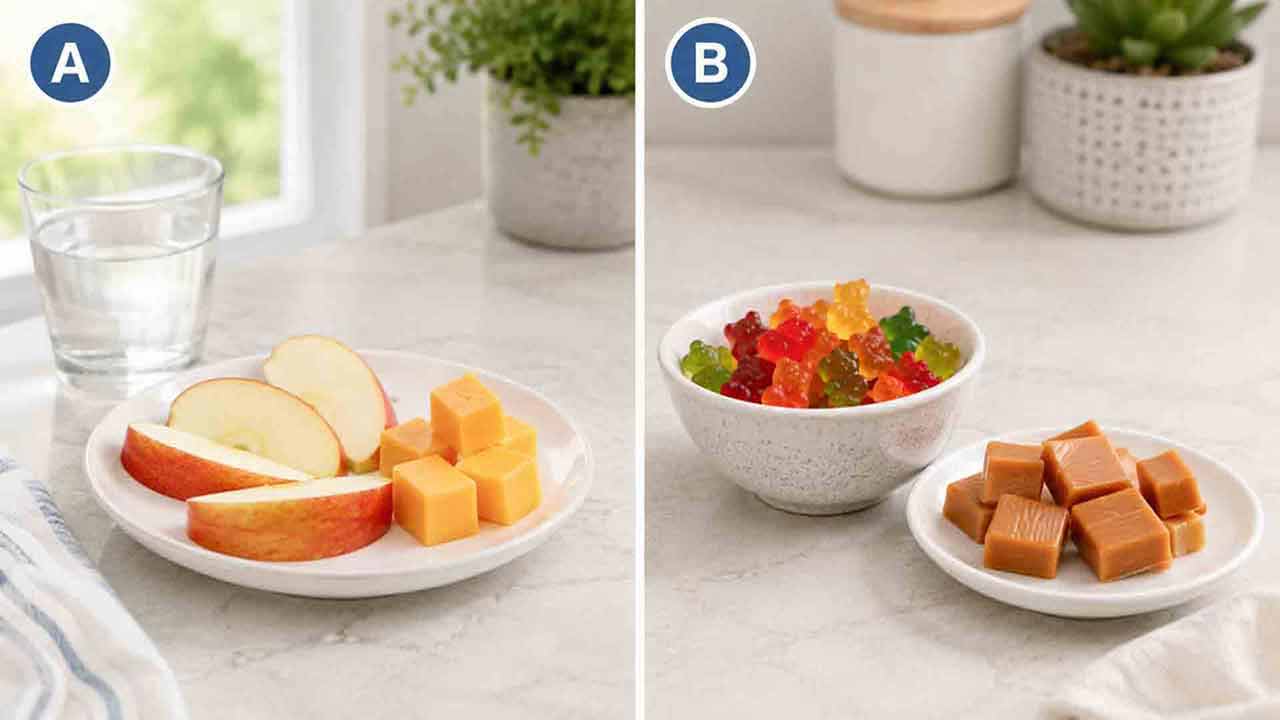
Plain cheese generally has a low added-sugar concern, low acidity, and a low tendency to remain on the teeth, making it a practical everyday option.
Plain unsweetened yogurt generally has little added sugar, although it has some natural acidity. It can still be a practical everyday snack for many people.
Unsweetened nuts generally have little added sugar and low acidity. They can be useful for most people, although some particles may remain in tooth grooves.
Raw vegetables usually have little added sugar and relatively low acidity. They can be strong everyday snack options.
A hard-boiled egg contains very little sugar, is not highly acidic, and does not usually remain around the teeth for long.
Whole fresh fruit usually contains no added sugar, although its natural sugar and acidity vary by fruit. It can still be a reasonable everyday choice within a balanced diet.
Dried fruit contains concentrated natural sugars, and some products contain additional sweeteners. Many dried fruits can also be sticky, so they are better treated as a defined serving rather than something to graze on continuously.
Sweetened granola bars often contain moderate or high levels of added sugar and may be sticky. Check the Nutrition Facts label and consider how often they are eaten.
Crackers and chips may contain little added sugar, but their refined starch can still be metabolized by oral bacteria. Small pieces may also remain in tooth grooves.
Cookies usually contain added sugar and refined carbohydrates. They are better treated as occasional foods rather than continuous snacks.
Sticky candy combines a high sugar exposure with a tendency to remain around teeth.
Sour candy can create both sugar exposure and significant acidity, making it a higher-concern choice for both cavities and dental erosion.
Sugary soda combines sugar with acidity in many cases and can expose teeth repeatedly when sipped over a long period.
Plain water contains no sugar and creates no meaningful dietary acid challenge, making it the simplest routine beverage for dental health.
A food does not need to be banned simply because it has a less favorable dental profile. The more useful question is whether it should be an everyday repeated snack or an occasional part of an otherwise balanced diet.
Why Does Snack Frequency Matter?
How often you expose the teeth to sugar and fermentable carbohydrates can matter alongside how much you consume.
Each eating event containing sugar or starch gives plaque bacteria another opportunity to produce acid. Frequent consumption can create repeated acid challenges, making it harder for enamel to regain lost minerals between exposures.
Consider two patterns.
In the first pattern, a person eats a snack at 3:00 p.m., finishes it, and then returns to drinking water.
In the second pattern, a person takes a few bites every 20 or 30 minutes from 3:00 p.m. until 5:30 p.m.
The amount of food might be similar, but the second pattern creates more separate exposure periods.
A practical rule is that a defined snack is generally preferable to continuously grazing on sugary or starchy foods.
The goal is not to create an inflexible meal schedule. It is to recognize that repeated exposure is one factor you can control.
A Five-Factor Framework for Choosing a Tooth-Friendly Snack
Instead of memorizing a list of approved foods, evaluate a snack using five factors.
Factor 1: Added Sugar
Added sugar is an easy starting point because packaged foods in the United States display Added Sugars on the Nutrition Facts label.
The U.S. Food and Drug Administration defines added sugars as sugars introduced during processing as well as sugars from sources such as syrups, honey, and concentrated fruit or vegetable juices used as sweeteners.
Naturally occurring sugar in milk and whole fruit is included in Total Sugars but not Added Sugars.
When comparing similar products, the one with less added sugar can often be the more practical routine choice.
Sugar content should not be your only test.
Factor 2: Acidity
Acidity raises a separate dental issue called erosion.
Dental erosion is chemical loss of hard tooth structure caused by acids that are not produced by oral bacteria. It is different from bacterial tooth decay.
Soft drinks, sour candies, and acidic fruit beverages can create substantial acid exposure, particularly when consumed frequently.
Factor 3: Retention Around the Teeth
Texture matters because some foods stay in molar grooves or between teeth longer than others.
There is no Nutrition Facts number for stickiness, so practical observation matters.
If a food routinely packs between your teeth or remains in grooves long after eating, that is useful information when comparing snack options.
Factor 4: Eating Duration
A snack eaten in several minutes creates a different exposure pattern from a bag of candy, sweetened coffee, or dried fruit consumed slowly over several hours.
Ask whether you are having one snack or creating an afternoon-long eating event.
Factor 5: Frequency
One sweet exposure is different from repeated sweet exposures throughout the day.
Frequency becomes particularly important for people who habitually sip sweetened beverages or keep snacks at a desk and eat continuously.
A useful shortcut is to compare two snacks by asking which has less added sugar, less acidity, less sticking, a shorter eating period, and fewer repeated exposures.
You do not need every answer to be perfect.
The framework is designed to help you make a better choice, not a flawless one.
How Can You Read a Nutrition Facts Label for Dental Health?
Start with serving size and Added Sugars, then use the ingredient list and food texture to complete the picture.
A nutrition label is not a cavity-risk calculator, but it provides useful comparison information.
Step 1: Check the Serving Size
Determine whether the listed nutrition information represents the amount you actually expect to eat.
If a package contains multiple servings but you usually eat the entire package, the per-serving values can underestimate your actual intake.
Step 2: Compare Added Sugars
The FDA requires Added Sugars to appear separately within the Total Sugars section on Nutrition Facts labels.
When comparing two flavored yogurts, two snack bars, or two breakfast products, Added Sugars provides a useful standardized comparison.
Step 3: Read the Ingredient List
The ingredient list can show whether sweetness comes from ingredients such as sugar, syrups, honey, or concentrated juices used as sweeteners.
Do not assume terms such as natural, organic, wholesome, fruit-based, energy, protein, or plant-based tell you how much added sugar a product contains.
The front of a package is primarily marketing. The Nutrition Facts panel and ingredient list provide more useful information.
Step 4: Think Beyond the Label
A food label cannot tell you how slowly you will eat something or how much of it will remain between your teeth.
Combine label information with the five-factor framework rather than relying on one number.
Which Is Better for Teeth: Whole Fruit, Dried Fruit, or Fruit Juice?
For routine snacking, whole fruit is generally the most practical of these three forms because dried fruit is concentrated and can be sticky, while fruit juice can create repeated sugar and acid exposure if sipped over time.
This does not mean whole fruit contains no sugar or acid.
Food form and eating pattern are the important differences.
Whole Fruit
Whole fruit retains its natural structure and is normally eaten as a defined serving.
It also contributes to overall diet quality, so eliminating fruit solely to reduce dental sugar exposure would usually be unnecessarily restrictive.
Some fruits are acidic, so people with significant erosive tooth wear may need individualized dietary guidance.
Dried Fruit
Drying removes much of the water, concentrating the food into a smaller volume.
Raisins, dried cranberries, dates, and similar foods may also lodge between teeth or be eaten repeatedly from a package.
Some commercially dried fruits contain additional sweeteners, making label checking useful.
Dried fruit can still fit a balanced diet. For dental purposes, it is generally more sensible to eat a defined serving than to graze on it throughout the day.
Fruit Juice
Fruit juice creates a different exposure because sugar and dietary acids are delivered as a beverage.
Acidic fruit juices are among the dietary exposures associated with dental erosion, particularly when exposure is frequent.
Plain water remains the simpler everyday beverage between eating occasions.
Snack FAQs: Crackers, Cheese, Gum, and Drinks
Are Crackers and Chips Better Than Candy Because They Are Not Sweet?
Not automatically. A food does not need to taste sweet to contain starches that oral bacteria can metabolize.
The National Institute of Dental and Craniofacial Research explains that bacteria involved in the tooth-decay process can use sugars and starches from foods and beverages to produce acid.
Refined crackers or chips can also break into small particles that collect in molar grooves.
This does not mean that a cracker and a sticky candy create identical dental conditions.
It means that not sweet is an incomplete decision rule.
For example, plain cheese and unsweetened nuts eaten as one snack generally create a simpler dental exposure pattern than crackers eaten by the handful every few minutes for several hours.
The second pattern creates repeated starch exposure even though the snack may not taste sugary.
Is Cheese Really Good for Teeth?
Cheese can be a practical low-sugar snack, but it is not a substitute for fluoride, brushing, or professional dental care.
American Dental Association nutrition guidance discusses dairy foods as potentially favorable in relation to dental caries, including possible roles for calcium and phosphate.
The evidence does not justify treating cheese as a cavity-prevention therapy by itself.
A more accurate conclusion is that cheese is useful because it offers a low-added-sugar alternative to many common snack foods.
Is Sugar-Free Gum Useful After a Snack?
Sugar-free gum can be a useful addition after eating because chewing stimulates saliva, but it does not replace brushing or interdental cleaning.
Stimulated saliva helps clear acids and provides calcium and phosphate involved in enamel remineralization.
Sugar-free gum can be especially practical when brushing is not immediately convenient.
It is still optional rather than essential.
People with jaw pain, chewing restrictions, orthodontic instructions, or swallowing difficulties may need another approach.
Plain water is a simple alternative.
What Should You Drink With a Snack?
Plain water is the simplest routine drink for teeth because it adds neither sugar nor a significant dietary acid challenge.
Sugary drinks combine liquid sugar exposure with the possibility of prolonged sipping.
Many soft drinks and fruit beverages are also acidic, adding an erosion concern separate from bacterial tooth decay.
After acidic foods or drinks, rinsing or drinking water can help reduce residual acid exposure.
A useful everyday rule is to eat the snack, finish it, and then return to water.
Real-World Example and Snack Decision Tree
Real-World Example: The Same Snack, Different Exposure Pattern
Consider two people working at neighboring desks.
Both have the same sweetened granola bar and the same sweetened coffee.
Person A eats the bar during a single afternoon break, finishes the coffee with the snack, and then drinks water for the rest of the afternoon.
Person B takes a bite of the granola bar every 20 or 30 minutes and slowly sips the coffee for several hours.
The total quantity consumed could be identical.
The dental exposure pattern is not.
Person B creates more repeated opportunities for plaque bacteria to encounter sugars and starches.
This example shows why snack frequency can sometimes be improved without banning a particular food.
The practical change is often not never eat that. It is eat it, finish it, and move on.
A Simple Snack Decision Tree
First, ask whether the snack contains significant added sugar.
If it does not, move on to acidity and texture.
If it does, see whether a comparable lower-added-sugar option is available.
Next, consider whether the snack is highly acidic or sour.
If it is highly acidic, avoid turning it into a prolonged or repeatedly consumed snack.
Then consider whether the food sticks to your teeth.
If it frequently remains around the teeth, consider whether a less retentive alternative is available.
Next, think about how long you will eat it.
A defined snack creates a more limited exposure than continuous grazing.
Finally, consider what you will drink.
Plain water is usually the simplest routine choice. Sugary or acidic beverages create additional exposure, especially when sipped for long periods.
If you frequently develop cavities, general snack rules may not address every contributing factor. Individual risk can also be influenced by fluoride exposure, saliva, plaque control, dental anatomy, and other conditions.
Dry Mouth, Fluoride, and Existing Tooth Decay
How Does Dry Mouth Change Snack Choices?
Dry mouth can make snack selection more important because saliva normally helps clear food and acids and provides minerals used in enamel repair.
When saliva is limited, repeatedly consuming sticky sweets, refined snacks, or sugary and acidic beverages can be less forgiving.
Practical choices include drinking water regularly, limiting prolonged sugary or acidic exposure, choosing snacks that do not remain around the teeth, using sugar-free gum when appropriate, and discussing persistent dry mouth with a healthcare or dental professional.
Persistent dry mouth can have several causes, so it should not automatically be treated as a hydration problem alone.
Do Healthy Snacks Replace Brushing and Fluoride?
No. Better snack choices can reduce one source of cavity risk, but they cannot replace plaque removal or fluoride.
Fluoride helps protect enamel against mineral loss and promotes replacement of minerals in early stages of tooth decay. Brushing with fluoride toothpaste is therefore an important part of cavity prevention.
Healthy snack choices work alongside brushing with fluoride toothpaste, cleaning between teeth, limiting repeated sugar exposure, drinking water, and receiving regular dental care appropriate to individual risk.
People at higher cavity risk may also be advised to use additional fluoride based on a dentist's assessment.
Regular dental care also helps identify plaque buildup, early decay, and other risk factors that diet alone cannot address.
No individual snack can replace these preventive measures.
What If Tooth Decay Is Already Present?
Healthy snack choices can reduce future sugar and acid exposure, but they cannot rebuild missing tooth structure.
Very early non-cavitated decay may sometimes be stabilized or remineralized with fluoride and improved risk control. Once a true cavity has formed, professional dental treatment is generally required.
Diet therefore supports prevention and future risk reduction. It does not replace treatment for an established cavity.
Common Snack Mistakes That Can Increase Dental Risk
Assuming Organic Means Tooth-Friendly
Organic sugar is still a source of fermentable carbohydrate.
Use the Nutrition Facts label instead of front-of-package marketing as your primary comparison tool.
Assuming No Added Sugar Means No Dental Considerations
No Added Sugar can be useful information, but it is not a complete dental-health assessment.
A product may still contain naturally occurring sugars, starches, or acids.
Slowly Sipping a Sweet Drink
One beverage can become many exposure periods when it remains on your desk for several hours.
Keep sweetened drinks with a defined eating occasion when practical rather than sipping them continuously.
Choosing a Healthy Snack Bar Without Reading the Label
Granola bars, protein bars, breakfast bars, and fruit bars vary widely.
Some contain little added sugar, while others contain substantial amounts.
Compare labels rather than assuming the product category determines the answer.
Grazing on Crackers Instead of Candy
Replacing candy with a refined starch does not automatically solve the frequency issue.
Sugars and starches can both participate in bacterial acid production.
Treating Fruit as Either Perfect or Dangerous
Whole fruit does not need to be categorized at either extreme.
A better approach considers the form of the fruit, acidity, frequency, and whether it is eaten as one serving or repeatedly.
Brushing Aggressively Immediately After Acidic Foods
Dental erosion and cavities are different processes.
After significant dietary acid exposure, rinsing with water is generally more appropriate than immediately scrubbing the teeth aggressively.
Troubleshooting Everyday Snack Situations
If you crave something sweet every afternoon, have a defined snack instead of grazing for several hours.
If yogurt looks healthy but tastes very sweet, compare its Added Sugars with a plain version.
If dried fruit repeatedly sticks between your teeth, use a defined serving and maintain normal interdental cleaning.
If you snack when you are actually thirsty, try water first.
If crackers remain in molar grooves, consider a less retentive option and maintain normal oral hygiene.
If you sip sweetened coffee all afternoon, shorten the drinking period or keep it with a meal or snack.
If you regularly drink juice between meals, consider whole fruit plus water instead.
If sour candy causes noticeable tooth sensitivity, reduce acid exposure and discuss persistent sensitivity with a dentist.
If you have persistent dry mouth, favor water and seek professional advice if it continues.
If you frequently develop new cavities, ask a dentist to assess individual risk factors rather than relying on snack changes alone.
Many dental-health improvements involve changing a habit pattern rather than banning one specific food.
A Grocery Shopping Checklist for Tooth-Friendly Snacks
When comparing everyday snacks, first check whether the product contains added sugar.
Look for a lower-added-sugar version when available.
Consider whether the product is highly acidic or sour.
Notice whether it is sticky or likely to lodge around the teeth.
Think about whether you normally eat the food all at once or graze from the package.
Consider whether a less processed alternative would meet the same need.
Make sure the snack also fits your broader nutritional needs.
Ask whether plain water will work well with it.
Base your judgment on the Nutrition Facts label and ingredient list rather than words such as healthy, natural, or wholesome on the front of the package.
Finally, decide whether this is a food you want to eat occasionally or something you expect to snack on every day.
The objective is not to build a perfect dental diet.
The objective is to make the foods and drinks you consume most frequently easier on your teeth.
Which Snack Strategy Works for Different People?
For Someone With Generally Healthy Teeth
Keep the routine simple.
Favor low-added-sugar snacks most of the time, drink water between meals, brush with fluoride toothpaste, and clean between the teeth.
Occasional sweets do not need to become a source of anxiety.
For Someone Who Frequently Develops Cavities
Pay particular attention to frequency.
Look for repeated exposures from sweetened coffee, soda, mints, desk snacks, dried fruit, crackers, or similar foods.
If cavities continue despite reasonable oral hygiene and diet, professional assessment can help identify additional risk factors.
For Someone With Braces
Brackets and wires create additional areas where food can collect.
Choose foods allowed by your orthodontist and pay more attention to cleaning around the appliance after eating.
Sticky foods may be particularly inconvenient even apart from their sugar content.
For Someone With Dry Mouth
Prioritize water and avoid turning sugary or acidic foods into long-duration snacks.
Because saliva normally contributes to acid buffering and remineralization, reduced salivary flow can make repeated snack exposure more important.
For Parents Choosing Children's Snacks
Limit repeated sugary exposures, offer water routinely, choose minimally sweet everyday snacks, avoid constant grazing, and use fluoride toothpaste according to age-appropriate guidance.
Both what children eat and how often they eat it matter for tooth-decay prevention.
For Someone Who Loves Sweets
You do not necessarily need to eliminate desserts.
A practical approach is to make sweets a defined eating event rather than keeping candy, cookies, or sweet drinks available continuously throughout the day.
That changes frequency without requiring an unrealistic all-or-nothing diet.
Related Oral-Health Guides
How Tooth Decay Really Progresses: From Early Enamel Changes to a Cavity explains how repeated mineral loss can eventually become a cavity.
How to Clean Between Your Teeth: Flossing, Gum Disease Prevention, and Professional Dental Care explains how plaque can be removed from surfaces a toothbrush may not fully reach.
What Dental X-Rays Can Reveal About Your Teeth — and What They Cannot explains where imaging fits into dental diagnosis.
Why Are My Teeth Sensitive to Cold? A Practical Guide to Tooth Sensitivity covers common causes of temperature sensitivity.
What Causes Bleeding Gums and When Should You See a Dentist? explains common reasons for gum bleeding and when evaluation is appropriate.
Internal links should be positioned where the related article answers a natural next question rather than being inserted simply to increase link count.
The Practical Bottom Line
The best snacks for healthy teeth are not defined by one magical ingredient or one perfect food list.
A stronger strategy is to choose everyday snacks with little added sugar, avoid frequent prolonged exposure to sugary or highly acidic foods and drinks, and pay attention to foods that remain around the teeth.
Plain cheese or yogurt, unsweetened nuts and seeds, vegetables, eggs, whole fruit, and other minimally sweet foods can all fit this approach when they also meet your nutritional needs.
If you enjoy cookies, candy, sweetened drinks, dried fruit, or other higher-sugar foods, consider the pattern as well as the product. Eating something as a defined snack is different from grazing or sipping it repeatedly for hours.
For people with generally healthy teeth, focus on a sustainable routine involving reasonable snack choices, water, fluoride toothpaste, and daily cleaning.
For people who frequently develop cavities, have dry mouth, wear braces, or have other dental risk factors, food choices are still valuable but may need to be combined with individualized preventive guidance.
When tooth decay is already present, diet remains useful for controlling future risk, but it cannot replace professional care for an established cavity.
The most practical goal is not to eat perfectly. It is to reduce unnecessary repeated sugar and acid exposure while building everyday food habits that support both dental health and overall nutrition.