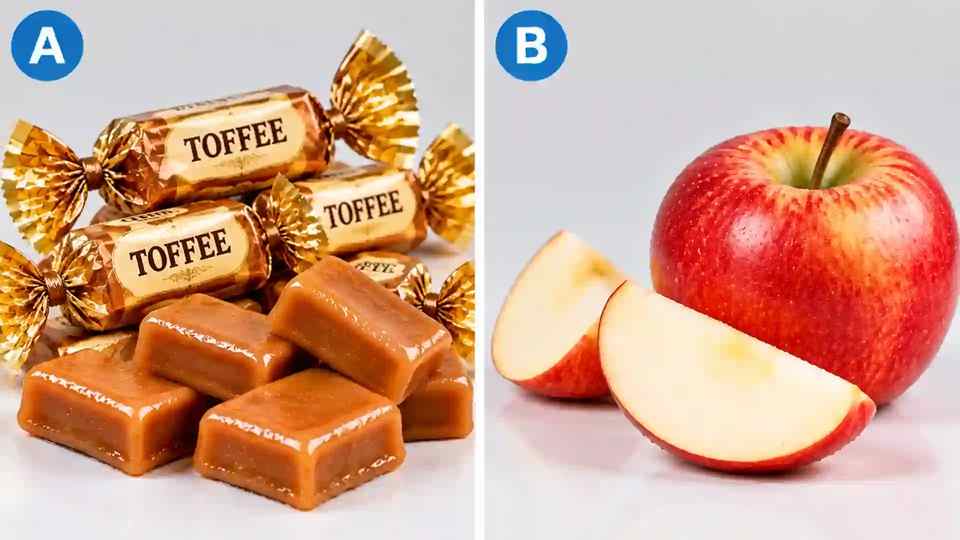
Which Food Is More Likely to Stick to Your Teeth? Toffee vs. Apple
The correct quiz answer is A: Toffee. Toffee has a chewy, sticky consistency that may allow food residue to remain in tooth grooves and between neighboring teeth. Apples contain natural sugars but also provide water and fiber. Sticky texture is one factor in dental health, but it does not determine cavity risk by itself.
Key Takeaways:
The correct quiz answer is A: Toffee.
Toffee combines fermentable sugars with a sticky texture that may allow residue to remain on teeth.
Plaque bacteria can turn sugars into acids that contribute to enamel mineral loss.
Eating sugary foods frequently can create repeated opportunities for acid attacks.
Brushing twice daily with fluoride toothpaste and cleaning between teeth help protect oral health.
An occasional sweet does not automatically cause a cavity.
This article explains why toffee can stick to teeth, how sticky foods relate to cavities, how to compare toffee with other foods, and which everyday habits can help reduce tooth decay risk.
Medical information notice: This article provides general educational information and does not replace individualized examination, diagnosis, or treatment from a licensed dental professional.
Quiz Answer: Why Is Toffee More Likely to Stick to Teeth?
Toffee is the correct answer because its chewy consistency allows it to deform under pressure and mold around uneven tooth surfaces. As someone chews, the candy may press into the pits and grooves of molars or become lodged between teeth.
An apple is not typically as sticky as toffee. However, the comparison is about texture and residue, not a guarantee that one food causes cavities and the other does not. Both food choices should be considered within an overall diet and oral hygiene routine.
Why Can Toffee Remain in Tooth Grooves?
Toffee's chewy consistency allows it to mold around the uneven surfaces of teeth. During chewing, residue may become lodged in the pits and grooves of molars or between neighboring teeth, particularly where spaces are narrow or difficult to clean.
The amount of residue left behind depends on the candy's formulation, temperature, chewing pattern, tooth anatomy, and saliva flow. Some pieces clear relatively quickly, while others may require brushing or interdental cleaning to remove fully.
Food residue is not the same as a cavity. Finding toffee in a tooth groove does not mean tooth decay will inevitably occur. Fermentable sugars, plaque bacteria, repeated acid exposure, fluoride, saliva, and oral hygiene all influence the risk.
How Does Sugar Damage Tooth Enamel?
Tooth enamel is the hard outer layer that protects each tooth. Although enamel is highly mineralized, it can lose minerals when exposed to acids. This process is called demineralization.
Dental plaque is a sticky film containing bacteria that forms on teeth. When plaque bacteria break down sugars from foods such as toffee, they produce acids that cause minerals to leave the enamel. Repeated acid attacks can increase the likelihood that early mineral loss will progress toward a cavity.
Saliva helps neutralize acids and supplies minerals, including calcium and phosphate, that support enamel repair. Fluoride helps strengthen enamel and supports remineralization, the process of replacing lost minerals. The National Institute of Dental and Craniofacial Research explains these processes in its guide to the tooth decay process: https://www.nidcr.nih.gov/health-info/tooth-decay/more-info/tooth-decay-process.
How Does Toffee Compare With Other Foods That May Affect Teeth?
Toffee is not the only food that can contribute to tooth decay. Foods and drinks containing fermentable sugars, as well as some starch-rich foods, can contribute to acid production when oral bacteria break them down.
Toffee and caramel are often sticky. Gummy candy may remain in tooth grooves, while hard candy can expose teeth to sugar for an extended period when sucked. Cookies and sweet pastries contain sugars and often refined starches. Dried fruit contains naturally occurring sugars and may be sticky, while sugary soda can expose teeth to sugar and dietary acids.
Fresh whole fruit, including apples, can be part of a balanced diet. Cheese, plain nuts, and unsweetened vegetables are other practical alternatives to sugary snacks. This comparison is not a scientific ranking of cavity risk. Preparation, portion size, frequency of consumption, and individual oral health can change the risk associated with a particular food.
The American Dental Association discusses the relationship between diet and oral health in its Nutrition and Oral Health guidance: https://www.ada.org/resources/ada-library/oral-health-topics/nutrition-and-oral-health.
Is Toffee Worse Than Chocolate?
Toffee may be harder to clear from some tooth surfaces than chocolate that melts and is swallowed relatively quickly. However, the actual risk depends on the products being compared and how they are consumed.
A sugary chocolate bar eaten occasionally with a meal is not necessarily more harmful than toffee eaten repeatedly between meals. Chocolate with a sticky caramel center also combines characteristics of both sweets.
When comparing sweets, consider three factors: how much fermentable sugar a serving contains, whether the food is likely to remain in tooth grooves or between teeth, and how frequently it is eaten. Without comparable evidence about the products and eating patterns, it would be misleading to declare one type of candy universally worse than another.
Why Does Eating Frequency Matter for Cavity Risk?
After consuming fermentable carbohydrates, plaque bacteria produce acids that cause enamel to lose minerals. Saliva helps neutralize acids and supplies minerals that support repair. Repeatedly eating sugary snacks creates additional opportunities for acid attacks.
Consider two routines involving the same total amount of toffee. In the first, someone eats a small serving with lunch and does not continue snacking on sweets throughout the afternoon. In the second, someone divides the same amount into several portions eaten at different times.
The second routine creates more separate opportunities for sugar-triggered acid production. This illustrates the importance of exposure frequency, not a precise calculation of individual cavity probability. Saliva, fluoride, plaque, and other dietary factors also influence the outcome.
The American Dental Association recommends reducing the amount and frequency of carbohydrate consumption, particularly for people at elevated risk of cavities. Its Caries Risk Assessment and Management guidance provides further information: https://www.ada.org/resources/ada-library/oral-health-topics/caries-risk-assessment-and-management.
Does Drinking Water After Eating Toffee Help?
Drinking water after eating toffee can help rinse away some food residue and supports hydration. Plain water is generally preferable to following candy with soda, juice, or another sugary drink.
Water does not remove all dental plaque or guarantee that sugar has been cleared from every groove and contact point. It should supplement, not replace, brushing with fluoride toothpaste and daily interdental cleaning.
If residue repeatedly remains between particular teeth, dental floss or another suitable interdental cleaner can help remove it. Persistent food trapping in the same location may warrant examination by a dentist.
How Should You Brush to Help Prevent Cavities?
The American Dental Association recommends brushing for two minutes twice daily with fluoride toothpaste. Use a soft-bristled toothbrush and clean all tooth surfaces, paying particular attention to the grooves of the back teeth and the gumline.
Fluoride helps reduce mineral loss and supports remineralization. Regular use of fluoride toothpaste is an established component of cavity prevention. Brushing works best as a consistent daily habit rather than an occasional response to eating candy.
Follow age-appropriate toothpaste guidance for children and supervise young children to reduce swallowing. The ADA provides additional recommendations in its Home Oral Care guidance: https://www.ada.org/resources/ada-library/oral-health-topics/home-oral-care/.
Why Is Cleaning Between Your Teeth Important?
A toothbrush cannot effectively reach every tight space between neighboring teeth. Plaque and food debris can accumulate in these areas, creating locations where decay may develop.
Dental floss, interdental brushes, and other suitable interdental cleaners can help clean between teeth. The appropriate tool depends on tooth spacing, dental work, and individual needs.
If toffee repeatedly becomes trapped between the same two teeth, mention it to your dentist. A tight contact, an existing restoration, or another local issue may warrant examination. The ADA provides further information about dental floss and interdental cleaners: https://www.ada.org/resources/ada-library/oral-health-topics/floss/.
How Can You Reduce the Risk of Cavities After Eating Toffee?
You do not necessarily have to eliminate every sweet from your diet to protect your teeth. A consistent routine can reduce avoidable sugar exposure and support enamel health.
Step 1: Limit the frequency of sugary snacks. Keep toffee as an occasional treat rather than eating it repeatedly throughout the day. Having candy with a meal is generally more practical than spreading the same treat across multiple snack periods.
Step 2: Drink plain water after eating. Water helps rinse away some residue without introducing additional sugar. Persistent dry mouth may warrant discussion with a healthcare professional.
Step 3: Brush twice daily with fluoride toothpaste and clean between your teeth every day. These habits help remove plaque and support enamel protection.
Step 4: Schedule regular dental checkups. A dentist can identify early signs of decay and may recommend professional fluoride treatment, dental sealants, dietary changes, or a personalized examination schedule according to your risk.
Step 5: Consider sugar-free gum when appropriate. Chewing sugar-free gum after meals can stimulate saliva production, which helps neutralize plaque acids. It is an additional preventive measure, not a substitute for brushing, interdental cleaning, or dental treatment. See the ADA's guidance on chewing gum: https://www.ada.org/resources/ada-library/oral-health-topics/chewing-gum.
How Should Cavity Prevention Change With Your Dental Risk?
The most useful cavity prevention steps depend on your habits and dental history. People who occasionally eat toffee and have no recent cavities can focus on routine fluoride brushing and daily interdental cleaning. Those who frequently snack on sweets may benefit from reducing between-meal sugar exposure.
If toffee often gets stuck between your teeth, clean the area carefully and arrange a dental examination if the problem persists. People with dry mouth or medication-related changes in saliva should discuss their cavity risk with a dentist or clinician.
New sensitivity or a white spot may warrant a dental assessment. A visible hole, persistent toothache, or pain when chewing should also be evaluated. Children may benefit from supervised brushing and discussion of fluoride and sealants with their dentist.
This framework provides general education. It cannot diagnose tooth decay or determine an individual's clinical risk without an examination.
What Are the Early Signs of Tooth Decay?
Early tooth decay often causes no pain. A person may have mineral loss on the enamel without noticing any symptoms. Possible signs include white spots, changes in tooth color, sensitivity to sweet or cold foods, and visible pits or holes. However, discoloration and sensitivity can also have causes unrelated to cavities.
A dentist can assess the tooth visually and, when appropriate, use dental X-rays to look for decay that is difficult to see during an examination. A lack of pain does not guarantee that a tooth is healthy.
Can Early Tooth Decay Be Reversed?
Early mineral loss may be stopped or reversed when the tooth surface has not developed a physical cavity. Fluoride, improved oral hygiene, and changes in sugar consumption can help support this process.
Once tooth structure has broken down and a physical cavity has formed, home care cannot rebuild the missing tooth tissue. A dentist may need to restore the tooth with a filling or another appropriate treatment.
The National Institute of Dental and Craniofacial Research explains this distinction in its guide to the tooth decay process: https://www.nidcr.nih.gov/health-info/tooth-decay/more-info/tooth-decay-process. The appropriate approach depends on the stage and location of the lesion and the individual's risk factors.
When Should You See a Dentist for Cavities?
Arrange a dental appointment if you notice a persistent toothache, a visible hole, new sensitivity, or food repeatedly becoming trapped in one location. Symptoms alone cannot reliably show how extensive tooth decay has become.
Seek urgent dental advice for severe or worsening pain. Facial swelling, fever associated with a suspected dental infection, or difficulty opening the mouth can indicate a more serious problem. Difficulty breathing or swallowing requires emergency medical care.
Do not delay an examination simply because discomfort comes and goes. Home care supports prevention, but it cannot replace professional assessment and treatment when a cavity has formed.
Common Mistakes to Avoid When Eating Sticky Foods
Mistake 1: Assuming that removing visible food residue eliminates all cavity risk. Food removal helps, but plaque, sugar exposure, saliva, and fluoride also influence tooth decay.
Mistake 2: Treating all sticky foods as equally harmful. Sticky texture matters, but carbohydrate type and consumption frequency also affect risk.
Mistake 3: Waiting for pain before booking an appointment. Early decay may not cause symptoms, so regular dental examinations remain important.
Mistake 4: Trying to repair an established cavity at home. Home care can support prevention and early enamel repair, but it cannot replace tooth structure lost to a physical cavity.
Frequently Asked Questions About Sticky Foods and Cavities
Does toffee cause more cavities than other candy?
Not necessarily. Toffee can remain on tooth surfaces, but cavity risk also depends on sugar content, eating frequency, saliva, fluoride exposure, and oral hygiene. There is no reliable universal ranking that establishes toffee as more harmful than every other candy.
Can drinking water prevent cavities after eating candy?
Water can rinse away some residue and is preferable to another sugary drink. It cannot guarantee that all sugar or plaque has been removed, so it should complement a consistent oral hygiene routine.
Are sticky foods safe for people who already have cavities?
People with existing cavities should be particularly mindful of frequent sugar exposure. Sticky sweets may also become trapped around damaged teeth or restorations. Dietary changes alone do not repair an established cavity.
Can a dentist reverse early tooth decay without a filling?
Sometimes. Early enamel demineralization without a physical cavity may be managed with fluoride and other preventive measures. Once a cavity has formed, a restoration may be necessary. Treatment depends on the lesion's stage, location, and individual risk factors.
Should I stop eating toffee completely to protect my teeth?
Not necessarily. For many people, keeping toffee occasional and avoiding repeated sugary snacks is a practical approach. People with frequent cavities, dry mouth, or other elevated risk factors should ask their dentist whether additional preventive measures are appropriate.
When should I seek professional dental care after eating sticky candy?
Eating sticky candy alone does not usually require a dental appointment. Seek an assessment if you notice persistent sensitivity, tooth pain, a visible hole, recurring food impaction, or other new dental symptoms. Facial swelling, fever with suspected dental infection, or severe worsening pain warrants prompt professional attention.
Conclusion: Protect Your Teeth With Simple, Consistent Habits
Toffee can contribute to tooth decay because it combines fermentable sugar with a texture that may allow residue to remain on teeth. The most useful response is to consider both how often you consume sugary foods and how effectively you maintain your oral health.
If you rarely eat sticky candy and have no recent dental problems, continue routine preventive care and attend regular checkups. If you frequently snack on sweets, have dry mouth, or experience repeated cavities, ask your dentist for a personalized prevention plan. If you already have pain or a visible cavity, arrange an examination rather than relying on home remedies.
Understanding how sticky foods and cavities are connected helps you make informed choices without assuming that an occasional sweet will inevitably damage your teeth.
Sources
- National Institute of Dental and Craniofacial Research. The Tooth Decay Process: How to Reverse It and Avoid a Cavity. https://www.nidcr.nih.gov/health-info/tooth-decay/more-info/tooth-decay-process
- National Institute of Dental and Craniofacial Research. Tooth Decay. https://www.nidcr.nih.gov/health-info/tooth-decay
- American Dental Association. Nutrition and Oral Health. https://www.ada.org/resources/ada-library/oral-health-topics/nutrition-and-oral-health
- American Dental Association. Caries Risk Assessment and Management. https://www.ada.org/resources/ada-library/oral-health-topics/caries-risk-assessment-and-management
- American Dental Association. Home Oral Care. https://www.ada.org/resources/ada-library/oral-health-topics/home-oral-care/
- American Dental Association. Dental Floss and Interdental Cleaners. https://www.ada.org/resources/ada-library/oral-health-topics/floss/
- American Dental Association. Chewing Gum. https://www.ada.org/resources/ada-library/oral-health-topics/chewing-gum