Knocked-Out Permanent Tooth: Why Milk Can Help and What to Do Immediately
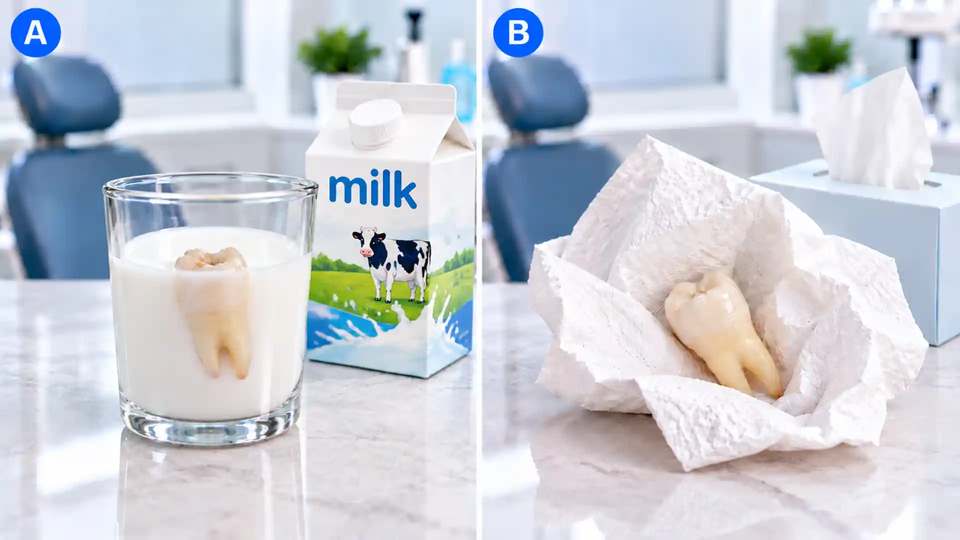
The correct quiz answer is A: Place it in milk. If a permanent tooth is knocked out, act immediately. Pick it up by the crown, avoid touching the root, and gently rinse away visible dirt with milk or saline. If safe and possible, place the tooth back into its socket. Otherwise, keep it in milk or a suitable tooth preservation solution and seek emergency dental care immediately. Never replant a baby tooth.
Key Takeaways:
A knocked-out permanent tooth is a time-sensitive dental emergency. Replantation should happen as quickly as possible when safe and appropriate.
Always handle the tooth by its crown rather than its root.
Milk can help preserve delicate periodontal ligament cells when immediate replantation is not possible.
Never wrap the tooth in dry tissue, scrub its root, or store it in plain water for an extended period.
Never replant a knocked-out primary tooth because doing so may damage the developing permanent tooth underneath.
Emergency dental assessment is necessary even when the tooth has been stored properly or successfully replanted.
This guide explains how to respond to a knocked-out permanent tooth, why milk can help, which storage methods to avoid, and what to expect during emergency dental treatment.
Medical information notice: This article provides general educational information and does not replace emergency dental or medical assessment.
Quiz Answer: How Can You Keep a Knocked-Out Permanent Tooth Moist?
Placing the tooth in milk is the correct answer. Milk provides a more suitable temporary environment for cells on a knocked-out permanent tooth's root than leaving the tooth dry.
If a confirmed permanent tooth cannot be safely replanted, immediately place it in a clean container containing enough milk to cover it. A commercially available tooth preservation solution is another suitable option.
Wrapping the tooth in dry tissue is incorrect because the root surface can dehydrate quickly. Drying damages periodontal ligament cells that contribute to healing after replantation.
Milk is a temporary preservation method, not a treatment. Bring the tooth to an emergency dentist immediately, even if considerable time has passed since the injury.
What Should You Do Immediately if a Permanent Tooth Is Knocked Out?
A knocked-out permanent tooth is a dental emergency called tooth avulsion. This means the entire tooth has been displaced from its socket by an injury.
Step 1: Check for serious injuries. Call emergency medical services for loss of consciousness, significant head trauma, difficulty breathing, uncontrolled bleeding, or other potentially serious injuries. Never prioritize tooth replantation over urgent medical needs.
Step 2: Find the tooth and hold it by the crown. The crown is the white part normally visible above the gums. Avoid touching the root because delicate periodontal ligament cells may remain attached to it.
Step 3: Gently rinse visible dirt. Briefly rinse the tooth with milk, saline, or the injured person's saliva. If these are unavailable, a brief rinse with clean water may be used. Do not scrub the root or use soap, disinfectants, or a toothbrush.
Step 4: Replant the tooth if safe and possible. If you are certain it is permanent and the injured person is conscious and cooperative, gently guide it into the original socket. Do not force it into place. The person may gently bite on clean gauze to help hold it in position.
Step 5: Use milk if replantation is not possible. Place the tooth in a clean container with enough milk to cover it, or use an appropriate tooth preservation solution.
Step 6: Seek emergency dental care immediately. Contact a dentist or endodontist and explain that a permanent tooth has been completely knocked out. Bring the tooth and its storage container.
Why Can Milk Help Save a Knocked-Out Permanent Tooth?
Milk can help preserve a knocked-out permanent tooth because its composition provides a more suitable temporary environment for periodontal ligament cells than ordinary water or dry storage.
The periodontal ligament is specialized tissue that helps attach the tooth root to the surrounding bone. When a tooth is knocked out, some ligament cells may remain attached to its root. Their condition affects the tooth's ability to heal after replantation.
Milk contains water, proteins, minerals, and other components that create an environment compatible with short-term cell preservation. Its osmotic properties are more favorable for periodontal ligament cells than those of ordinary tap water.
Osmolality describes the concentration of dissolved particles in a liquid. A poorly balanced storage environment can damage cells by causing them to swell or shrink.
Milk helps limit this damage during transport, but it does not prevent all deterioration or guarantee successful replantation. The International Association of Dental Traumatology (IADT) identifies milk as a suitable storage medium when immediate replantation is not possible.
What Kind of Milk Should You Use for a Knocked-Out Tooth?
Conventional milk is an appropriate emergency storage option for a knocked-out permanent tooth when immediate replantation is not possible.
Cold or refrigerated milk is a practical choice when readily available. However, finding a particular temperature or type of milk should never delay emergency dental treatment.
Place the tooth in a clean container containing enough milk to cover it. Keep the root submerged during transportation rather than allowing the tooth to dry out.
The established dental first-aid recommendation refers to conventional milk. Plant-based beverages such as almond, oat, and soy drinks differ considerably in composition, and their effectiveness as emergency tooth storage media is not sufficiently established to treat them as equivalent substitutes.
The most important priorities are minimizing dry time, avoiding root damage, and reaching a dentist quickly.
Milk vs. Water vs. Saliva: Which Storage Method Is Better?
The preferred immediate approach is generally to replant a confirmed permanent tooth when doing so is safe and appropriate. If replantation is not possible, use a suitable storage medium that keeps the root moist.
Immediate replantation: Preferred when safe and appropriate because it minimizes time outside the socket.
Tooth preservation solution containing Hank's Balanced Salt Solution (HBSS): Suitable for protecting cells during transportation.
Conventional milk: Suitable and widely accessible. It helps protect periodontal ligament cells.
Saliva in a clean container: An acceptable temporary alternative when better options are unavailable, although it is less ideal than milk.
Physiological saline: An acceptable option for keeping the tooth moist during transportation.
Plain water: Not recommended for prolonged storage because its osmotic properties can damage root surface cells.
Dry tissue or paper towel: Avoid because it allows the root surface to dehydrate.
Holding the tooth inside the cheek can create swallowing or choking concerns, particularly for children. A clean, closed container with an appropriate liquid is generally the safer transport option when available.
How Quickly Must a Knocked-Out Permanent Tooth Be Replanted?
A knocked-out permanent tooth should be replanted as soon as possible when safe and appropriate because periodontal ligament cells deteriorate during dry storage.
The American Association of Endodontists (AAE) recommends reaching a dentist or endodontist within 30 minutes whenever possible. Immediate replantation, ideally within minutes, generally offers more favorable conditions for healing.
According to the IADT's 2020 guidelines, most periodontal ligament cells become nonviable after approximately 30 minutes of dry storage. Dry periods exceeding 60 minutes are associated with a substantially worse biological prognosis.
These timeframes are clinical guidance rather than absolute guarantees. Outcomes also depend on the storage medium, severity of trauma, root maturity, and subsequent professional treatment.
A tooth that has been outside the mouth for more than 60 minutes should still be taken to a dentist immediately. Prolonged dry time makes normal healing less likely, but professional evaluation and replantation may still be appropriate.
Time outside the mouth and time spent dry are not the same. A tooth placed in milk soon after an injury generally has more favorable conditions for preserving root surface cells than a tooth left dry for the same period.
What if You Are Not Sure Whether the Tooth Is Permanent?
Do not attempt replantation unless you are confident the knocked-out tooth is permanent.
Primary teeth, commonly called baby teeth, should never be replanted because doing so could damage the developing permanent tooth underneath.
Permanent teeth usually begin erupting around age six. During the mixed-dentition years, children may have both primary and permanent teeth. Age and tooth position can provide clues, but neither confirms tooth type in every situation.
If you are uncertain whether the tooth is permanent, do not force it into the socket. Keep it moist and contact an emergency dentist immediately, explaining the uncertainty.
If a baby tooth is knocked out, use clean gauze or a soft cloth to apply gentle pressure if there is bleeding and arrange urgent dental assessment. The dentist can check for injuries to the gums, neighboring teeth, and developing permanent teeth.
What Happens During Emergency Tooth Avulsion Treatment?
Emergency treatment focuses on evaluating the injury, returning the permanent tooth to an appropriate position when possible, stabilizing it, and managing healing.
The dentist first examines the injured area, surrounding teeth, gums, and supporting bone. Dental X-rays may be needed to assess the socket, tooth root, neighboring teeth, and possible fractures.
The dental team reviews when the injury occurred, how long the tooth remained outside the mouth, how it was stored, and whether it has already been replanted. Tetanus vaccination status may be assessed, and the clinician determines whether antibiotics are indicated.
If replantation is appropriate, the dentist positions the tooth in the socket or checks and adjusts a tooth that has already been replanted. A flexible dental splint may be attached to neighboring teeth to provide temporary stabilization.
The IADT generally recommends flexible splinting for approximately two weeks in uncomplicated avulsion cases. Injuries involving supporting bone fractures may require a different stabilization plan.
Replanted permanent teeth with fully developed roots generally require root canal treatment, usually initiated within two weeks after replantation. Immature permanent teeth may be managed differently because their developing roots have a different potential for healing.
The dentist determines the treatment and follow-up schedule based on the individual injury.
What Should You Do After a Tooth Has Been Replanted?
Follow the dentist's specific aftercare instructions because the appropriate plan depends on the injury and treatment performed.
A soft diet may be recommended temporarily to reduce pressure on the injured area. Avoid biting directly into hard or crunchy foods with the affected tooth until the dentist advises that normal use is appropriate.
Avoid contact sports and activities that could cause another facial injury during the initial healing period.
Continue oral hygiene according to the dental team's instructions. A soft toothbrush may be recommended for gently cleaning the surrounding teeth and gums. If a dentist prescribes an antimicrobial mouth rinse or medication, use it exactly as directed.
Attend every recommended follow-up appointment. Possible complications include infection, root resorption, and ankylosis, a condition in which the tooth root becomes fused to surrounding bone.
Contact the dental office promptly if the tooth becomes increasingly painful, changes color, develops swelling, or feels unusually loose.
How Can You Find Emergency Dental Care for a Knocked-Out Tooth?
Contact your regular dentist immediately and explain that a permanent tooth has been completely knocked out. If the office is closed, check its after-hours instructions or contact an emergency dental clinic or endodontist.
Tell the dental team whether the tooth is permanent or possibly a baby tooth, approximately when the injury occurred, whether it has been replanted, how long it remained dry, and whether it is being stored in milk or another preservation medium.
Seek emergency medical care for loss of consciousness, severe head or facial injury, difficulty breathing, uncontrolled bleeding, or suspected major jaw injury. If the patient is coughing or choking and the tooth cannot be found, urgent assessment is necessary because the tooth may have entered the airway.
For isolated tooth avulsion without other serious injuries, immediate dental treatment is generally the priority.
If emergency dental care is unavailable, contact a hospital emergency department for guidance rather than waiting until the next day. Keep the tooth in an appropriate storage medium during transport unless it has already been safely replanted.
Do not delay emergency treatment while comparing prices or waiting for insurance authorization.
Common Mistakes That Can Reduce the Chance of Saving a Tooth
Touching, scrubbing, or scraping the root: The root contains delicate periodontal ligament cells needed for healing.
Cleaning the tooth with soap or disinfectants: These substances can damage root surface cells and are not appropriate for routine avulsion first aid.
Wrapping the tooth in dry tissue or paper: Dry storage allows rapid dehydration and should be avoided.
Storing the tooth in plain water: Extended water exposure can damage periodontal ligament cells because of osmotic imbalance.
Forcing the tooth into its socket: If the tooth does not fit easily or safe replantation is uncertain, keep it moist and seek emergency care.
Attempting to replant a baby tooth: Primary teeth should never be replanted because the developing permanent tooth underneath may be injured.
Delaying treatment because bleeding or pain has improved: A knocked-out permanent tooth remains a dental emergency even when symptoms appear manageable.
How Can You Reduce the Risk of Knocked-Out Teeth?
Not every dental injury can be prevented, but a properly fitted mouthguard can help protect teeth during sports involving collisions, falls, or contact with equipment.
Families and schools can also reduce avoidable fall hazards and keep basic dental emergency supplies accessible, including clean gauze, a secure container, and emergency dental contact information.
A commercially available tooth preservation product may be useful in settings where dental injuries are possible. However, do not delay emergency treatment searching for a preservation kit when milk or another suitable storage medium is readily available.
Knowing the difference between a knocked-out permanent tooth and a primary tooth is especially important for caregivers, coaches, teachers, and other adults supervising children.
Frequently Asked Questions About Knocked-Out Permanent Teeth
How can you keep a knocked-out permanent tooth moist if it cannot be put back in place?
Place it in conventional milk or an appropriate tooth preservation solution and seek emergency dental care immediately. Do not wrap it in dry tissue.
Can milk really help save a knocked-out permanent tooth?
Milk can help preserve periodontal ligament cells on the root during transportation. It does not guarantee successful replantation, but it is a suitable temporary storage option.
What kind of milk should I use?
Conventional milk is appropriate. Refrigerated milk is practical when available, but do not delay treatment searching for a particular temperature or type.
Can a dentist save a tooth after one hour?
Possibly. Prolonged time outside the mouth, especially when the tooth remains dry, reduces the likelihood of favorable healing. However, professional evaluation and replantation may still be appropriate. Bring the tooth to a dentist immediately.
Should I put a knocked-out tooth back into its socket?
If the tooth is confirmed to be permanent and the injured person is conscious, cooperative, and able to tolerate the procedure safely, immediate gentle replantation is generally preferred. Do not force the tooth into place, and never replant a baby tooth.
What if I cannot find the knocked-out tooth?
Seek urgent dental evaluation anyway. A dentist can assess the injury and determine whether the tooth is missing, displaced into surrounding tissue, or affected by another type of trauma. Breathing difficulties or suspected aspiration require emergency medical care.
Will a replanted permanent tooth need a root canal?
Permanent teeth with fully developed roots generally require root canal treatment, usually initiated within two weeks after replantation. Immature teeth may be managed differently according to root development and healing.
Sources
- American Association of Endodontists (AAE). Knocked Out Teeth. https://www.aae.org/patients/dental-symptoms/knocked-out-teeth/
- International Association of Dental Traumatology (IADT). Guidelines for the Management of Traumatic Dental Injuries: Avulsion of Permanent Teeth. Dental Traumatology, 2020. https://doi.org/10.1111/edt.12573
- American Dental Association, MouthHealthy. Dental Emergencies. https://www.mouthhealthy.org/all-topics-a-z/dental-emergencies
- American Academy of Pediatric Dentistry (AAPD). Acute Management of an Avulsed Permanent Tooth. https://www.aapd.org/research/oral-health-policies--recommendations/decision-trees-for-management-of-an-avulsed-permanent-tooth/
- National Health Service (NHS). Knocked-Out Tooth. https://www.nhs.uk/conditions/knocked-out-tooth/
- Mayo Clinic. Tooth Loss: First Aid. https://www.mayoclinic.org/first-aid/first-aid-tooth-loss/basics/art-20056635