Dental Implants vs. Removable Dentures: How Missing Teeth Can Be Replaced
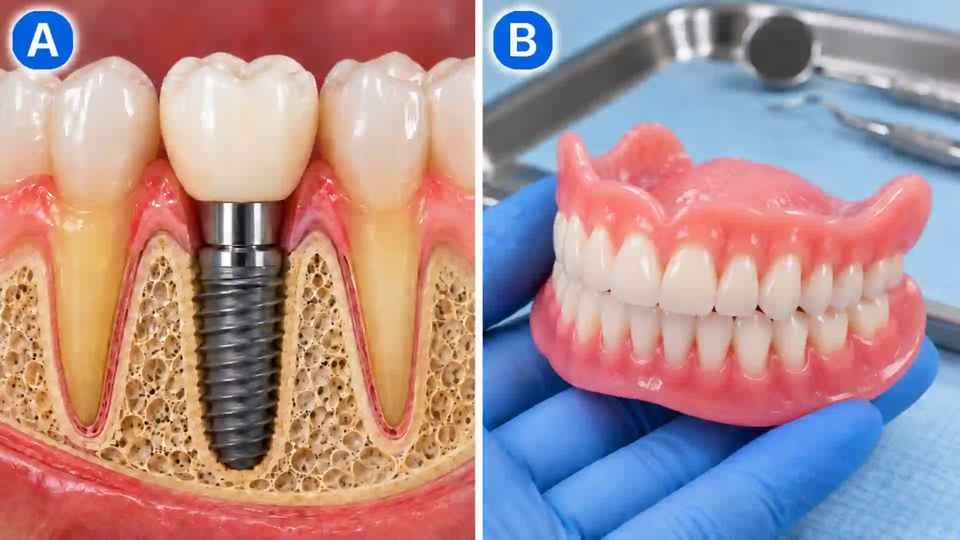
The correct quiz answer is A: Dental implant. Dental implants and removable dentures can both replace missing teeth, but they differ in stability, treatment time, cost, and maintenance. Implants are surgically placed in the jawbone to support replacement teeth, while conventional removable dentures rest on the gums and may attach to remaining teeth. The better choice depends on oral health, bone condition, budget, and personal preferences.
Key Takeaways:
Dental implants provide stable anchorage for individual crowns, bridges, or dentures. The replacement teeth may be fixed or removable depending on the restoration design.
Conventional removable dentures replace missing teeth without implant surgery, although adjustments may become necessary as the mouth changes.
Dental implants generally involve higher initial costs, while dentures may require relining, repairs, or replacement over time.
Implant-supported dentures combine jawbone-anchored implants with denture restorations. Some are removable by the patient, while others are fixed.
Bone health, periodontal disease, medical conditions, cleaning requirements, and treatment goals should guide the decision.
Both options require ongoing oral care and professional evaluation.
This guide compares dental implants and removable dentures, explains how each option works, and reviews treatment procedures, costs, maintenance, and practical selection criteria.
Medical information notice: This article provides general educational information and does not replace individualized dental examination, diagnosis, or treatment planning.
Quiz Answer: Which Option Replaces a Missing Tooth Using Support Anchored in the Jawbone?
Dental implant is the correct answer. A dental implant is surgically inserted into the jawbone to provide a stable foundation for a replacement tooth or another dental restoration.
For a single missing tooth, an implant commonly supports a dental crown through a connecting component called an abutment. Implants can also support dental bridges and certain types of dentures.
A conventional removable denture works differently. It rests on the gums and supporting jaw structures, and a removable partial denture may also attach to remaining natural teeth.
The distinction concerns the source of support, not simply whether the visible replacement teeth can be removed. Some implant-supported dentures are removable, but their support still comes from implants anchored in the jawbone.
Both approaches can replace missing teeth. A dentist determines which option is appropriate after examining the mouth, supporting bone, remaining teeth, and overall health.
How Do Dental Implants and Removable Dentures Replace Missing Teeth?
Dental implants replace the support normally provided by tooth roots, while conventional removable dentures replace visible teeth and rest on the gums or other supporting oral structures.
A dental implant is a medical device surgically placed in the jawbone. Most implant bodies are made from titanium-based materials or zirconia ceramics.
A typical implant-supported single-tooth restoration includes three components: the implant body placed in the jawbone, an abutment connecting the implant to the restoration, and a dental crown forming the visible replacement tooth.
During healing, the surrounding bone can form a stable connection with the implant surface through a process called osseointegration.
A conventional removable denture contains artificial teeth attached to a supporting base. Complete dentures replace all teeth in an upper or lower arch, while partial dentures replace selected missing teeth when natural teeth remain.
Conventional complete dentures receive support primarily from the gums and jaw ridges. Partial dentures may use clasps or attachments connected to remaining teeth.
Both options can improve chewing, speech, and appearance, but their support systems and treatment requirements differ.
Dental Implants vs. Dentures: What Are the Main Differences?
The main differences between dental implants and conventional removable dentures involve support, stability, surgery, treatment duration, cost, and maintenance.
Primary support: Dental implants are surgically anchored in the jawbone. Conventional removable dentures rest on the gums and jaw ridges, sometimes with support from remaining natural teeth.
Surgery: Implant placement requires surgery. Conventional denture placement generally does not require implant surgery, although extractions or other preparatory procedures may still be necessary.
Stability: Successfully integrated implants generally provide stable support. Conventional dentures may move during eating or speaking, particularly when their fit changes.
Removal: Single implant crowns are usually fixed. Certain implant-supported dentures can be removed by the patient. Conventional removable dentures are designed to be taken out.
Bone requirements: Implant placement requires adequate bone or additional preparation. Conventional dentures can often be made without implant-level bone support.
Costs and treatment time: Implants generally involve a higher initial investment and may require several months of healing. Conventional dentures often involve a shorter treatment process, although healing after extractions can affect timing.
Long-term care: Implant restorations require cleaning and monitoring, while conventional dentures may need adjustment, relining, or replacement.
Costs and treatment time should be compared for the same clinical need. Replacing one tooth with an implant is not directly comparable to replacing an entire arch with a complete denture.
Which Tooth Replacement Options Are Available?
The available options depend on how many teeth are missing, where they were located, and which supporting tissues remain healthy.
Single-tooth dental implant: One implant supports a replacement crown. This may be suitable for replacing one tooth without preparing neighboring teeth to support a conventional bridge.
Removable partial denture: An appliance replaces one or several missing teeth while other natural teeth remain. It may use an acrylic base, metal framework, clasps, or other attachments.
Complete removable denture: An appliance replaces all teeth in an upper or lower arch and receives support primarily from the gums and underlying jaw structure.
Implant-supported denture: One or more implants provide support or retention for a denture restoration. Some implant overdentures are removable by the patient, while fixed full-arch restorations generally require professional removal.
A removable implant overdenture can offer greater retention than a conventional complete denture while allowing removal for cleaning.
These designs should not be confused with conventional dentures that have no implant support. A dentist can explain which restorations are clinically suitable for the number and location of missing teeth.
Who Is a Good Candidate for Dental Implants?
A suitable dental implant candidate generally has adequate bone support, healthy or appropriately treated gums, and medical circumstances compatible with surgery and healing.
Eligibility cannot be determined from age alone. A dentist evaluates the jawbone, remaining teeth, bite, oral hygiene, and medical history.
After tooth loss, the jawbone may gradually change because it no longer receives the same functional stimulation from natural tooth roots. If insufficient bone remains, implant placement may require additional preparation or a different treatment approach.
Specialized imaging may be recommended to assess bone height, width, nearby anatomical structures, and surgical planning needs.
Smoking, poorly controlled diabetes, certain medications, and some medical conditions can affect implant healing or surgical risk.
Tell your dentist about osteoporosis medications, previous cancer treatment, radiation therapy involving the jaws, and other significant health conditions.
These factors do not automatically rule out implants, but they may change the recommended treatment or require additional assessment.
Do You Need a Bone Graft Before Getting Dental Implants?
Bone grafting is not necessary for every dental implant.
A dental bone graft uses bone or a bone-substitute material to rebuild or support an area of the jaw where additional bone may be needed.
When the available jawbone is insufficient, grafting may help create more suitable conditions for implant placement. The amount of treatment and healing time depend on the location, available bone, and individual circumstances.
The American Academy of Periodontology describes ridge modification as one approach for rebuilding deficient jawbone before or during implant treatment.
A dentist or specialist should explain whether grafting is necessary, how it affects the treatment timeline and cost, and whether alternative replacement options are available.
The decision should be based on clinical examination and appropriate imaging rather than assuming everyone with missing teeth requires bone grafting.
Can People With Gum Disease Get Dental Implants?
People with a history of gum disease may still be candidates for dental implants, but active periodontal disease requires appropriate assessment and management.
Periodontal disease involves inflammation or destruction of tissues that support natural teeth. Untreated periodontitis can affect implant planning because healthy supporting tissues and adequate bone are important for successful treatment.
Depending on the diagnosis, periodontal care may involve improved plaque removal, professional cleaning, scaling and root planing, or specialist treatment.
Scaling and root planing is not automatically required before every implant procedure. The treatment depends on the person's periodontal condition.
A periodontist may help evaluate the jawbone, manage periodontal problems, and plan implant placement.
Even after gum disease is treated, a history of periodontitis may increase the risk of inflammation around implants. Ongoing home care and professional maintenance remain essential.
What Happens During the Dental Implant Procedure?
Dental implant treatment usually involves evaluation, surgical placement, healing, and attachment of the final restoration. The exact sequence depends on whether extractions, bone grafting, or other preparatory procedures are necessary.
Step 1: Examination and treatment planning. The dentist assesses the teeth, gums, bite, supporting bone, medical history, and treatment goals. Dental X-rays or three-dimensional imaging may be recommended when necessary.
Step 2: Preparing the implant site. A damaged remaining tooth may require extraction. Some patients also need bone grafting or treatment of existing oral disease.
Step 3: Placing the implant. The clinician surgically positions the implant body within the jawbone. Local anesthesia is commonly used, while additional anesthesia or sedation may be appropriate in selected cases.
Step 4: Healing and osseointegration. The implant develops sufficient stability through its connection with surrounding bone. Healing may take several months or longer depending on the case.
Step 5: Attaching the final restoration. Once healing and stability are satisfactory, an abutment and crown, bridge, or denture restoration can be attached. The dentist evaluates appearance, chewing function, and bite alignment.
Some patients may receive temporary or earlier restorations, but immediate restoration is not appropriate for everyone.
Professional monitoring continues after treatment is completed.
What Happens When You Get Removable Dentures?
Conventional removable dentures usually do not require implant surgery, but fitting them involves several clinical stages.
Step 1: Oral examination. The dentist evaluates remaining teeth, gum health, jaw ridges, and whether extractions or other treatment are needed before denture fabrication.
Step 2: Impressions or digital records. The dental team records the shape of the supporting tissues to help design the appliance.
Step 3: Bite and appearance assessment. The dentist evaluates how the jaws meet and how the proposed replacement teeth will look and function. A trial arrangement may be used when appropriate.
Step 4: Denture delivery and adjustment. The finished appliance is fitted and checked. New dentures may initially feel bulky, and speaking or eating can require a period of adaptation.
Step 5: Ongoing fit evaluation. Gum and jawbone contours may change over time, making adjustments, relining, or replacement necessary.
Persistent pressure spots, pain, or looseness should be discussed with the dentist. Denture adhesives are not a substitute for correcting an improperly fitting appliance.
Which Option Feels More Stable When Eating and Speaking?
Successfully integrated dental implants generally provide more stable support than conventional removable dentures.
However, comfort and chewing ability depend on restoration design, fit, bite, number of missing teeth, and individual adaptation.
Implant-supported restorations can provide firm support during chewing. Patients must still follow healing instructions and avoid excessive forces that could damage the implant or restoration.
People adapting to removable dentures may find it helpful to begin with soft foods and smaller bites. Chewing on both sides can help distribute pressure more evenly.
Very sticky or hard foods may remain difficult for some denture wearers. A denture that repeatedly moves or causes pain should be professionally evaluated.
Both options can improve speech affected by missing teeth. Dentures may initially change tongue space and the pronunciation of certain sounds, while implant restorations can also affect comfort if components are bulky or poorly designed.
Greater stability is one consideration, but it does not mean implants are the best choice for every patient.
How Much Do Dental Implants and Dentures Cost?
Dental implant treatment generally has a higher initial cost than conventional removable dentures because it involves surgical and restorative components.
Actual costs vary substantially with geographic location, number of missing teeth, treatment complexity, materials, bone conditions, and the dental provider.
Dental implant costs may include an initial examination, diagnostic imaging, extractions, surgical placement, bone grafting when needed, the abutment, final crown or other restoration, and follow-up appointments.
Conventional denture costs may include examination, impressions, denture fabrication, adjustments, and future relining, repairs, or replacement.
To compare costs fairly, consider the same number of missing teeth and the same functional goal. A single implant crown and a complete removable denture treat different clinical needs and should not be compared as equivalent procedures.
Long-term cost planning should include future maintenance. A lower initial cost does not always mean a lower lifetime cost, but the higher initial expense of implants does not guarantee that they will cost less over time.
Request written estimates identifying all planned procedures, possible additional treatment, and expected maintenance.
Does Dental Insurance Cover Implants or Dentures?
Dental insurance coverage for implants and dentures varies by policy.
Some plans cover selected implant components or restorations, while others exclude implant surgery or impose substantial coverage limitations.
Removable denture coverage may also depend on eligibility, waiting periods, annual maximums, frequency restrictions, and other plan conditions.
Original Medicare generally does not cover routine dental implants or dentures. Certain dental services connected to qualifying medical treatment may be covered under specific circumstances. Medicare Advantage plans may offer additional dental benefits depending on the plan.
Before committing to treatment, ask which procedures are covered, whether the dental provider is in network, what limits apply, and what the estimated out-of-pocket cost will be.
A written estimate from the dental office and benefit information from the insurer provide a more useful comparison than assuming either option is automatically covered.
What Are the Risks of Dental Implants?
Dental implants involve surgery and ongoing biological and mechanical risks.
Potential complications include infection, nerve injury, sinus-related problems in certain upper-jaw procedures, loosening of implant components, and implant failure.
Peri-implantitis is an inflammatory condition associated with loss of supporting bone around a dental implant. It can threaten long-term stability if not appropriately managed.
Smoking, a history of periodontal disease, poor plaque control, and certain medical conditions may influence implant-related risks.
Regular cleaning around implant restorations and professional monitoring are important even after healing is complete.
Contact a dentist if you notice increasing pain, swelling, bleeding, or movement around an implant.
Implants may function successfully for many years, but no implant treatment guarantees permanent success or freedom from repairs.
What Problems Can Develop With Removable Dentures?
Conventional removable dentures may cause pressure sores, looseness, difficulty chewing, or irritation as the fit changes over time.
Jawbone and gum contours can change after tooth loss, making a previously comfortable denture unstable or uncomfortable.
Poorly maintained dentures may accumulate plaque and microorganisms, contributing to oral irritation and other complications.
Daily cleaning, proper storage, and regular evaluation of the appliance and supporting tissues are important.
Patients should not rely indefinitely on additional denture adhesive to compensate for poor fit. Persistent looseness, soreness, or changes in chewing function require professional assessment.
Denture adjustments, relining, repairs, or replacement may be needed as oral tissues and appliance materials change.
How Should You Care for Dental Implants and Removable Dentures?
Both dental implants and removable dentures require consistent care, but their cleaning routines differ.
Dental implants: Brush and clean around the implant-supported restoration as instructed. Interdental brushes, floss, or other specialized cleaning tools may be recommended according to the restoration design.
Removable dentures: Remove and clean the appliance daily using a suitable denture brush and nonabrasive cleanser. Follow the dentist's guidance for cleaning supporting gums, remaining natural teeth, and any attachments.
Implant-supported removable dentures: Clean both the removable restoration and the implant attachments according to professional instructions.
Professional examinations remain necessary to monitor implant tissues, restoration integrity, denture fit, and changes in oral health.
Implant warning signs include persistent bleeding, swelling, pain, or looseness. Denture warning signs include pressure sores, irritation, unstable fit, and persistent discomfort.
The most appropriate maintenance routine depends on the final restoration and the patient's oral health.
How Should You Choose Between Dental Implants and Dentures?
Choosing a missing-tooth replacement begins with identifying which teeth need to be replaced, whether surgery is suitable, and what maintenance responsibilities are manageable.
Replacing one tooth without a removable appliance: Discuss a single implant and crown when oral conditions allow.
Replacing several teeth without implant surgery: A removable partial denture may be appropriate.
Replacing all teeth with a lower initial investment: Conventional complete dentures may be worth considering.
Improving retention of a loose complete denture: An implant-supported overdenture may provide greater stability in suitable patients.
Avoiding surgery because of medical concerns: Removable dentures or other nonsurgical options may be preferable.
Significant jawbone loss: Dentures or implants with additional assessment and possible grafting may be considered.
Wanting fixed replacement teeth across an entire arch: A fixed implant-supported restoration may be an option when conditions are favorable.
These are discussion points rather than automatic treatment recommendations. A comprehensive dental examination is necessary before selecting a procedure.
Three Common Missing-Tooth Replacement Scenarios
Scenario 1: One missing back tooth. A patient with healthy gums and sufficient bone may consider a single dental implant and crown. A conventional dental bridge or removable partial denture may also be discussed depending on neighboring teeth, oral health, and budget.
Scenario 2: Several missing teeth and limited funds. A removable partial denture may restore function and appearance without the initial expense of multiple implants. The dentist should assess how the appliance will affect remaining natural teeth.
Scenario 3: A loose lower complete denture. A patient who struggles with denture movement while eating may benefit from discussing an implant-supported overdenture. The decision depends on available bone, medical suitability, cost, and cleaning ability.
In each situation, the best choice depends on the specific clinical need rather than a general assumption that implants or dentures are always superior.
Questions to Ask Before Choosing Tooth Replacement Treatment
Before agreeing to a treatment plan, discuss the available options with your dentist.
Which replacements are appropriate for the number and location of my missing teeth?
Do I have adequate bone for implant placement, or would bone grafting be necessary?
Are there gum disease, tooth decay, or other oral health problems that need treatment first?
What procedures, healing stages, and follow-up visits should I expect?
Will the final restoration be fixed or removable, and how will it attach to its supporting structures?
What costs are included in the written treatment estimate, and which services may be billed separately?
How will I clean and maintain the replacement teeth?
What happens if an implant fails, a restoration breaks, or a denture becomes loose?
Clear answers can help patients compare function, treatment complexity, maintenance, cost, and long-term expectations.
Common Mistakes to Avoid When Comparing Dental Implants and Dentures
Assuming every implant-supported restoration is fixed: Some implant-supported dentures can be removed by the patient. The implant remains anchored in the jawbone, but the replacement teeth may be fixed or removable.
Comparing unrelated treatment scopes: The cost of replacing one tooth with an implant should not be compared directly with the cost of a complete denture replacing an entire arch.
Ignoring bone and gum health: Adequate supporting bone and healthy or appropriately treated gums are important for implant planning.
Choosing based only on the initial price: Future maintenance, repairs, relining, and replacement may affect long-term costs.
Assuming implants require no maintenance: Implants and their restorations need daily cleaning and professional monitoring.
Using adhesive instead of correcting poor denture fit: Persistent looseness or irritation should be assessed by a dentist.
Frequently Asked Questions About Dental Implants and Removable Dentures
Which option replaces a missing tooth using support anchored in the jawbone?
A dental implant is surgically anchored in the jawbone and can support a replacement crown, bridge, or denture. A conventional removable denture primarily rests on the gums and supporting oral structures.
Are dental implants better than removable dentures?
Dental implants generally provide greater stability, but they require surgery and suitable bone and gum conditions. Conventional removable dentures avoid implant surgery and may cost less initially. The better choice depends on individual circumstances.
Can you get dental implants after wearing dentures for years?
Possibly. Long-term tooth loss may involve jawbone changes, but previous denture use does not automatically rule out implants. A dentist must evaluate available bone and whether additional procedures are needed.
How long do dental implants and dentures last?
Longevity varies. Implants may function for many years, but failure and restoration repairs are possible. Dentures may require relining, adjustment, or replacement as oral tissues and appliance materials change.
Are implant-supported dentures removable?
Some are. Implant overdentures may be removed by the patient for cleaning, while fixed full-arch implant restorations are generally removed only by a dental professional.
Can people with gum disease get dental implants?
They may be eligible after appropriate examination and treatment. Active periodontal disease may need to be managed before implant placement, and long-term periodontal maintenance remains important.
What if I cannot afford dental implants?
Ask about removable partial or complete dentures, conventional bridges when appropriate, and staged treatment plans. Compare written cost estimates and verify insurance benefits before choosing a replacement.
Sources
- U.S. Food and Drug Administration (FDA). Dental Implants: What You Should Know. https://www.fda.gov/medical-devices/dental-devices/dental-implants-what-you-should-know
- American Dental Association (ADA), MouthHealthy. Implants. https://www.mouthhealthy.org/all-topics-a-z/implants
- American Dental Association (ADA), MouthHealthy. Dentures. https://www.mouthhealthy.org/all-topics-a-z/dentures
- American Dental Association (ADA), MouthHealthy. Partial Dentures. https://www.mouthhealthy.org/all-topics-a-z/dentures-partial
- American Academy of Periodontology (AAP). Ridge Modification. https://www.perio.org/for-patients/periodontal-treatments-and-procedures/dental-implant-procedures/ridge-modification/
- American Academy of Periodontology (AAP). Peri-Implant Diseases. https://www.perio.org/for-patients/periodontal-treatments-and-procedures/dental-implant-procedures/peri-implant-diseases/
- American Dental Association (ADA). Denture Care and Maintenance. https://www.ada.org/resources/ada-library/oral-health-topics/dentures
- Medicare.gov. Dental Services. https://www.medicare.gov/coverage/dental-services