When Do Wisdom Teeth Need Removal? Signs, Risks, and Treatment Options
The correct quiz answer is A: When it causes problems or poses a dental risk. Wisdom teeth may need removal when they cause recurring infection, significant pain, untreatable decay, cysts, or damage to neighboring teeth. However, healthy wisdom teeth, including some impacted teeth, do not automatically require extraction. A dentist examines symptoms, gum health, tooth position, and X-rays to decide whether removal, another treatment, or regular monitoring is the safest choice.
Key Takeaways:
Wisdom tooth removal is not automatic. Healthy, functional teeth that are easy to clean may remain in place.
Repeated gum infections, unrestorable decay, cysts, and damage to the adjacent molar are common reasons to consider extraction.
An impacted wisdom tooth is not necessarily infected or diseased.
Wisdom tooth surgery carries potential risks, including dry socket, infection, bleeding, and temporary or occasionally lasting nerve symptoms.
Extraction difficulty, anesthesia, location, and dental insurance benefits can affect treatment costs and recovery.
The decision should consider clinical findings, surgical risks, patient preferences, and the feasibility of monitoring.
This guide explains when wisdom teeth need removal, which symptoms deserve attention, how dentists evaluate impacted teeth, what treatment options are available, and what to expect during surgery and recovery.
Medical information notice: This article provides general educational information and does not replace individualized examination, diagnosis, or treatment by a licensed dentist or oral and maxillofacial surgeon.
Quiz Answer: When Might a Wisdom Tooth Need to Be Removed?
A wisdom tooth may need to be removed when it causes problems or poses a significant dental risk. This is the correct answer.
Reasons for extraction may include recurring gum infection, significant pain attributable to the tooth, untreatable decay, cysts, damage to the neighboring second molar, or interference with another necessary dental procedure.
The statement that all wisdom teeth must be removed is incorrect. A healthy, functional wisdom tooth may remain in place, particularly when it can be cleaned effectively and shows no evidence of disease.
Some impacted wisdom teeth without symptoms or disease can also be monitored. Impaction alone does not establish that extraction is necessary.
A dentist or oral surgeon evaluates the tooth's position, surrounding tissues, radiographic findings, potential future risks, and complications associated with surgery before recommending treatment.
When Do Wisdom Teeth Actually Need Removal?
Wisdom teeth, also called third molars, are the last permanent teeth. They commonly emerge around ages 17 to 21, although some people never develop all four.
Removal is considered when a wisdom tooth is diseased, repeatedly symptomatic, or threatens nearby structures. A healthy, functional tooth may need only routine dental care.
Recurring pericoronitis: Infection or inflammation beneath gum tissue covering a partly erupted wisdom tooth can become a repeated problem.
Untreatable decay: A wisdom tooth may need extraction when a cavity cannot be predictably restored or the tooth cannot be adequately cleaned.
Damage to neighboring teeth: An impacted or poorly positioned wisdom tooth may contribute to decay, periodontal damage, or root resorption affecting the adjacent second molar.
Cysts or other abnormal changes: Pathological changes around a wisdom tooth may require treatment, including possible extraction.
Persistent pain: Pain attributable to the third molar after appropriate examination may support removal.
Interference with other necessary treatment: A wisdom tooth may obstruct certain dental or jaw procedures.
The American Dental Association recognizes these clinical considerations. However, pain near the back of the jaw can have causes unrelated to a wisdom tooth, so diagnosis should precede treatment.
What Wisdom Tooth Symptoms Need Attention?
Wisdom tooth symptoms can include tenderness, swollen gums, trapped food, unpleasant taste, and difficulty opening the mouth. Some impacted teeth cause no symptoms at all.
No pain, healthy gums, and no visible damage: Monitoring may be appropriate after dental evaluation.
Food repeatedly trapped behind the second molar: Cleaning may be difficult, especially when a wisdom tooth has only partly erupted. Arrange an examination and ask about hygiene measures.
Tender gum tissue or occasional swelling: This may indicate pericoronitis, which is inflammation around a partially erupted tooth.
Recurring swelling, foul taste, or discharge: Repeated infection requires prompt dental assessment.
Pain involving the neighboring second molar: The problem may involve decay, periodontal damage, or another dental condition requiring examination.
Fever, worsening facial swelling, or increasing difficulty opening the mouth: Seek urgent dental or medical assessment because infection may be spreading.
Difficulty breathing or swallowing, or rapidly spreading swelling: Seek emergency medical care immediately.
A single mild episode of gum inflammation does not automatically mean extraction is necessary. The dentist considers severity, recurrence, anatomy, and the likelihood of managing the problem.
What Is an Impacted Wisdom Tooth?
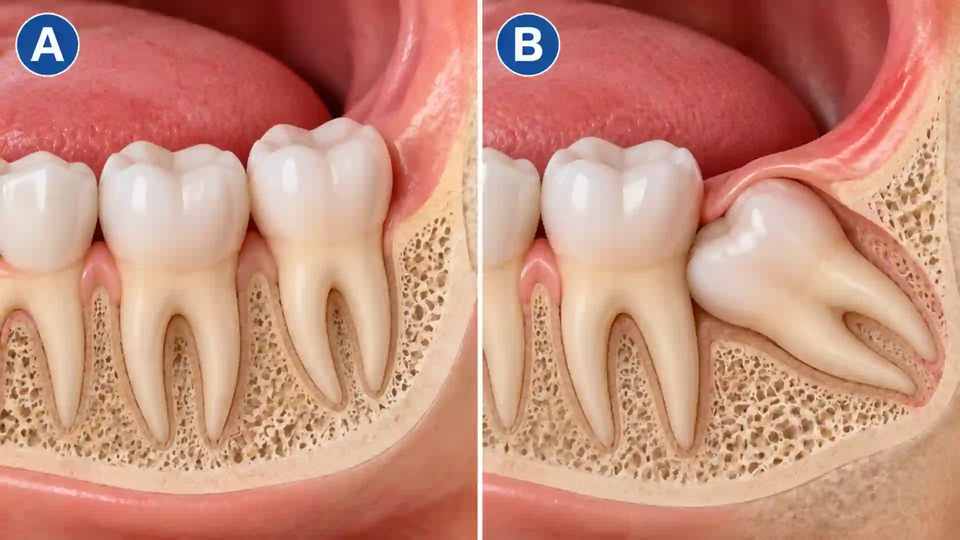
An impacted wisdom tooth cannot emerge normally because its path is blocked by gum tissue, bone, another tooth, or its own position.
Impaction describes the tooth's location and eruption pattern. It does not automatically mean the tooth is diseased, infected, or requires removal.
Fully erupted and functional wisdom tooth: A tooth that is properly positioned, healthy, and accessible for cleaning may remain in place with routine care.
Partially erupted wisdom tooth: Gum tissue may cover part of the tooth, allowing food and bacteria to accumulate. The dentist evaluates whether inflammation or infection is present and whether it recurs.
Fully impacted wisdom tooth without disease: Monitoring may be appropriate when examination and imaging do not reveal relevant problems.
Wisdom tooth impacted against the second molar: This position may create concerns about decay, root resorption, or damage to the neighboring tooth and requires individualized assessment.
Wisdom teeth may be upright, tilted, partially visible, or completely covered by gum and bone. Dental X-rays help determine their position and relationship to nearby structures.
Should Painless or Healthy Wisdom Teeth Be Removed?
Not necessarily. Wisdom teeth without symptoms do not automatically require extraction, but the absence of pain does not guarantee the absence of disease.
A clinical examination may reveal decay, gum problems, or damage to the neighboring second molar even when a patient feels comfortable.
A 2020 Cochrane systematic review found insufficient evidence to determine whether asymptomatic, disease-free impacted wisdom teeth should routinely be removed or retained. The available studies provided low- to very-low-certainty evidence.
The American Association of Oral and Maxillofacial Surgeons supports managing third molars with disease or significant risk while actively monitoring teeth without these findings.
The UK's National Institute for Health and Care Excellence advises against routine preventive extraction of pathology-free impacted third molars within the NHS.
These perspectives emphasize the need to assess the individual tooth rather than apply a universal extraction rule.
Monitoring may be reasonable when no disease is evident, the adjacent second molar remains healthy, surgical risks are meaningful, and the patient can attend appropriate follow-up examinations.
Removal may be favored when repeated infection, cyst formation, unrestorable decay, or damage to nearby structures makes retention less appropriate.
The decision should reflect clinical findings, potential risks, patient preferences, and the feasibility of continued monitoring.
Wisdom Tooth Monitoring vs. Removal: How Do You Compare the Options?
Monitoring and extraction serve different purposes. Monitoring aims to identify changes while retaining a tooth; extraction removes the tooth when the expected benefit justifies the procedure and its risks.
Current disease: A disease-free tooth may be monitored, while infection, a cyst, significant damage, or unrestorable decay may favor removal.
Symptoms: A stable tooth without symptoms may be suitable for observation. Recurrent or significant symptoms may support extraction after diagnosis.
Neighboring second molar: Retention may be appropriate when the adjacent tooth is healthy and accessible for cleaning. Developing decay or periodontal damage may alter the recommendation.
Surgical risk: Nerve proximity, medical conditions, and anatomical complexity can influence whether surgery offers a favorable balance of benefits and risks.
Ability to attend follow-up: Monitoring requires appropriate dental examinations and imaging when indicated. It cannot guarantee that future disease will be prevented.
For example, a completely buried, disease-free wisdom tooth may be monitored, while one causing repeated infections and damage to its neighbor may warrant removal.
The most appropriate plan depends on the specific tooth and the patient's overall circumstances.
How Does a Dentist Decide Whether Extraction Is Needed?
A dentist evaluates wisdom teeth using symptom history, examination findings, medical history, and appropriate dental imaging. An oral surgeon may assess more complex cases.
Step 1: Review symptoms. The dentist asks when pain, swelling, or infection began, how often symptoms recur, and whether previous treatment has helped.
Step 2: Examine the mouth. The clinician checks gum tissue around the wisdom tooth, visible decay, jaw opening, and the condition of the adjacent second molar.
Step 3: Review imaging. A panoramic or another appropriate dental X-ray helps show the tooth's position, roots, and relationship to nearby structures.
Step 4: Evaluate anatomical risks. Lower wisdom tooth roots may be close to sensory nerves, while upper wisdom teeth may be near the maxillary sinus.
Step 5: Discuss alternatives. Monitoring, local treatment, restorative care, and surgical removal may be considered according to the diagnosis.
Step 6: Establish follow-up. If the tooth remains in place, the dentist explains how it will be monitored and which symptoms require attention.
Cone-beam computed tomography, or CBCT, is not routinely required before wisdom tooth removal.
A surgeon may consider CBCT when conventional dental X-rays cannot answer a specific clinical question that could affect treatment planning.
The proximity of a wisdom tooth to a nerve does not automatically mean that a CBCT scan is necessary.
What Questions Should You Ask Before Wisdom Tooth Removal?
Before agreeing to extraction, ask the dentist or oral surgeon to explain the diagnosis and expected benefit.
What specific disease, symptom, or significant future risk makes removal advisable?
Is the neighboring second molar healthy, and can the area be cleaned effectively?
What do the dental X-rays show about the wisdom tooth roots, nearby nerves, and surrounding bone?
Could the tooth be monitored instead, and what changes would make extraction necessary?
Would a general dentist or oral and maxillofacial surgeon perform the procedure?
Would a different treatment, such as local gum care, a restoration, or coronectomy, be appropriate?
What anesthesia will be used, and what transportation or driving restrictions will apply?
What recovery restrictions and possible complications should be expected?
What services are included in the written treatment estimate?
These questions help patients make informed decisions based on their specific dental condition rather than the assumption that every wisdom tooth should be removed.
What Treatment Options Are Available Besides Full Removal?
Not every wisdom tooth problem requires immediate full extraction. The appropriate treatment depends on the diagnosis, tooth position, surrounding anatomy, and likelihood of recurrence.
Active monitoring: A disease-free wisdom tooth may be reviewed during future dental appointments, with additional imaging when clinically indicated. Monitoring helps identify changes but does not prevent future disease.
Local treatment: A dentist may clean or irrigate inflamed gum tissue around a partially erupted tooth and explain how to keep the area clean. Recurrent or severe pericoronitis may shift the recommendation toward extraction.
Antibiotics are reserved for appropriate clinical indications, such as spreading infection. They do not automatically resolve an underlying structural or recurring problem.
Restorative treatment: A fully accessible wisdom tooth with treatable decay may sometimes be restored. Limited access, repeated decay, or damage to the neighboring molar may make restoration less appropriate.
Coronectomy: In selected lower wisdom teeth positioned very close to a sensory nerve, an oral surgeon may remove the crown while intentionally leaving healthy roots in place.
Coronectomy may reduce the risk of nerve injury in suitable cases, but retained roots can occasionally cause later problems and require follow-up.
The procedure is not suitable for every impacted tooth. Infection involving the roots or other unfavorable findings may rule it out.
An oral surgeon determines whether coronectomy or another approach is appropriate.
What Happens During Wisdom Tooth Removal?
Wisdom tooth removal may involve a straightforward extraction or a surgical procedure, depending on how the tooth has erupted and its relationship to surrounding tissues.
A fully erupted tooth may be removed by a dentist without an incision. Impacted or complicated teeth may require surgical extraction by an appropriately trained dentist or oral and maxillofacial surgeon.
Step 1: Confirm the treatment plan. The clinician reviews the diagnosis, medical conditions, medications, imaging, and informed consent. Ask about sedation, fasting, and transportation before the appointment.
Step 2: Provide anesthesia. Local anesthesia numbs the area. Sedation or general anesthesia may be offered in selected cases according to procedure complexity, anxiety, and medical suitability.
Step 3: Access the tooth. A fully erupted tooth may be removed directly. For an impacted tooth, the surgeon may open the gum and remove a limited amount of covering bone.
Step 4: Remove the tooth. The tooth may be removed intact or divided into sections to reduce the force required.
Step 5: Protect the surgical site. The clinician cleans the area, places stitches when appropriate, and provides gauze to help control bleeding.
Step 6: Review aftercare. The patient receives instructions about bleeding, eating, oral hygiene, medication use, activity, and when to call the dental office.
Not all four wisdom teeth need to be removed during the same appointment.
What Are the Main Risks of Wisdom Teeth Surgery?
Wisdom tooth extraction carries possible complications, and the level of risk depends on tooth position, anatomy, procedure complexity, and patient health.
Dry socket: Loss or breakdown of the protective blood clot can cause substantial pain several days after extraction.
Infection: Increasing pain, swelling, fever, or discharge may indicate an infection requiring professional treatment.
Bleeding: Some oozing is expected initially, but heavy or persistent bleeding needs assessment.
Nerve irritation or injury: Removal of certain lower wisdom teeth can affect nearby sensory nerves, potentially causing numbness or tingling in the lower lip, chin, or tongue. Symptoms are often temporary but can occasionally persist.
Neighboring tooth injury: Adjacent teeth or restorations may be affected during difficult extractions.
Sinus-related complications: Upper wisdom teeth may be located close to the maxillary sinus, creating anatomical considerations during removal.
The National Health Service identifies dry socket, infection, and nerve injury among recognized complications.
For selected lower teeth close to a sensory nerve, ask whether coronectomy is clinically appropriate.
How Long Does Wisdom Tooth Extraction Recovery Take?
Recovery depends on extraction complexity, the type of anesthesia used, and the patient's overall health.
Some people return to ordinary activities the following day, while difficult surgical extractions may require several days of reduced activity. Swelling and jaw stiffness may last longer.
First 24 hours: A blood clot forms at the extraction site. Rest, follow gauze instructions, and avoid vigorous rinsing, forceful spitting, smoking, and disturbing the surgical area.
Days 2 to 3: Swelling and tenderness may become more noticeable. Choose soft foods and use appropriate pain relief as directed.
Following days: Discomfort should generally begin improving. Resume normal activities gradually according to the dental team's instructions.
Up to approximately two weeks: Residual tenderness or stiffness may persist after more difficult procedures. Attend follow-up appointments when recommended.
After the first 24 hours, gentle saltwater rinses may be advised. Avoid hard foods and follow the clinician's instructions about straws, oral hygiene, and strenuous activity.
The ADA's 2024 acute dental pain guidance favors suitable nonopioid medicines, including nonsteroidal anti-inflammatory drugs, for many extraction-related pain situations. Medication choice should account for personal contraindications.
When Is Pain or Swelling After Wisdom Tooth Removal Abnormal?
Some soreness and swelling are expected after wisdom tooth extraction, but worsening symptoms may indicate a complication.
Pain that becomes more intense after initially improving, especially around days three to five, may suggest dry socket. An unpleasant taste or odor may also occur.
Contact the dentist or oral surgeon promptly if you experience increasing pain, worsening swelling, fever, pus, persistent abnormal numbness after the expected anesthetic effects have worn off, or bleeding that does not stop with the instructed pressure.
Difficulty breathing or swallowing and rapidly spreading swelling require emergency medical attention.
Do not attempt to diagnose or treat a possible dry socket or infection using household remedies. Professional examination determines the appropriate treatment.
How Much Does Wisdom Tooth Removal Cost in the United States?
Wisdom tooth extraction costs vary according to impaction, surgical complexity, anesthesia, geographic location, and provider fees.
CareCredit's October 11, 2024 U.S. cost guide reported the following historical single-tooth estimates. They are not verified current 2026 prices or guaranteed dental office quotes.
Simple extraction: Reported average $177; published range $137–$335.
Surgical extraction: Reported average $363; published range $281–$702.
Soft-tissue impaction: Reported average $423; published range $325–$829.
Full bony impaction: Reported average $532; published range $413–$1,041.
Complicated impaction: Reported average $835; published range $639–$1,620.
These are single-tooth procedure estimates with local anesthesia. Consultation, imaging, sedation, and other services may be charged separately.
The same 2024 guide reported average sedation and general anesthesia costs of $349 and $639, respectively. Neither applies automatically, and the source does not provide a universal wisdom tooth consultation fee.
For a useful estimate, ask for an itemized quote identifying every planned extraction, imaging, anesthesia, consultation, and follow-up charge.
Source: CareCredit, How Much Does Wisdom Teeth Removal Cost? October 11, 2024. https://www.carecredit.com/well-u/health-wellness/wisdom-teeth-removal/
Does Dental Insurance Cover Wisdom Tooth Removal?
Dental insurance may cover eligible wisdom tooth extractions, but the amount paid depends on the patient's specific plan.
Coverage can be affected by deductibles, annual maximums, provider networks, waiting periods, exclusions, and preauthorization requirements.
Certain complex procedures may qualify for medical insurance benefits under specific circumstances, but medical coverage is not automatic.
Before a nonurgent procedure, ask the dentist or oral surgeon for an itemized estimate showing consultation fees, diagnostic imaging, each extraction, anesthesia, and expected follow-up services.
Confirm whether the provider participates in your insurance network and whether any authorization is required.
Do not delay treatment for a severe infection solely because insurance information remains incomplete.
How Should You Prepare for a Wisdom Teeth Consultation?
Bring a current medication list, information about medication allergies, and any dental imaging requested by the treating office.
Tell the dentist or oral surgeon about relevant medical conditions, blood-thinning medications, diabetes, smoking, pregnancy, and previous problems with anesthesia.
Confirm whether extraction is planned during the appointment or whether the visit is primarily for consultation.
Ask which type of anesthesia will be used and whether fasting or medication adjustments are necessary. Follow the clinician's specific instructions rather than making changes independently.
If sedation or general anesthesia is planned, arrange for a responsible adult to accompany you home when required.
Do not drive after sedation or general anesthesia until the period specified by your anesthesia team has passed.
Confirm transportation arrangements, expected recovery time, postoperative restrictions, and whom to contact if complications occur.
Patients who retain their wisdom teeth should continue appropriate brushing, interdental cleaning, and routine dental monitoring.
Common Mistakes to Avoid
Assuming every impacted wisdom tooth must be removed: Impaction describes tooth position. Extraction decisions should consider disease, future risk, surgical risk, and the feasibility of monitoring.
Ignoring recurring gum infections: Repeated tenderness, swelling, or an unpleasant taste behind the last molar deserves evaluation, even when symptoms temporarily improve.
Assuming removal prevents all future crowding: Evidence does not establish that preventive extraction of disease-free wisdom teeth reliably prevents lower front-tooth crowding.
Treating antibiotics as a permanent solution: Antibiotics do not necessarily resolve recurring infection caused by an underlying structural or dental problem.
Comparing extraction prices without comparing services: Simple extraction, impacted surgery, and sedation-inclusive treatment packages are different procedures with different costs.
The safest approach is to obtain an accurate diagnosis, understand available options, and follow the dentist's individualized recommendations.
Frequently Asked Questions About Wisdom Tooth Removal
When might a wisdom tooth need to be removed?
Removal may be appropriate when a wisdom tooth causes recurring infection, significant pain, untreatable decay, cysts, damage to neighboring teeth, or another clinically important dental risk.
Do all wisdom teeth need to be removed?
No. Healthy, functional wisdom teeth may be retained, and some symptom-free impacted teeth can be monitored. The decision depends on disease, anticipated risk, anatomy, and professional assessment.
Can an impacted wisdom tooth stay in place forever?
Sometimes, but there is no guarantee that it will remain problem-free. Regular dental examinations can identify changes involving the wisdom tooth or adjacent molar, even when no pain is present.
Is wisdom tooth removal more difficult after age 30?
Surgery may become more challenging with age as roots and surrounding bone mature, but age alone does not determine whether removal is necessary. The dentist evaluates actual anatomy and health risks.
Do wisdom teeth cause crowding after braces?
Wisdom teeth are not established as the sole cause of lower front-tooth crowding. Evidence has not demonstrated that routinely removing symptom-free impacted wisdom teeth reliably prevents this problem.
How much does removal of one impacted wisdom tooth cost?
CareCredit's 2024 U.S. references reported averages of $423 for soft-tissue impaction, $532 for full bony impaction, and $835 for complicated impaction. These historical procedure averages are not current quotes, and additional services may increase the total cost.
When should I call the surgeon during recovery?
Contact the dental office promptly for worsening pain after initial improvement, fever, discharge, increasing swelling, persistent abnormal numbness, or bleeding that does not stop with instructed pressure. Difficulty breathing or swallowing requires emergency medical care.
Sources
- American Dental Association (ADA), MouthHealthy. Wisdom Teeth. https://www.mouthhealthy.org/all-topics-a-z/wisdom-teeth
- American Association of Oral and Maxillofacial Surgeons (AAOMS). Clinical Papers and Third Molar Management. https://aaoms.org/publications/position-papers/clinical-papers/
- Cochrane Oral Health. Surgical Removal Versus Retention of Asymptomatic Disease-Free Impacted Wisdom Teeth. 2020. https://www.cochrane.org/evidence/CD003879_surgical-removal-versus-retention-management-asymptomatic-disease-free-impacted-wisdom-teeth
- European Academy of DentoMaxilloFacial Radiology (EADMFR). Matzen LH, Berkhout E. Cone Beam CT Imaging of the Mandibular Third Molar: A Position Paper. 2019. https://pubmed.ncbi.nlm.nih.gov/30810357/
- National Institute for Health and Care Excellence (NICE). Guidance on the Extraction of Wisdom Teeth. March 27, 2000. https://www.nice.org.uk/guidance/ta1/chapter/1-Recommendations
- National Health Service (NHS). Wisdom Tooth Removal. https://www.nhs.uk/tests-and-treatments/wisdom-tooth-removal/
- NHS inform. Wisdom Tooth Removal. https://www.nhsinform.scot/tests-and-treatments/dental-treatments/wisdom-tooth-removal/
- University College London Hospitals NHS Foundation Trust. Wisdom Tooth Surgery: Advice for Patients Considering Coronectomy. https://www.uclh.nhs.uk/patients-and-visitors/patient-information-pages/wisdom-tooth-surgery-advice-patients-considering-coronectomy
- American Dental Association (ADA). Acute Dental Pain Management Guideline. https://www.ada.org/resources/research/science/evidence-based-dental-research/pain-management-guideline/
- CareCredit. How Much Does Wisdom Teeth Removal Cost? October 11, 2024. https://www.carecredit.com/well-u/health-wellness/wisdom-teeth-removal/