Direct Answer and Key Takeaways
Direct Answer
A mesothelioma lawsuit may be available when a person diagnosed with mesothelioma can connect the disease to asbestos exposure involving one or more legally responsible parties. Depending on the circumstances, compensation may also be pursued through asbestos bankruptcy trusts, veterans benefits, workers’ compensation, or wrongful death claims. Available claims, damages, defendants, and filing deadlines depend on the evidence and applicable state law.
Key Takeaways
1. Asbestos exposure is the major known risk factor for mesothelioma, according to the National Cancer Institute.
2. A mesothelioma diagnosis does not automatically prove that a particular company is legally responsible.
3. An asbestos trust fund is different from a conventional lawsuit and follows its own eligibility and evidence procedures.
4. A mesothelioma settlement is negotiated, while a trial verdict results from the court process. No outcome is guaranteed.
5. Medical records, employment history, worksite details, product information, and witnesses can all matter when reconstructing exposure.
This guide explains how asbestos exposure relates to legal claims, where mesothelioma compensation may come from, how trust claims differ from lawsuits, what evidence may matter, and how to compare attorney options.
Legal Information Notice
This article provides general U.S. legal information and is not legal advice. Statutes of limitation, liability standards, available damages, bankruptcy trust rules, workers’ compensation rules, and attorney-fee requirements can vary by state, trust, court, and case. A qualified attorney can evaluate how those rules apply to a specific situation.
How Asbestos Exposure Relates to a Mesothelioma Lawsuit
Asbestos exposure is medically significant because it is the major known risk factor for mesothelioma. The National Cancer Institute explains that many people with mesothelioma previously worked or lived in places where they inhaled or swallowed asbestos and that the disease can develop long after exposure.
Official National Cancer Institute source:
https://www.cancer.gov/types/mesothelioma/causes-risk-factors
The medical relationship is only one part of a legal case. A case-specific evaluation may also need to examine whether the relevant exposure can be connected to a company, product, worksite, premises owner, contractor, supplier, or another party that may be legally responsible.
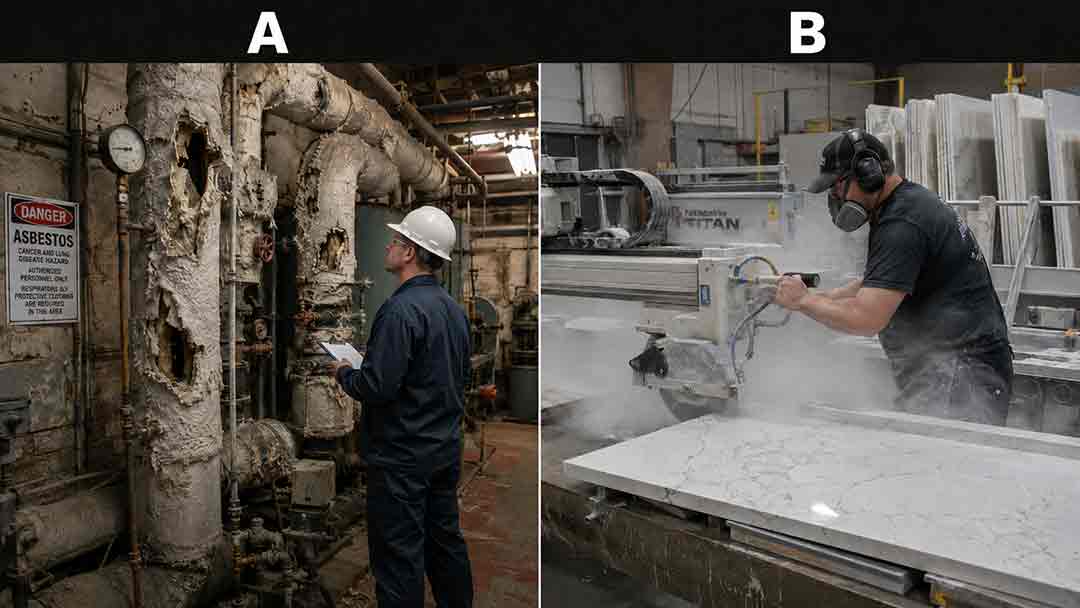
The U.S. Environmental Protection Agency explains that asbestos was historically used in products such as insulation, roofing materials, floor tiles, cement products, automobile friction products, gaskets, and coatings. EPA also explains that fibers can be released when asbestos-containing material is disturbed or damaged during repair, maintenance, remodeling, or demolition.
Official U.S. Environmental Protection Agency source:
https://www.epa.gov/asbestos/learn-about-asbestos
For legal purposes, two questions should be separated. Is there medical evidence supporting an asbestos-related disease? Can the relevant exposure be linked to one or more potentially responsible parties? A diagnosis alone does not automatically prove the second question.
Types of Asbestos Exposure That May Matter
Occupational Exposure
Occupational exposure is one of the most familiar patterns. Historical exposure may have occurred in shipyards, construction, insulation work, demolition, manufacturing, industrial maintenance, pipe work, or automotive repair.
A useful employment history records the employer, worksite, approximate dates, job title, duties, nearby trades, equipment, contractors, and product names the worker genuinely remembers. If exact details are uncertain, they should be identified as estimates rather than guessed.
Household or Take-Home Exposure
Household or take-home exposure can also matter. The National Cancer Institute recognizes living with a person who works near asbestos as a mesothelioma risk factor.
Whether a specific household exposure supports a legal claim depends on the available evidence and applicable state law. Medical evidence that an exposure pathway is possible does not automatically establish legal responsibility for a particular company.
Military Exposure
Military exposure may also be relevant. The U.S. Department of Veterans Affairs states that a veteran may be eligible for disability compensation when the veteran has a health condition caused by asbestos exposure and had contact with asbestos while serving in the military.
Official U.S. Department of Veterans Affairs source:
https://www.va.gov/disability/eligibility/hazardous-materials-exposure/asbestos/
A VA disability claim is separate from a civil asbestos lawsuit. Depending on the circumstances, a veteran may need to evaluate both paths independently.
Who May Be Able to Pursue a Mesothelioma Claim
There is no single nationwide test that determines whether every person diagnosed with mesothelioma has a viable lawsuit.
A preliminary review usually asks whether there is a confirmed diagnosis, whether asbestos exposure can be documented or reconstructed, whether specific worksites or products can be identified, and whether potentially responsible companies are solvent, bankrupt, or difficult to trace.
Jurisdiction also matters. The state whose law applies may affect liability, filing deadlines, recoverable damages, and who may bring a wrongful death or survival claim if the patient has died.
Military service or employment may create additional compensation paths. These questions help organize an investigation, but they do not establish that a person definitely qualifies for compensation.
Potential Sources of Mesothelioma Compensation
Mesothelioma compensation may potentially come from more than one system.
Depending on the circumstances, possible paths include a personal injury lawsuit, a wrongful death or survival claim, an asbestos bankruptcy trust claim, VA disability compensation, or workers’ compensation.
A personal injury lawsuit may be considered when a living patient alleges legally actionable asbestos exposure involving one or more potentially responsible defendants.
A wrongful death or survival claim may become relevant after a patient dies, but who may file and what damages may be available depend on applicable state law.
An asbestos trust claim may apply when exposure involves a company whose asbestos liabilities were addressed through a qualifying bankruptcy trust.
VA disability compensation may be available to certain veterans when asbestos exposure during military service is connected to an asbestos-related health condition.
Workers’ compensation may apply in some employment-related situations, subject to state-specific rules.
These paths are not automatically interchangeable or cumulative. Their interaction can depend on applicable law, trust rules, court procedures, and individual facts.
How an Asbestos Trust Fund Works
An asbestos trust fund is generally a compensation mechanism created through certain bankruptcy reorganizations to address qualifying present and future asbestos-related claims.
Section 524(g) of Title 11 of the U.S. Code provides a federal bankruptcy framework under which qualifying asbestos liabilities may be directed to a trust established through a reorganization plan.
Official statutory source, 11 U.S.C. §524:
https://uscode.house.gov/view.xhtml?req=(title:11%20section:524%20edition:prelim)
When a qualifying asbestos trust has assumed relevant liabilities, an eligible claimant may need to use the trust process rather than pursue a conventional lawsuit against the reorganized company for those channeled claims.
The U.S. Government Accountability Office explains that trust distribution procedures govern matters such as claim intake, medical and exposure criteria, review, valuation, payment, and dispute procedures.
Official U.S. Government Accountability Office source:
https://www.gao.gov/products/gao-11-819
A trust claim may require medical records, diagnosis documentation, employment history, exposure dates, worksite information, product evidence, and other materials required by that specific trust.
Different trusts can use different standards and procedures. A claimant should not assume that eligibility for one asbestos trust automatically establishes eligibility for another.
When More Than One Trust or Defendant May Be Relevant
Potentially.
A worker may have encountered asbestos-containing products associated with several companies over the course of a career. Some companies may remain solvent, while others may have entered bankruptcy and established asbestos trusts.
That means one exposure history can potentially lead to several separate investigations.
For example, one worksite may involve a solvent equipment manufacturer, another product may be associated with a bankruptcy trust, and a third supplier may require additional corporate research.
Employment dates, workplaces, product identification, and exposure descriptions should remain accurate and consistent across related claims.
The U.S. Government Accountability Office has also discussed how asbestos trust claims and tort litigation can interact. Disclosure requirements, payment credits, and other coordination rules may depend on applicable law and court procedure.
Mesothelioma Lawsuit vs. Mesothelioma Settlement
A mesothelioma lawsuit is the legal proceeding. A mesothelioma settlement is one possible negotiated resolution of some or all claims.
Settlement
A settlement can provide greater control over whether to accept an offer and can avoid some uncertainty associated with trial.
It may also reduce additional litigation and establish defined terms for resolving claims against a particular defendant.
However, a settlement may require the claimant to release covered claims against the settling party. An offer may also be lower than the claimant believes the evidence supports.
Trial
A trial allows disputed liability and damages to be adjudicated when the parties cannot reach an agreement.
The tradeoff is uncertainty. No trial outcome is guaranteed, and post-trial motions or appeals may affect when a result becomes final.
Which Is Better?
Neither settlement nor trial is automatically better.
The decision may depend on the strength of the exposure evidence, available defendants, proposed settlement terms, applicable law, litigation risks, claimant priorities, and advice from qualified counsel.
Those factors generally require case-specific evaluation, and no settlement or trial result should be treated as guaranteed.
Evidence That May Matter in an Asbestos Lawsuit
Medical Records
Medical records such as pathology reports, imaging, oncology records, surgery records, hospital records, and physician documentation can establish diagnosis and treatment history.
These records are important, but they do not by themselves establish which company may be legally responsible for the exposure.
Employment History
Employment records can help establish where and when a person worked.
Useful details may include employer names, worksite locations, employment dates, job titles, departments, job duties, equipment, nearby trades, and contractors.
If exact dates cannot be remembered, approximate dates should be identified honestly as estimates.
Product and Worksite Evidence
Product and worksite evidence may include manufacturer names, product names, invoices, purchase records, job specifications, equipment manuals, photographs, construction documents, company records, and coworker testimony.
A qualified asbestos lawyer may also investigate historical records that the claimant does not personally possess.
Witnesses
Former coworkers or supervisors may remember which materials were used, where certain products were installed, how tasks were performed, or which contractors worked at a site.
Preserving names and contact details early may therefore be useful, particularly when the relevant employment occurred decades ago.
Military Records
For veterans, military records can help document occupations, specialties, duty locations, and service history.
The Department of Veterans Affairs identifies medical records, service information, and evidence connecting military asbestos exposure with the claimed health condition as relevant to its disability compensation process.
How to Build an Asbestos Exposure Timeline
Step 1: List Major Jobs and Worksites
Begin with the earliest potentially relevant employment and move forward chronologically.
Include employers, worksite locations, approximate dates, military service, temporary assignments, contractors, and departments when remembered.
Step 2: Record Potential Exposure Tasks
Identify work involving insulation, pipes, gaskets, flooring, roofing, cement products, brakes, clutches, boilers, fire-resistant materials, or other potentially relevant products.
The goal is not to assume that every listed material contained asbestos. It is to create a factual record that can later be investigated.
Step 3: Add Product Information
Record manufacturer names, product names, packaging, equipment names, labels, or other identifying details that are genuinely remembered.
Do not guess when memory is uncertain.
Information discovered later through records or investigation should be distinguished from firsthand memory.
Step 4: Identify Witnesses
List supervisors, coworkers, contractors, or other individuals who may remember the worksite, products, tasks, or conditions.
Step 5: Add Non-Work Exposure
Include potentially relevant military, household, renovation, or take-home exposure.
Step 6: Preserve Supporting Documents
Useful materials may include employment records, military documents, medical records, photographs, invoices, manuals, union records, pension documents, and relevant correspondence.
The goal is an organized factual exposure record for investigation, not a self-made determination of legal liability.
How Mesothelioma Compensation Is Evaluated
There is no universal formula that accurately predicts the value of every mesothelioma lawsuit.
Potential value may depend on the strength of exposure evidence, available defendants, applicable state law, medical circumstances, documented economic losses, available defenses, insurance or assets, asbestos trust eligibility, settlement negotiations, and litigation outcomes.
For that reason, an advertised average mesothelioma settlement should not be treated as a prediction of an individual result.
Consider a hypothetical claimant with $42,000 in uncovered medical expenses, $28,000 in documented lost income, and $7,500 in treatment-related travel costs.
The arithmetic is:
$42,000 + $28,000 + $7,500 = $77,500.
$77,500 is not the value of the lawsuit.
It is only the subtotal of three hypothetical categories of documented economic loss.
Other damages may or may not be legally available depending on applicable state law and the facts. There is no universal multiplier that can responsibly convert that subtotal into a guaranteed settlement amount.
A Practical Claim-Source Decision Framework
Instead of treating every asbestos exposure as one event, separate each exposure period and potentially responsible entity.
Shipyard insulation associated with a solvent manufacturer may require investigation of a civil claim.
Industrial gaskets associated with a bankrupt manufacturer may require review of an asbestos trust fund.
An unidentified construction supplier may require product and corporate research before any claim path can be evaluated.
Military ship service may justify a separate VA benefits review.
Household exposure may require a state-specific legal analysis.
This framework helps answer a more useful question than “How much is my claim worth?”
The better first question is which legally available compensation paths are supported by the person’s diagnosis, exposure history, evidence, and potentially responsible entities.
What a Mesothelioma Lawyer May Do
A mesothelioma lawyer or mesothelioma attorney may investigate whether medical and historical evidence supports claims against potentially responsible companies or asbestos trusts.
Depending on the representation, the attorney’s work may include reviewing medical records, reconstructing employment history, researching asbestos-containing products, identifying manufacturers or corporate successors, locating witnesses, researching bankruptcy trusts, evaluating defendants, analyzing jurisdiction and deadlines, preparing filings, conducting discovery, negotiating settlements, and preparing cases for trial when necessary.
The attorney’s role should involve investigation and legal analysis, not a guaranteed compensation promise.
How to Compare Mesothelioma Attorney Options
Focus on how the case will actually be handled rather than on advertising claims.
Ask who will manage the case and who will be the primary point of contact.
Ask whether the firm handles both civil asbestos litigation and bankruptcy trust claims when both may be relevant.
Ask how historical exposure and product identification will be investigated.
Ask whether the attorneys have experience with the jurisdiction that may govern the claim.
Ask how litigation expenses are handled and whether another firm may participate in the representation.
Ask how settlement decisions are made, how frequently case updates are provided, and whether the firm prepares cases for trial when necessary.
These questions are more useful than unsupported “best lawyer” rankings or advertisements suggesting a guaranteed result.
How Contingency Fees Work
Some personal injury lawyers use contingent-fee arrangements, meaning the attorney fee depends on the outcome of the representation.
The exact written agreement matters.
American Bar Association Model Rule 1.5 states that a contingent-fee agreement should be in writing and explain the method used to determine the fee, including applicable percentages and how litigation or other expenses are handled.
Official American Bar Association source:
https://www.americanbar.org/groups/professional_responsibility/publications/model_rules_of_professional_conduct/rule_1_5_fees/
The ABA Model Rules are model standards. Lawyers are governed by the professional-conduct rules applicable in their jurisdictions.
Before signing an agreement, a client can ask:
What percentage applies?
Does the percentage change if the case proceeds to trial or appeal?
Who advances litigation expenses?
Could the client owe expenses if there is no recovery?
Are expenses deducted before or after the attorney fee is calculated?
Will another law firm receive part of the fee?
Who decides whether to accept a settlement?
These terms should be understandable before representation begins.
Real-World-Style Example: One Diagnosis, Several Potential Paths
Consider a hypothetical retired industrial worker with mesothelioma.
The worker spent eight years maintaining boilers, five years at a shipyard, several years repairing industrial machinery, and an earlier period serving in the Navy.
An investigation identifies three companies.
Company A remains solvent.
Company B entered bankruptcy and has an asbestos trust.
Company C requires additional corporate-status research.
Military records may also support a separate VA benefits review.
The investigation could therefore involve a civil claim involving Company A, a possible trust claim involving Company B, additional research concerning Company C, and a separate VA benefits analysis.
This example shows why identifying supported claim paths is more useful than beginning with a settlement estimate.
Why Should Filing Deadlines Be Reviewed Early?
Mesothelioma lawsuits are subject to statutes of limitation and other procedural rules.
The applicable deadline and the event that starts the legal clock may depend on the state, type of claim, and individual circumstances.
Personal injury, wrongful death, workers’ compensation, and trust claims may not follow identical rules.
Do not assume every state gives claimants the same amount of time.
Do not assume the deadline always begins on the original asbestos exposure date.
Do not assume personal injury and wrongful death claims use the same deadline.
Do not assume filing an asbestos trust claim automatically preserves a separate civil lawsuit.
Because missing an applicable deadline can affect legal rights, a state-specific review should occur promptly when a claim is being considered.
Common Mistakes, Checklist, and Next Steps
Waiting Too Long to Reconstruct Exposure
Companies can close, documents may become harder to locate, and witnesses may be difficult to find.
Organizing the exposure history early may preserve useful information.
Assuming the Employer Is the Only Relevant Entity
An employer and an asbestos-product manufacturer may be different entities.
Depending on the facts and applicable state law, manufacturers, suppliers, contractors, premises owners, equipment companies, or other parties may require investigation.
Guessing Product Names
If a person does not remember the manufacturer or product, it is better to document that uncertainty than convert a guess into a factual statement.
Historical records or witness information may later help identify the product.
Treating Every Asbestos Trust the Same
Trust eligibility standards and procedures can differ.
A person who appears eligible for one asbestos trust does not automatically qualify for every other trust.
Choosing an Attorney Because of a Promised Recovery
No settlement, verdict, or compensation amount should be treated as guaranteed based solely on a diagnosis.
A useful consultation should focus on evidence, defendants, trusts, jurisdiction, deadlines, fees, and litigation strategy.
Mesothelioma Claim Preparation Checklist
1. Obtain pathology and diagnosis records.
2. List relevant employers and worksites.
3. Record approximate employment dates and job duties.
4. Identify products and manufacturers genuinely remembered.
5. List coworkers or supervisors with relevant knowledge.
6. Gather military records when applicable.
7. Document possible household or take-home exposure.
8. Preserve photographs, invoices, manuals, employment records, and correspondence.
9. Organize medical expenses and lost-income records.
10. Identify companies known to have entered bankruptcy.
11. Determine whether relevant asbestos trust claims may exist.
12. Ask which state’s law may govern the case.
13. Confirm applicable filing deadlines.
14. Review attorney fees and litigation expenses in writing.
15. Ask who will actually manage the representation.
General Considerations for Different Claim Situations
If You Were Recently Diagnosed
Prioritize medical records and a complete exposure timeline.
A prompt legal review may help identify potential defendants, trust claims, jurisdiction, and filing deadlines.
If Your Exposure Happened Decades Ago
Do not assume the history cannot be investigated.
Begin with employers, worksites, job duties, coworkers, products, military service, and surviving records.
If a Manufacturer Entered Bankruptcy
Investigate whether a qualifying asbestos trust fund exists and what evidence the trust requires.
Section 524(g) of the U.S. Bankruptcy Code provides the federal framework used for certain asbestos personal injury trusts.
If You Are a Veteran
Evaluate VA disability compensation separately from possible claims involving private companies.
The Department of Veterans Affairs states that asbestos-related disability compensation requires relevant health and service-exposure evidence.
If a Family Member Has Died
Determine promptly whether applicable state law permits a wrongful death or survival claim and who is legally authorized to pursue it.
Practical Conclusion
A strong mesothelioma claim begins with evidence rather than a promised settlement number.
A recently diagnosed patient should preserve medical documentation and reconstruct asbestos exposure as accurately as possible. A worker exposed at several jobs should separate each workplace, product, and company into distinct potential claim sources.
Veterans should evaluate VA benefits separately, while exposure involving bankrupt manufacturers may require asbestos trust analysis.
When comparing a mesothelioma lawyer, focus on investigation methods, jurisdictional experience, trust-claim capabilities, litigation strategy, communication, fee terms, and who will actually handle the case.
The most useful question is not simply, “What is the average mesothelioma settlement?”
It is:
Which claims are supported by this person’s diagnosis, asbestos exposure history, evidence, potentially responsible parties, applicable state law, and available compensation systems?
Frequently Asked Questions
Can I Pursue a Mesothelioma Lawsuit If I Do Not Remember the Asbestos Product?
Potentially.
Product identification may sometimes be supported through employment records, jobsite documents, former coworkers, invoices, historical product information, or other evidence.
Whether that evidence is legally sufficient depends on the individual case and applicable state law.
Is an Asbestos Trust Fund the Same as a Lawsuit?
No.
An asbestos bankruptcy trust follows its governing documents and trust distribution procedures.
A conventional lawsuit proceeds through the civil court system against defendants subject to that litigation.
Section 524(g) provides the federal bankruptcy framework used for certain asbestos personal injury trusts.
Can Someone Pursue Both Trust Claims and Lawsuits?
Potentially.
A person may have exposure involving both bankrupt and solvent companies.
The interaction among trust claims, civil litigation, disclosures, and possible payment credits can depend on applicable law, trust rules, and court procedures.
How Long Does a Mesothelioma Lawsuit Take?
There is no universal timeline.
Timing may depend on jurisdiction, defendants, evidence, discovery, settlement negotiations, court schedules, motions, trial, and possible appeals.
How Much Is a Mesothelioma Settlement?
There is no universal formula or guaranteed settlement amount.
Potential case value depends on evidence, responsible parties, applicable state law, documented losses, available defenses, trust eligibility, and litigation outcomes.
Published averages should not be treated as predictions of an individual result.
Do Veterans Exposed to Asbestos Have a Separate Compensation Option?
Potentially.
The U.S. Department of Veterans Affairs states that a veteran may be eligible for disability compensation when the veteran has a health condition caused by asbestos exposure and had contact with asbestos during military service.
VA benefits should be evaluated separately from possible civil claims involving private companies.