Direct Answer and Key Takeaways
Direct Answer
A wrongful death claim may allow eligible survivors or a personal representative to seek damages when another person’s legally wrongful conduct causes a death. Depending on state law, recoverable losses may include reasonable funeral or burial expenses, lost financial support, household services, and other economic or noneconomic losses. Who may recover, which damages are available, and how they are calculated vary significantly by state.
Key Takeaways
Funeral expenses may be a recoverable component of a wrongful death case in some jurisdictions, but a funeral bill does not determine the value of the entire claim. New York, for example, expressly identifies qualifying reasonable funeral expenses as a proper element of damages under EPT §5-4.3.
Wrongful death and survival claims are related but legally distinct. California law expressly separates damages awarded in a wrongful death action from damages recoverable on a decedent’s surviving cause of action.
Economic damages should be developed from evidence rather than a simple income multiplier. Earnings history, actual family contributions, employment benefits, household services, work history, and the probable duration of support may require separate analysis.
Who may bring or benefit from a wrongful death action depends on state law. California and Texas illustrate materially different statutory structures.
Wrongful death compensation is not determined by a universal formula. Liability, causation, eligible beneficiaries, documented losses, state damage rules, defenses, insurance, and collectability can all affect the analysis.
This guide explains where funeral expenses fit into a wrongful death claim, how economic damages can be documented, why future financial support requires more than multiplying salary by life expectancy, and how families can organize evidence before evaluating a possible wrongful death settlement.
Legal Information Notice
This article provides general U.S. legal information and is not legal advice.
Wrongful death law is primarily state-specific. States differ on who may sue, who receives damages, recoverable loss categories, survival claims, noneconomic damages, punitive damages, comparative fault, filing deadlines, and the treatment of medical and funeral expenses.
The California, Texas, and New York provisions discussed below are state-specific examples.
California example ≠ nationwide rule.
Texas example ≠ nationwide rule.
New York example ≠ nationwide rule.
How a Wrongful Death Claim Works
A wrongful death claim generally begins with conduct that allegedly caused a person’s death and could create civil liability under applicable law.
The analysis does not begin with the amount of a funeral invoice or the size of an insurance policy.
A practical evidence chain is:
Death
→ Wrongful Conduct
→ Causation
→ Eligible Claimant
→ Recoverable Damage Category
→ Supporting Evidence
→ Economic Projection
→ Applicable Legal Limits
→ Resolution
Each stage answers a separate question.
Evidence may support liability without automatically establishing which relatives are legally entitled to recover.
A person may be an eligible beneficiary without automatically proving a particular amount of economic loss.
A documented expense may be real without necessarily being recoverable under the governing wrongful death statute.
Liability ≠ damages.
Damages ≠ automatic compensation.
Policy limits ≠ claim value.
Who Can Bring a Wrongful Death Claim
State law determines who may bring or benefit from a wrongful death action.
California Code of Civil Procedure §377.60 identifies categories of people authorized to assert a wrongful death cause of action, including specified surviving family members and, in certain circumstances, the decedent’s personal representative acting on behalf of persons entitled under the statute.
Texas uses a different statutory structure.
Texas Civil Practice and Remedies Code §71.004 states that a wrongful death action under that subchapter is for the exclusive benefit of the surviving spouse, children, and parents of the deceased. One or more of those individuals may bring the action for the benefit of all, and the executor or administrator can have a role under the statute if the eligible individuals do not begin an action within the specified period.
Other states use different beneficiary rules.
Relationship alone should therefore not be assumed to create legal standing.
A sibling, unmarried partner, stepchild, dependent, estate representative, or more distant relative may receive different treatment depending on the governing law and facts.
A wrongful death attorney evaluating a case should separate two questions:
Who is legally entitled to assert the claim?
Who is legally entitled to receive particular damages?
Those issues may overlap, but they are not necessarily identical.
Wrongful Death vs. Survival Action
Wrongful death and survival actions can arise from the same event but address different legal interests.
A wrongful death action generally addresses losses resulting from the death to people protected by the applicable wrongful death law.
A survival action generally preserves a cause of action that belonged to the deceased person before death, subject to the law of the jurisdiction.
California provides a clear state-specific example.
California Code of Civil Procedure §377.61 allows damages in a wrongful death action that may be just under the circumstances but expressly excludes damages recoverable under §377.34. Section 377.34 separately addresses damages on causes of action belonging to the decedent.
This distinction can become important when expenses arise between the original injury and death.
For example, pre-death losses may raise different claim-ownership questions from financial support survivors lose after the death.
Do not automatically combine every loss associated with a death into one damages category.
Wrongful death damages ≠ survival damages.
California’s statutory framework is an example, not a nationwide rule.
How Funeral Expenses Fit Into a Wrongful Death Claim
Funeral and burial expenses may be recoverable in wrongful death litigation depending on state law.
New York provides a clear example.
New York Estates, Powers and Trusts Law §5-4.3 provides for fair and just compensation for pecuniary injuries resulting from the death and separately identifies reasonable funeral expenses paid by distributees, or for which a distributee is responsible, as a proper element of damages.
California court materials also identify funeral expenses as a wrongful-death damages category. The current Judicial Council Statement of Damages form, CIV-050, separately lists funeral expenses, future contributions, and the value of personal service, advice, or training for wrongful death actions.
These examples do not establish that funeral expenses are recoverable in every U.S. wrongful death claim.
A funeral expense compensation analysis should ask:
Who paid the expense?
Who remains legally responsible for the bill?
Was the charge related to the death?
Does applicable law require the expense to be reasonable?
Which claim or claimant may recover the expense?
Was any amount reimbursed by insurance or another benefit, and how does applicable state law treat that payment?
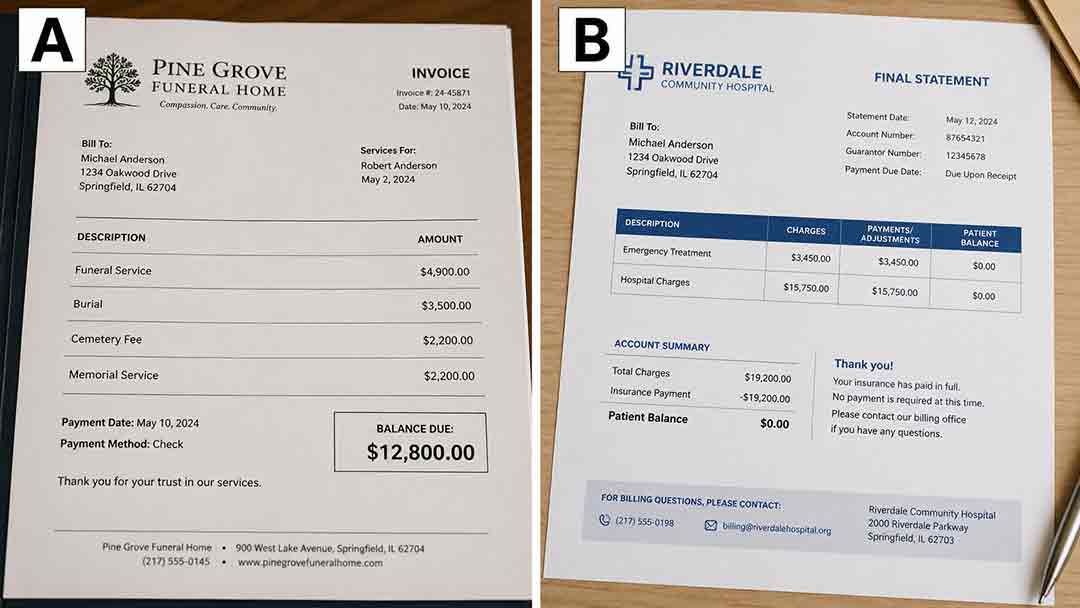
The invoice can document an expense.
It does not establish the value of the entire wrongful death case.
Funeral and Burial Records to Preserve
Families should preserve detailed financial records associated with funeral and burial arrangements.
Useful documents can include the funeral-home contract, itemized invoices, proof of payment, cemetery charges, burial or cremation expenses, and other documented costs potentially recognized under applicable law.
Records concerning burial insurance, benefits, reimbursements, or other payments should also be retained.
An itemized invoice is usually more useful for financial analysis than a single credit-card total because the individual charges can be evaluated separately.
Consider a hypothetical example.
Funeral-home services: $10,800.
Cemetery and burial charges: $3,900.
Other documented potentially qualifying arrangements: $1,700.
Arithmetic total: $16,400.
$16,400 is not automatically the value of the wrongful death claim.
It is only a hypothetical subtotal of funeral-related expenses.
The overall case can involve separate economic losses, noneconomic damages where legally permitted, liability disputes, statutory restrictions, insurance issues, defenses, and multiple beneficiaries.
Funeral expenses ≠ total claim value.
Economic Damages in a Wrongful Death Claim
Economic damages generally describe financial losses that can be measured or reasonably projected using monetary evidence.
Depending on state law, a wrongful death economic analysis may involve funeral expenses, lost financial support, lost employment benefits, lost household services, and other pecuniary losses.
New York EPT §5-4.3 expressly focuses on pecuniary injuries and also identifies qualifying reasonable funeral and medical expenses.
California’s CIV-050 form separately identifies future contributions and the value of personal service, advice, or training in wrongful death actions.
Because jurisdictions differ, a national list should not be treated as though every damage category is available everywhere.
For each proposed economic loss, ask:
Was the loss actually incurred or reasonably projected?
Is it supported by evidence?
Is the category recoverable under applicable law?
Which claimant does it affect?
Was it caused by the death?
Economic damages ≠ automatic compensation.
How Lost Financial Support Is Calculated
Lost financial support should focus on the resources the deceased person probably would have contributed to eligible survivors rather than simply using gross earnings.
The distinction is critical.
Earnings history ≠ family contribution.
Business revenue ≠ personal income.
Personal income ≠ family support.
A person earning $100,000 annually does not necessarily provide $100,000 annually to surviving family members.
Depending on applicable law and the facts, taxes, personal consumption, savings, debt, business expenses, household structure, employment benefits, and historical family contributions may matter.
Potential evidence includes tax returns, W-2 forms, 1099 forms, payroll records, bank records, business records, retirement contributions, insurance benefits, and household financial records.
When individual records are incomplete, the U.S. Bureau of Labor Statistics Occupational Employment and Wage Statistics program can provide external wage context. The current May 2025 OEWS estimates, released May 15, 2026, provide employment and wage estimates for about 830 occupations nationally, across states, and in hundreds of geographic areas.
BLS wage data = benchmark.
BLS wage data ≠ substitute for case-specific earnings evidence.
If reliable personal earnings records exist, those records can be more informative than an occupational average.
A Three-Layer Economic Support Framework
A useful financial analysis separates economic support into three layers.
Earnings Capacity
The first layer asks what the deceased person reasonably could have earned.
Relevant evidence may include wages, occupation, education, business history, career progression, employment stability, bonuses, and employment benefits.
Family Contribution
The second layer asks how much of those economic resources probably would have benefited eligible survivors.
Historical transfers, mortgage or rent payments, childcare expenses, health insurance, household costs, retirement contributions, and other recurring support can help establish the answer.
Future Duration and Projection
The third layer asks how long the support probably would have continued and how future losses should be projected under applicable law.
Age, work history, retirement expectations, beneficiary circumstances, wage progression, personal consumption, taxes where relevant, and present-value requirements may all matter.
The framework is:
Earnings Capacity
→ Family Contribution
→ Future Duration and Projection
It should not be reduced to:
Annual salary × life expectancy = damages.
That shortcut can materially overstate or understate economic loss.
Life Expectancy, Work-Life, and Support Duration
Life expectancy can be one demographic input, but it is not the same as work-life expectancy or duration of financial support.
The Social Security Administration currently publishes a 2023 period life table used in the 2026 Trustees Report. SSA explains that a period life table provides average remaining life expectancy at specific ages based on population mortality conditions.
Those figures do not predict how long a particular individual would have worked.
They also do not establish how long a spouse, child, parent, or other beneficiary would have received financial support.
A responsible projection may separately consider:
Expected lifespan.
Expected working years.
Probable retirement.
Duration of dependency or support.
Historical family patterns.
Case-specific employment evidence.
Applicable state law.
Life expectancy ≠ work-life expectancy.
Life expectancy ≠ support duration.
Published life tables can provide contextual information, not a guaranteed projection of an individual future.
How Household Services Are Evaluated
Economic loss can extend beyond wages when applicable law recognizes household services or similar contributions.
The deceased person may have regularly provided childcare, cooking, transportation, caregiving, home maintenance, financial management, repairs, or other services.
Those contributions are easier to analyze when described specifically.
“Helped around the house” gives little financial detail.
A more useful record identifies the activity, frequency, time required, who now performs it, whether replacement services have been purchased, and whether reliable market-cost information exists.
California’s CIV-050 form identifies the value of personal service, advice, or training as a wrongful-death category, illustrating that economic contribution is not necessarily limited to wages.
That is a California example, not a nationwide damages rule.
A Practical Wrongful Death Economic-Damages Example
Consider a hypothetical family.
The deceased person earned $78,000 annually before death.
Historical household and bank records indicate that approximately $43,000 per year was actually used to support the household after accounting for amounts not benefiting the survivors.
The family also documents $16,400 in potentially qualifying funeral and burial expenses.
An overly simple approach might use:
$78,000 annual earnings × selected number of years + $16,400 funeral expenses.
That approach misses important distinctions.
A better analysis first asks whether $43,000 more accurately represents historical family support than the $78,000 gross earnings figure.
It then considers how long that contribution probably would have continued, whether it would have changed, whether benefits or household services should be analyzed separately, and which adjustments applicable law requires.
For arithmetic illustration only, assume a 10-year period:
$43,000 × 10 = $430,000.
Then add the hypothetical funeral subtotal:
$430,000 + $16,400 = $446,400.
$446,400 is not automatically the value of the wrongful death claim.
It is only an arithmetic illustration.
The figure does not resolve wage growth, taxes where legally relevant, personal consumption, present value, work-life assumptions, household services, other damages, liability, comparative fault, legal restrictions, insurance, or collectability.
No wrongful death multiplier, income multiplier, funeral-expense multiplier, or settlement multiplier should be substituted for those questions.
How to Build a Wrongful Death Claim Step by Step
Step One: Establish Legal Responsibility
Determine what conduct caused the death and whether it can support civil liability under applicable law.
Step Two: Identify Eligible Claimants
Determine which surviving relatives or representatives may legally assert the action or receive damages.
Step Three: Separate Wrongful Death From Estate or Survival Claims
Identify which losses belong to survivors and which may belong to the decedent’s surviving cause of action or estate.
Step Four: Document Immediate Expenses
Preserve funeral, burial, medical, and related records and identify the legally appropriate damages category.
Step Five: Reconstruct Financial Support
Use tax returns, payroll records, bank records, benefits information, and household financial documents.
Step Six: Identify Non-Wage Contributions
Document household services, caregiving, transportation, childcare, advice, training, or similar contributions where applicable law recognizes them.
Step Seven: Build the Future Projection
Separate historical evidence from assumptions involving future earnings, duration, retirement, benefits, and support.
Step Eight: Apply State Damage Rules
Determine which categories the jurisdiction recognizes and whether comparative fault, caps, offsets, or other legal rules may apply.
Step Nine: Evaluate Insurance and Other Recovery Sources
Insurance can affect practical recovery but does not establish liability or claim value.
Step Ten: Evaluate Resolution
Only after liability and damages are reasonably developed should the parties evaluate a potential settlement.
This is an investigative framework, not a legal scoring system or settlement formula.
Evidence Most Useful for Economic Damages
A strong economic-damages analysis usually combines multiple types of independent records.
Income evidence can include tax returns, W-2s, 1099s, payroll records, employment contracts, and business records.
Benefits evidence may include employer health insurance, retirement contributions, pensions, bonuses, or other employment benefits.
Support evidence can include bank transfers, mortgage payments, rent, tuition, childcare costs, insurance premiums, and recurring household expenses.
Household-service evidence may include calendars, family testimony, receipts for replacement services, and records describing the deceased person’s regular responsibilities.
Funeral expenses should generally be supported with itemized invoices and evidence of payment or legal responsibility.
The strongest financial analysis connects earnings with actual family support rather than assuming the two are identical.
Self-Employment and Incomplete Earnings Records
Self-employment requires additional care because business revenue is not the same as personal income.
For example, a company may receive substantial annual revenue while producing considerably less personal income after payroll, materials, rent, equipment, taxes, and other operating expenses.
Relevant records may include business and personal tax returns, profit-and-loss statements, payroll records, business bank records, ownership documents, distributions, and compensation history.
The analysis may also need to distinguish income generated by the deceased person’s labor from returns attributable to business assets, capital, or work performed by employees.
Do not substitute gross business receipts for financial support to survivors.
Business revenue ≠ personal income.
Personal income ≠ family support.
What If Earnings Records Are Incomplete?
Incomplete earnings records do not necessarily end an economic investigation, but estimates and assumptions should be identified clearly.
Potential sources can include prior tax filings, payroll records, bank deposits, employer documentation, contracts, invoices, Social Security earnings records where lawfully available, and occupational wage data.
BLS OEWS data can provide contextual benchmarks. The May 2025 estimates cover about 830 occupations and provide data across national, state, and local geographic levels.
Average occupational wage data should not automatically replace evidence specific to the deceased person.
A multi-year documented earnings history may provide substantially stronger evidence than a national mean.
Common Mistakes, Compensation Evaluation, and Next Steps
Mistake One: Treating the Funeral Bill as the Claim Value
Funeral expenses may constitute one damages category. They do not determine the entire claim.
Mistake Two: Multiplying Gross Salary by Life Expectancy
Gross earnings, family contribution, life expectancy, work-life expectancy, and support duration are different concepts.
Mistake Three: Assuming Every Relative Can Recover
Beneficiary and standing rules are state-specific. California and Texas illustrate different statutory approaches.
Mistake Four: Combining Wrongful Death and Survival Damages
These claims may arise from the same event but address different legal interests. California expressly separates wrongful death damages under §377.61 from damages recoverable under §377.34.
Mistake Five: Using Business Revenue as Personal Income
Business expenses, ownership, capital, and the role of other employees may need to be evaluated first.
Mistake Six: Ignoring Household Services
Non-wage contributions may have financial significance where applicable law recognizes them.
Mistake Seven: Using a Settlement Multiplier
There is no universal wrongful death multiplier that reliably converts funeral expenses, wages, or economic losses into compensation.
Mistake Eight: Assuming a Large Insurance Policy Determines the Settlement
A policy limit can affect available funds.
Large policy ≠ large settlement.
Policy limits ≠ claim value.
How Is Wrongful Death Compensation Evaluated?
Wrongful death compensation should follow the legal and economic evidence rather than a predetermined amount.
Relevant considerations may include liability, causation, eligible beneficiaries, documented funeral expenses, historical financial support, projected future losses, household services, noneconomic losses where permitted, comparative fault, insurance, collectability, and state-specific procedural requirements.
A wrongful death settlement is a negotiated resolution.
It is not automatically equal to calculated economic damages.
A settlement may reflect disputed liability, litigation risk, multiple defendants, insurance limits, evidentiary uncertainty, beneficiary issues, and other case-specific factors.
A wrongful death lawyer should be able to explain both the damages evidence and the uncertainty surrounding the analysis.
A wrongful death attorney should not represent that a funeral invoice, salary figure, economic projection, or policy limit guarantees a specific wrongful death compensation amount.
General Considerations for Different Family Situations
If funeral expenses have recently been incurred, preserve itemized invoices, contracts, proof of payment, and documents identifying who is legally responsible for each charge.
If the deceased person provided substantial financial support, collect tax returns, wage records, benefit statements, bank records, and documents showing actual household contributions.
If the deceased person was self-employed, preserve business and personal financial records rather than relying on gross business revenue.
If the deceased person provided substantial childcare, caregiving, transportation, home maintenance, or other recurring services, document the activities and frequency while the information remains available.
If several relatives may have beneficiary rights, identify the governing state statute rather than assuming every relative can participate in the claim.
If liability, eligibility, or damages are disputed, timely case-specific legal evaluation may be important because filing deadlines and procedures vary by state.
Practical Conclusion
A wrongful death claim is not calculated by adding a funeral invoice to projected salary.
A reliable analysis separates legal responsibility, eligible claimants, claim ownership, immediate expenses, actual family financial support, household services, future projections, and state-specific damages rules.
The core distinctions are:
Liability ≠ damages.
Damages ≠ automatic compensation.
Policy limits ≠ claim value.
Funeral expenses ≠ total claim value.
Gross earnings ≠ family financial support.
Life expectancy ≠ work-life expectancy.
Wrongful death damages ≠ survival damages.
Economic damages ≠ automatic compensation.
For families dealing primarily with immediate costs, preserve funeral and burial documentation.
For families that depended financially on the deceased person, reconstruct actual historical support rather than relying solely on salary.
For a self-employed deceased person, separate business revenue from personal income and family contributions.
A well-supported wrongful death damages analysis is built from records, realistic assumptions, applicable state law, and properly separated loss categories—not from a guaranteed compensation formula.
Frequently Asked Questions and Sources
Can Funeral Expenses Be Included in a Wrongful Death Claim?
Potentially.
The answer depends on applicable state law and the circumstances. New York EPT §5-4.3, for example, identifies reasonable funeral expenses paid by distributees, or for which a distributee is responsible, as a proper element of damages.
Does a Funeral Invoice Prove the Value of the Wrongful Death Claim?
No.
The invoice can document one category of expense. It does not establish liability, lost financial support, other recoverable damages, or total claim value.
Are Lost Earnings and Lost Financial Support the Same?
No.
Earnings describe what the deceased person earned or could have earned. Financial support focuses on resources that probably would have benefited eligible survivors.
Can Household Services Be Part of Economic Damages?
Potentially.
The answer depends on state law. California’s current CIV-050 form, for example, identifies the value of personal service, advice, or training as a wrongful death damages category.
Does a Large Insurance Policy Guarantee a Large Wrongful Death Settlement?
No.
Insurance limits can affect available funds, but compensation still depends on liability, causation, legally recoverable damages, defenses, governing law, and other case-specific circumstances.
Sources
California Legislature. Code of Civil Procedure §377.60, Wrongful Death.
https://leginfo.legislature.ca.gov/faces/codes_displaySection.xhtml?lawCode=CCP§ionNum=377.60
Identifies persons authorized to assert a California wrongful death cause of action.
California Legislature. Code of Civil Procedure §377.61.
https://leginfo.legislature.ca.gov/faces/codes_displaySection.xhtml?lawCode=CCP§ionNum=377.61
Addresses damages in California wrongful death actions and expressly distinguishes them from damages recoverable under §377.34.
California Legislature. Code of Civil Procedure §377.34.
https://leginfo.legislature.ca.gov/faces/codes_displaySection.xhtml?lawCode=CCP§ionNum=377.34
Addresses damages recoverable on a decedent’s surviving cause of action.
Judicial Council of California. Statement of Damages, CIV-050.
https://selfhelp.courts.ca.gov/jcc-form/CIV-050
The current California Courts form landing page links to CIV-050, which identifies funeral expenses, future contributions, and the value of personal service, advice, or training as wrongful death categories.
Texas Legislature. Civil Practice and Remedies Code §71.004, Benefitting From and Bringing Action.
https://statutes.capitol.texas.gov/DocViewer.aspx?DocKey=CP%2FCP.71&ExactPhrase=False&HighlightType=1&Phrases=71.004&QueryText=71.004
Section 71.004 identifies the surviving spouse, children, and parents of the deceased as the beneficiaries specified by the Texas statute and addresses who may bring the action.
New York State Senate. Estates, Powers and Trusts Law §5-4.3, Amount of Recovery.
https://www.nysenate.gov/legislation/laws/EPT/5-4.3
The current statute addresses fair and just compensation for pecuniary injuries and identifies qualifying reasonable funeral and medical expenses as proper elements of damages.
U.S. Bureau of Labor Statistics. Occupational Employment and Wage Statistics, May 2025.
https://www.bls.gov/news.release/archives/ocwage_05152026.htm
The May 2025 estimates were released May 15, 2026 and provide occupational employment and wage information for about 830 occupations across national, state, and local geographic levels.
Social Security Administration, Office of the Chief Actuary. Actuarial Life Table.
https://www.ssa.gov/oact/STATS/table4c6.html
The current table presents the 2023 period life table for the Social Security area population as used in the 2026 Trustees Report.
Source Review Date: August 13, 2026