Quick Answer and Key Takeaways
Quick Answer
Lost wages may be recoverable in a personal injury claim when an injury causes a person to miss work, reduce hours, or lose employment income. A well-supported lost wages claim connects the injury to the work interruption and documents the financial effect with payroll records, employer information, tax records, and appropriate medical restrictions. Future loss of earning capacity requires a separate analysis.
Key Takeaways
1. Lost wages generally concern income already missed because an injury affected a person’s ability to work.
2. Pay stubs, payroll records, W-2 forms, 1099 forms, tax records, employer verification, and medical work restrictions can help establish a consistent evidence trail.
3. Loss of earning capacity is different from past lost wages because it concerns a reduced ability to earn income in the future.
4. Hourly employees, salaried workers, commissioned employees, freelancers, and business owners may require different calculation methods.
5. A wage-loss calculation is only one component of potential economic damages. It does not determine the value of the settlement.
This guide explains how to document lost income, calculate common wage losses, distinguish past earnings from future earning capacity, and identify weaknesses in the evidence before presenting a claim. Because damage rules differ by jurisdiction, the legal treatment of a particular loss depends on applicable law.
How Lost Wages Fit Into a Personal Injury Claim
Lost wages are employment earnings that a person did not receive because an injury prevented or limited work.
They may form part of economic damages, meaning losses that can generally be expressed in financial terms. Depending on applicable law and the facts, an injury case may involve multiple categories of damages, so missed earnings should not be treated as the value of the entire claim.
Suppose an employee normally earns $1,100 per week and has four documented unpaid weeks away from work because of injury-related restrictions.
The starting calculation is:
$1,100 multiplied by four weeks equals $4,400 in gross missed wages.
The $4,400 measures the wage difference in this hypothetical example. It does not automatically determine recoverability and does not determine the value of the settlement.
Issues such as causation, liability, available coverage, documentation, and state-specific damage rules can affect the ultimate outcome. Official jury instructions are one example of why jurisdiction matters: California, for instance, maintains its own current Judicial Council civil jury instructions governing how civil issues are presented to juries.
What a Lost Wages Claim Needs to Establish
A useful lost wages analysis answers four questions.
What was the person earning before the injury?
How did the injury interfere with work?
How long did the work interruption or reduction last?
How was the claimed financial loss calculated?
These questions create an evidence chain.
Employment and payroll records establish the normal work arrangement.
Income records establish the earnings baseline.
Medical work restrictions or other appropriate documentation may help explain why the person could not perform normal duties.
Attendance records, schedules, payroll changes, or business records then show what changed during the relevant period.
The final calculation should connect those facts without relying on unexplained assumptions.
A large file is not automatically a strong file. Ten documents that contradict one another can create more uncertainty than several records that establish a consistent timeline.
Records That Best Support Lost Wages
The most useful records are those that establish both normal earnings and what changed after the injury.
For an employee, the core file may include recent pay stubs, payroll summaries, work schedules, attendance records, W-2 forms, employer verification, and documentation of reduced hours or unpaid leave.
Workers who regularly receive overtime, commissions, bonuses, shift differentials, or other variable pay should preserve records showing the historical pattern of those earnings.
Independent contractors, freelancers, and self-employed people may need 1099 forms, tax returns, invoices, contracts, bank records, payment processor statements, bookkeeping reports, profit-and-loss statements, and customer cancellation records.
Medical work restrictions should be kept with the wage documents when they explain why normal work could not continue.
If original wage records are missing, start with the employer or payroll provider rather than estimating from memory.
The IRS provides wage and income transcripts containing federal information reported on forms such as W-2s and the Form 1099 series. As of 2026, the IRS states that these transcripts are available for the current and nine prior tax years, although information for a year still being processed may be incomplete.
The Social Security Administration also allows workers to review recorded yearly earnings. SSA explains that employers report employee earnings for the Social Security record, while self-employed individuals report their earnings through the tax system. This earnings history can be useful as a longer-term cross-check, although it does not replace detailed payroll evidence.
A practical wage file should therefore be organized chronologically:
Normal earnings before the injury.
Date work stopped or changed.
Periods of complete absence.
Periods of reduced hours or modified duty.
Pay actually received during those periods.
Date normal duties resumed, if applicable.
Any continuing work restriction.
This single structure replaces the need for separate document lists at several points in the claim process.
Employer Verification and Medical Work Restrictions
An employer statement is most useful when it confirms specific facts that can be compared with payroll records.
Relevant information may include the employee’s position, pay rate, normal schedule, dates missed, reduced hours, return-to-work date, and whether modified duty was provided.
Where applicable, the employer may also be able to document recurring overtime, commissions, shift differentials, or bonuses.
A statement that simply says “the employee lost wages” provides little context.
A stronger record might show that the employee normally worked 40 hours per week at a particular rate, missed specific shifts during a documented period, and later returned on a reduced schedule.
The records should also explain continued payments.
For example, an employee may have been absent for three weeks while still receiving regular pay because sick leave, vacation time, salary continuation, or another benefit was used.
That does not necessarily eliminate every wage-related issue, but the payment should be identified rather than ignored.
How Do Medical Work Restrictions Support the Income-Loss Timeline?
Medical documentation can help explain why the injury affected employment.
Depending on the circumstances, a healthcare professional may restrict a person from working entirely or may limit hours, lifting, standing, driving, travel, repetitive movement, or other job functions.
Medical evidence and payroll evidence serve different purposes.
Payroll records show what happened to earnings.
Medical work restrictions can help explain why normal duties could not continue.
Suppose an employee normally works eight-hour shifts but has a documented restriction limiting work to four hours per day for two weeks.
If payroll records then show four paid hours rather than eight each day, the two sources reinforce the same timeline.
By contrast, inconsistencies should be identified rather than hidden.
If the wage calculation assumes complete inability to work during a period when the available medical records permitted unrestricted work, the difference may need explanation.
Calculating Lost Wages for Hourly and Salaried Employees
For a worker with stable hourly pay, the basic calculation is:
Hourly rate multiplied by documented hours missed equals estimated gross lost wages.
Suppose an employee earns $28 per hour and normally works 40 hours each week.
If the employee misses five full weeks:
$28 multiplied by 40 hours equals $1,120 per week.
$1,120 multiplied by five weeks equals $5,600.
Now suppose the employee returns but works only 25 hours per week for another three weeks.
The normal schedule is 40 hours.
The reduced schedule is 25 hours.
The difference is 15 hours per week.
15 multiplied by $28 equals $420 per week.
$420 multiplied by three weeks equals $1,260.
The combined estimated gross wage difference is $6,860.
That calculation is an example of documenting economic loss. The $6,860 figure does not automatically determine recoverability and is not the value of the overall claim.
How Are Lost Wages Calculated for Salaried Employees?
For a salaried employee, a practical starting point is to convert annual salary into the relevant weekly or pay-period amount.
Suppose an employee earns $78,000 annually.
$78,000 divided by 52 weeks equals $1,500 per week.
If the employee experiences six documented unpaid workweeks:
$1,500 multiplied by six equals $9,000 in estimated gross missed salary.
The calculation should then be checked against what the employee actually received.
A salaried worker may continue receiving full salary during an absence because of an employer leave program, paid time off, disability coverage, or another arrangement.
For that reason, the number of days away from the workplace does not always equal the number of unpaid days.
The calculation should follow the financial records.
Overtime, Commissions, and Bonuses
Overtime is easier to support when it was a recurring part of the worker’s established earnings rather than a possibility.
Suppose an employee regularly worked six to eight overtime hours per week for several months before an injury.
Payroll records documenting that pattern may be relevant when evaluating what the employee likely would have earned during the missed period.
Now consider an employee who worked overtime once during the previous year.
It would be harder to treat several hours of weekly overtime as an established income pattern without additional evidence.
A practical method is to separate the calculation into two parts.
First calculate regular wages.
Then calculate variable overtime using the worker’s actual historical records and information about whether similar overtime opportunities were available during the relevant period.
This prevents uncertain overtime from being presented as though it were guaranteed income.
How Should Commissions and Bonuses Be Calculated?
Commissions require a broader earnings history when payments vary significantly from month to month.
Suppose a salesperson earns $3,000 in commissions one month, $8,000 the next month, and $4,500 the following month.
Using only the $8,000 month as the expected monthly commission could produce a distorted result.
A more reliable approach may examine several months, the same period in prior years, seasonal patterns, customer accounts, employer compensation rules, and completed sales activity.
The right comparison period depends on how the income is actually generated.
For example, a salesperson whose strongest quarter occurs predictably at the end of each year may need a seasonal comparison rather than a simple annual average.
Bonuses should be evaluated in the same way.
A payment triggered by an objective compensation formula may be easier to document than a bonus that depends entirely on employer discretion.
The greater the uncertainty, the more clearly the calculation should distinguish verified earnings from assumptions.
Documenting Lost Income for Self-Employed People
Self-employed claimants should separate business revenue from the owner’s actual economic loss.
Suppose a contractor normally bills $18,000 per month.
That does not mean the contractor personally earns $18,000.
The business may pay for materials, subcontractors, vehicles, insurance, advertising, equipment, rent, software, and other expenses.
A careful analysis asks several questions.
Which projects or sales disappeared because the owner could not work?
Which business expenses continued?
Which expenses were avoided?
Did employees or subcontractors continue generating revenue?
What part of normal profit depended on the owner’s personal labor?
Useful supporting documents may include tax returns, 1099 forms, invoices, customer contracts, bank statements, accounting reports, appointment calendars, payment processor records, and records of canceled work.
Historical business records are particularly useful because they show how the business operated before the injury-related dispute existed.
Lost Business Revenue Is Not Automatically Lost Wages
Consider a business owner who normally generates $20,000 in monthly revenue but incurs $12,000 in costs associated with producing that revenue.
Treating the entire $20,000 as the owner’s personal lost earnings could overstate the financial effect.
Some expenses may disappear when projects are not performed.
Others may continue regardless of whether the owner works.
Employees may complete part of the work.
Existing contracts may continue producing revenue.
A business-income calculation should therefore identify revenue, expenses, profit, and the value of the owner’s contribution rather than using gross receipts as a shortcut.
Where the numbers are substantial or the business structure is complex, accounting analysis may become more important than simple wage arithmetic.
Lost Income for Freelancers and Gig Workers
Workers with irregular income generally need enough history to establish a representative baseline.
Useful evidence may include platform earnings reports, invoices, payment processor statements, bank deposits, tax records, accepted assignments, completed-job histories, and customer contracts.
A worker with stable freelance activity over several years may be able to show a recognizable average or seasonal pattern.
A freelancer who recently changed careers may need newer evidence showing why older earnings no longer represent current work.
Seasonal income requires particular care.
Dividing annual earnings by 12 may produce a misleading number when most of the worker’s business occurs during only part of the year.
The objective should be to identify the period that most fairly represents normal earnings, not the period that produces the highest claim.
Lost Wages vs. Loss of Earning Capacity
Lost wages generally measure income missed during an identifiable period.
Loss of earning capacity concerns a reduction in the ability to earn income in the future.
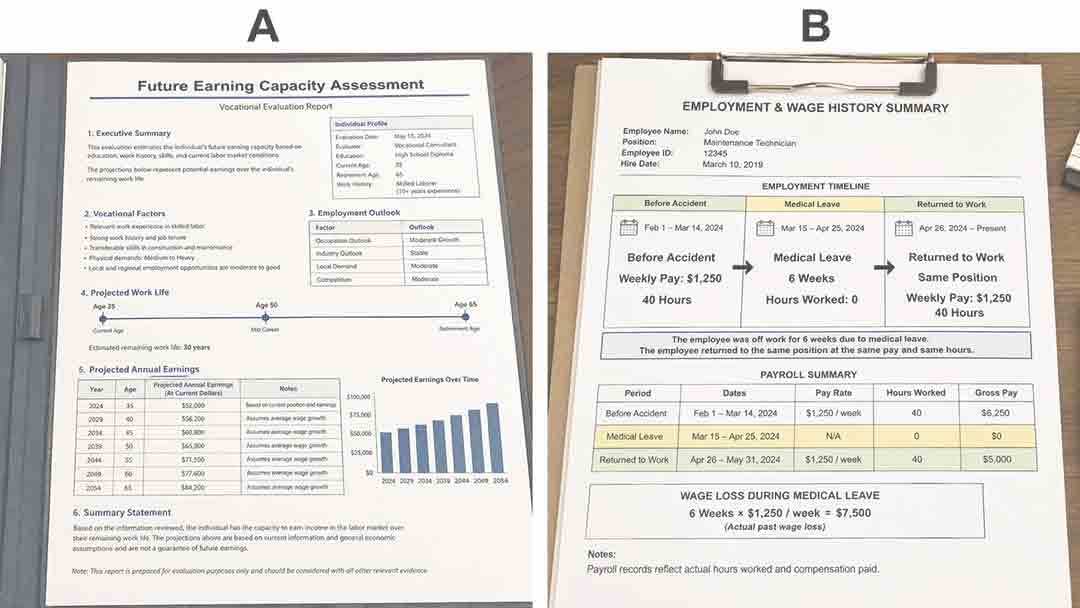
A short-term absence followed by a return to the same position and pay may primarily involve past lost wages.
A lasting injury that prevents the worker from returning to the former occupation may create a different issue.
Consider a technician earning $70,000 per year.
The technician cannot work for three months and later returns.
The three months of missed earnings can be evaluated as past wage loss.
Now suppose continuing restrictions make the former job impossible and the technician moves into lower-paying work.
The long-term difference involves potential earning capacity rather than simply another block of missed paychecks.
Lost Wages vs. Loss of Earning Capacity: Quick Comparison
Time period
Lost wages: Past or current period in which income was actually missed.
Loss of earning capacity: Future period affected by a reduced ability to earn.
What it measures
Lost wages: Documented earnings that were not received.
Loss of earning capacity: Potential reduction in future earning ability.
Typical evidence
Lost wages: Pay stubs, payroll records, employer records, schedules, tax documents, and work restrictions.
Loss of earning capacity: Work history, medical limitations, education, skills, occupational evidence, labor-market data, and appropriate projections.
Level of uncertainty
Lost wages: Usually lower when wages and missed time are directly documented.
Loss of earning capacity: Usually higher because future employment and earnings require additional assumptions.
The distinction matters because projected losses should not be presented with the same certainty as wages that have already been missed.
Labor-Market Data and Choosing the Right Income-Loss Method
Future earning capacity can involve occupation, education, work history, skills, medically supported limitations, geographic employment opportunities, and reasonable career alternatives.
Official occupational statistics can provide external context.
The U.S. Bureau of Labor Statistics Occupational Employment and Wage Statistics program publishes employment and wage estimates for occupations across national, state, metropolitan, and nonmetropolitan areas. The latest annual release available in August 2026 reports May 2025 occupational wage information.
BLS data should not be treated as proof of what one specific person would have earned.
For example, knowing the median or mean wage for an occupation does not establish the claimant’s individual career trajectory, experience level, working hours, benefits, promotions, or future employment history.
Its value is as a labor-market reference that can be considered alongside individualized evidence.
How Do You Choose the Right Income-Loss Method?
Start with the way the person was actually paid.
For fixed hourly pay and stable hours, use documented hourly wages and missed hours.
For salary, identify the salary that was actually unpaid during the relevant absence.
For overtime, commissions, and bonuses, establish a historical pattern before treating variable compensation as expected income.
For self-employment, separate business revenue from the actual economic effect on the owner.
For temporary reduced pay after a return to work, calculate the documented difference between the normal earnings and the reduced earnings.
For lasting work restrictions, determine whether the issue extends beyond past wages into future earning capacity.
The farther the calculation moves into the future, the more important it becomes to identify assumptions rather than treating a projection as an established fact.
A Three-Level Evidence Framework
A useful way to prevent overstatement is to separate claimed income losses into three evidence levels.
Level One: Directly Verified Losses
These amounts can be calculated from records with relatively few assumptions.
Example:
A worker earns $30 per hour.
Payroll records establish a normal 40-hour schedule.
The worker has 120 documented unpaid hours.
120 multiplied by $30 equals $3,600.
The calculation can be traced directly to the wage rate and missed hours.
Level Two: Historically Supported Variable Earnings
These amounts involve income that varies but has an established historical pattern.
Examples include recurring overtime, commissions, seasonal earnings, or performance-based compensation.
The calculation should explain which historical period was used and why that period reasonably represents normal earnings.
Level Three: Projected Future Losses
These amounts depend on events that have not yet occurred.
Examples include permanent reductions in work hours, a required career change, reduced advancement opportunities, or long-term differences between pre-injury and post-injury earning ability.
Future projections inherently require more assumptions.
Keeping all three levels separate allows a reviewer to see which numbers are directly documented, which depend on historical patterns, and which depend on future expectations.
Lower Pay, Partial Workdays, and Paid Leave
Returning to employment does not necessarily end the income-loss analysis.
Suppose an employee earned $32 per hour before an injury.
The employee returns to modified duties earning $24 per hour for 40 hours each week.
The hourly difference is:
$32 minus $24 equals $8.
$8 multiplied by 40 hours equals $320 per week.
If the reduced-pay period lasts ten weeks:
$320 multiplied by ten equals $3,200.
The $3,200 is an illustrative earnings difference, not an automatic measure of recoverable damages.
If the employee later returns to the original wage, the difference may primarily involve temporary lost income.
If lasting limitations cause the lower earning level to continue, future earning capacity may also need to be evaluated.
What If You Miss Only Part of Each Workday?
Partial workdays can be calculated from the documented reduction in hours.
Suppose a worker normally works eight hours per day at $25 per hour.
For 15 workdays, the employee can work only five hours per day.
The difference is three hours per day.
Three multiplied by $25 equals $75 per day.
$75 multiplied by 15 days equals $1,125.
The same approach can be used for other documented reductions when the normal schedule, actual schedule, pay rate, and relevant dates are known.
What If You Used Sick Leave or Vacation Time?
Keep detailed records of paid leave rather than assuming how it will affect the claim.
An employee may be away from work while continuing to receive some or all normal income through sick leave, vacation time, disability benefits, salary continuation, or another program.
The treatment of those benefits can depend on the source of the payment, the type of claim, and applicable law.
Document the dates, amount paid, type of benefit, and any leave balance used.
That creates a factual record first. The legal effect can then be evaluated under the rules that apply to the particular case.
Common Lost Wage Documentation Mistakes
One common mistake is providing only a total.
“I lost $12,000” is much harder to evaluate than a calculation showing the wage rate, dates, hours, historical earnings, and supporting documents.
Another mistake is confusing business revenue with personal income.
This is especially important for self-employed claimants.
A third mistake is selecting an unusually profitable month to establish commissions or other variable earnings without explaining why that month represents normal income.
Inconsistent timelines are another problem.
Employer attendance records, payroll data, work restrictions, and the wage calculation should tell a coherent story. If they do not, the discrepancy should be explained.
Uncertain income should also remain clearly identified as uncertain.
A possible promotion, discretionary bonus, potential customer contract, or occasional overtime opportunity should not automatically be treated as income that definitely would have been received.
Finally, avoid combining past documented wages and projected future earning losses into one unexplained number.
They measure different periods and involve different levels of uncertainty.
How to Check Whether a Wage Calculation Is Reliable
Use a five-question review before relying on the calculation.
Question One: Can normal pre-injury income be verified?
A reviewer should be able to trace the earnings baseline to payroll, tax, employment, or reliable business records.
Question Two: Can the exact work interruption be identified?
The calculation should show the days, weeks, or hours actually affected.
Question Three: Does the timeline make sense?
Medical restrictions, attendance information, payroll changes, and return-to-work records should be reasonably consistent.
Question Four: Can every major number be traced to a source?
If a calculation uses $35 per hour, the records should establish where $35 came from.
If it assumes eight overtime hours each week, there should be support for that assumption.
Question Five: Are projections separated from verified amounts?
Past missed paychecks should not be mixed with years of potential future earnings without distinguishing the different evidence behind each amount.
This review also functions as a troubleshooting tool.
If the wage rate is verified but the missed hours are unclear, the missing evidence concerns time.
If the absence is documented but commissions vary significantly, the weak point is the income baseline.
If past wages are clear but a permanent career impact is uncertain, the issue concerns future earning capacity rather than payroll documentation.
Real-World Example and State-Specific Damage Rules
Consider a delivery technician earning $30 per hour and normally working 40 hours per week.
After an injury, the technician cannot work for six weeks.
Past wage loss begins with:
$30 multiplied by 40 hours equals $1,200 per week.
$1,200 multiplied by six weeks equals $7,200.
The technician then returns for four weeks but works only 30 hours each week.
The reduction is 10 hours per week.
10 multiplied by $30 equals $300.
$300 multiplied by four weeks equals $1,200.
The combined gross wage difference is $8,400.
The $8,400 is not the value of the lawsuit or settlement. It is only the wage difference in this hypothetical example.
Now change the facts.
Suppose continuing restrictions ultimately prevent the technician from returning to the former job, and the available alternative occupation pays less.
Simply continuing to multiply $30 by 40 hours indefinitely would not provide a reliable future-loss calculation.
The analysis has shifted from known past wages to potential loss of earning capacity.
Work history, skills, medical limitations, occupational alternatives, labor-market information, and the assumptions behind future earnings may then become relevant.
This illustrates why the two categories should remain separate even when they arise from the same injury.
How Do State-Specific Damage Rules Affect the Analysis?
There is no single nationwide civil damages instruction that controls every state personal injury case.
State law and the specific cause of action can affect which damages are available and what must be established.
Official judicial materials are therefore more useful than assuming that a formula found online applies everywhere.
For example, the Judicial Branch of California currently publishes the 2026 edition of the Judicial Council of California Civil Jury Instructions, known as CACI. The Judicial Council describes these as official civil jury instructions that are regularly reviewed and updated.
California is only an example.
A claim arising elsewhere should be evaluated under the statutes, case law, jury instructions, evidentiary rules, and other authority applicable in that jurisdiction.
This is particularly important when evaluating future economic damages, employment benefits, proof requirements, or other issues that cannot be resolved from wage arithmetic alone.
Settlement Impact, Professional Analysis, Taxes, and Work-Situation Guidance
A well-supported lost wages calculation can establish one measurable part of the claimed economic loss.
It does not establish the entire value of a personal injury settlement.
The overall dispute may involve questions about fault, causation, insurance coverage, medical evidence, other economic losses, future damages, and applicable legal rules.
For that reason, a calculator that asks only for salary and the number of missed workdays cannot reliably determine the value of an entire case.
A lost wages calculation answers a narrower question:
How much income changed during the documented period?
That can be useful without pretending to resolve the rest of the claim.
There is no universal multiplier that turns missed wages into a guaranteed settlement amount.
When Might More Detailed Professional Analysis Be Useful?
Simple wage arithmetic may be sufficient to explain a short absence for a worker with fixed pay and a stable schedule.
More detailed analysis may become useful when the person owns a business, earns highly variable commissions, has several income sources, or faces significant long-term work restrictions.
Future earning-capacity claims may also require closer analysis because they involve events that have not yet occurred.
Depending on the case, occupational, vocational, accounting, tax, or legal expertise may help address different parts of the problem.
The important point is to use the right kind of analysis for the question being asked.
A payroll record can establish earnings.
An accountant may help explain complex business income.
Occupational evidence may help evaluate alternative work.
Legal advice addresses what evidence and damages are relevant under the governing law.
Are Lost Wage Settlement Payments Taxable?
Tax treatment depends on the nature and origin of the settlement payment rather than simply the label attached to it.
The IRS explains that damages received on account of personal physical injuries or physical sickness may fall within the exclusion in Internal Revenue Code Section 104, subject to applicable limitations. Current IRS guidance specifically notes that compensatory damages, including lost wages, received on account of a personal physical injury can be excludable from gross income.
That should not be confused with employment disputes.
IRS Publication 4345 explains that lost wages such as back pay, front pay, and severance in employment-related lawsuits are generally treated as taxable wages. It also describes different treatment for items such as lost business profits, punitive damages, and interest.
The facts and the substance of the underlying claim therefore matter.
A settlement may also contain several categories of payments, and those categories may not receive identical federal tax treatment.
For a substantial settlement, tax consequences should be evaluated from the actual settlement agreement and claims involved rather than from a general online damages calculation.
Practical Recommendations Based on Work Situation
For an hourly employee, start with the normal hourly rate, usual schedule, documented hours missed, and any period of reduced work.
For a salaried employee, determine whether salary actually stopped and identify paid leave or wage continuation separately.
For someone who regularly earns overtime, preserve enough payroll history to establish whether overtime was genuinely recurring.
For a commissioned worker, choose a representative historical period and account for seasonal patterns rather than relying on the strongest month.
For a freelancer or gig worker, preserve platform reports, invoices, payment records, tax documents, and work history.
For a business owner, separate revenue, expenses, business profit, and the owner’s individual contribution to earnings.
For someone who has returned to lower-paying work because of continuing restrictions, consider whether the issue involves future earning capacity in addition to temporary wage loss.
For any calculation, keep verified past losses separate from historical estimates and future projections.
Conclusion, FAQs, and Sources
Legal Information Notice
This article provides general educational information about lost wages and economic damages in U.S. personal injury claims. It is not legal advice and does not create an attorney-client relationship.
Personal injury law, evidence requirements, damage rules, filing deadlines, treatment of employment benefits, and available remedies can vary by jurisdiction and by the facts of a particular case.
Anyone making decisions about a specific claim should rely on the law applicable to that jurisdiction and qualified professional advice where appropriate.
Practical Conclusion
A strong lost wages claim begins with evidence, not a settlement estimate.
Establish normal earnings first.
Identify exactly when work stopped, decreased, or changed.
Connect the employment change to appropriate injury-related restrictions.
Separate fixed wages from overtime, commissions, bonuses, and business income.
Then distinguish past lost wages from any projected loss of earning capacity.
For a short absence involving predictable wages, the calculation may be straightforward.
For self-employed workers, commissioned employees, people with several income sources, or workers facing lasting career restrictions, the analysis can require considerably more documentation.
The most useful calculation is not necessarily the largest one. It is the calculation that clearly shows which amounts are verified, which are based on historical patterns, which are projections, and how each figure was derived.
Frequently Asked Questions
Can I prove lost wages without my original pay stubs?
Potentially. Employer payroll records, W-2 forms, relevant 1099 forms, tax records, bank deposits, and other employment records may help reconstruct earnings. The IRS also offers wage and income transcripts containing information reported on W-2s and various Form 1099 series documents, while SSA allows workers to review recorded yearly earnings.
Can overtime be included in lost wages?
Potentially, depending on the facts and applicable law. An established payroll history showing recurring overtime provides a stronger basis for an estimate than occasional or hypothetical overtime. The calculation should clearly distinguish documented regular wages from variable earnings.
Is loss of earning capacity the same as lost wages?
No. Lost wages generally concern income missed during an identifiable period. Loss of earning capacity concerns a reduction in future earning ability and may involve work history, medical limitations, skills, occupational alternatives, and labor-market information. BLS occupational wage data can provide external context but does not establish one individual’s future income.
Can a self-employed person claim lost income?
Potentially. The calculation often requires more analysis because gross business revenue does not automatically equal the owner’s personal economic loss. Business expenses, profit, work performed by employees, canceled contracts, and the owner’s personal role in generating revenue may all affect the calculation.
Does using sick leave or vacation mean there are no wage-related damages?
Not necessarily. Paid leave, disability benefits, salary continuation, and similar payments should be documented separately. Their legal treatment can depend on the type of benefit and applicable law, so the safer approach is to establish the facts first rather than automatically adding or subtracting the payments.
How much income history should be used?
There is no single period that works for every worker. A person with fixed wages may need relatively little history to establish normal earnings, while seasonal workers, commissioned employees, freelancers, and business owners may need a longer period to show a representative pattern. The goal is to select evidence that fairly reflects normal earnings rather than the period that produces the highest figure.
Sources
Internal Revenue Service, Topic No. 159, How to Get a Wage and Income Transcript or Copy of Form W-2. Updated February 2, 2026. The IRS explains the contents and availability of wage and income transcripts.
Internal Revenue Service, Transcript Types for Individuals and Ways to Order Them. Current IRS guidance explains that wage and income transcripts include data from information returns such as Forms W-2, 1098, 1099, and 5498 and are available for the current and nine prior tax years.
Social Security Administration, Review Record of Earnings. SSA explains how workers can review yearly earnings recorded in their Social Security history.
U.S. Bureau of Labor Statistics, Occupational Employment and Wage Statistics, May 2025. Released May 15, 2026. OEWS provides occupational employment and wage estimates that may serve as labor-market reference information.
Judicial Branch of California, Civil Jury Instructions Resource Center, Judicial Council of California Civil Jury Instructions, 2026 Edition. The official state resource illustrates why civil damages issues should be evaluated under current jurisdiction-specific authority.
Internal Revenue Service, Tax Implications of Settlements and Judgments. Current IRS guidance discusses the federal income-tax treatment of settlement payments, including amounts associated with personal physical injuries and lost wages.
Internal Revenue Service, Publication 4345, Settlements—Taxability. The publication explains that tax treatment depends on the nature of the underlying claim and distinguishes personal physical injury recoveries from categories such as employment-related lost wages, lost business profits, punitive damages, and interest.
Source Review Date: August 13, 2026